World models currently arrive in four flavours, and X-Era AI argues each of them fails in a different place. Simulation built on game engines and hand-written physics cannot cover the real range of contact. Video-generative models produce convincing frames without the physical or geometric consistency that control requires. Latent-space prediction is cheap to compute and hard to evaluate. Joint world-action models aim at the right question and are still mostly built on a video backbone.
E0.5, released with weights, a paper and a project page, is an attempt to fix the fourth by changing what the backbone is.
Promoting geometry from accessory to structure
Vision-language-action models take a vision-language foundation model, feed it observations, instructions and robot state, and emit actions. The training objective is action prediction. What the world does after the action is not modelled explicitly, so a policy can learn to grasp in a specific scene without representing how the grasp changes the arrangement of objects.
World-action models extend that to predicting future state, and the mainstream implementation predicts future frames. Depth and point clouds, where present, enter as auxiliary features or supervision targets while the core computation stays on the video backbone.
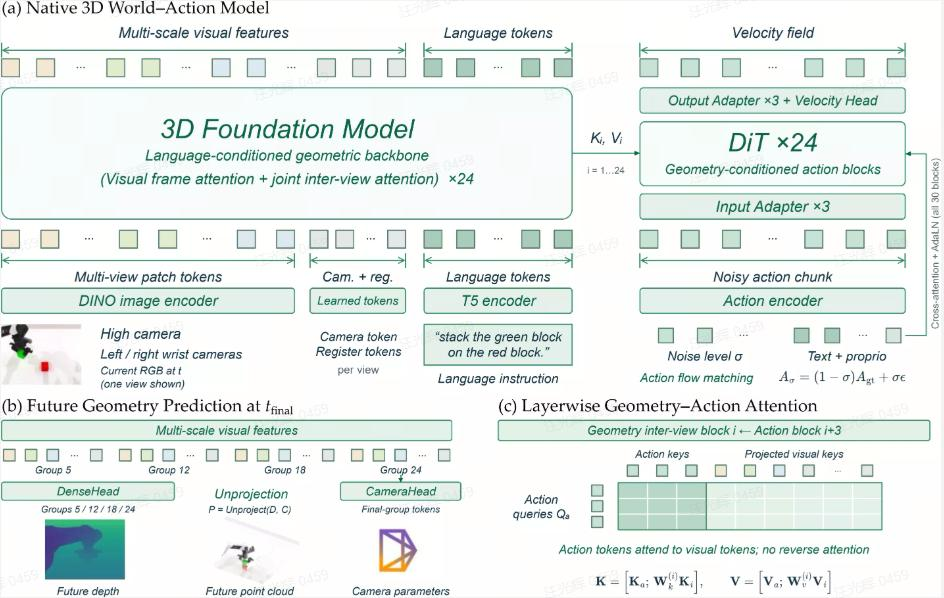
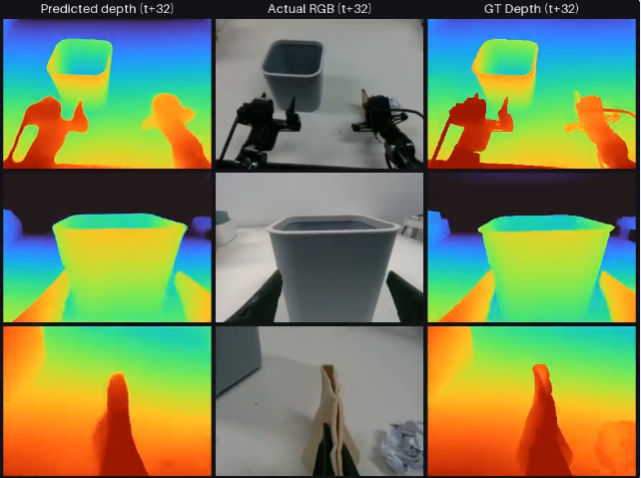
E0.5 inverts that. A 3D foundation model becomes the core representation, conditioned on language and coupled to action through layer-wise geometry-action interaction. Future 3D geometry becomes a primary prediction target instead of a reconstruction of the present.
The practical consequence is what the model is optimised to notice. Texture is cheap to generate and expensive to verify. Geometry is the opposite. A model trained to predict shape is being scored on the quantity a controller actually consumes.
Decoupling space from physics
The second design choice is separation. Spatial modelling and physical modelling are trained as distinct objectives and recombined, on the argument that mixing them forces one head to learn two incompatible distributions.
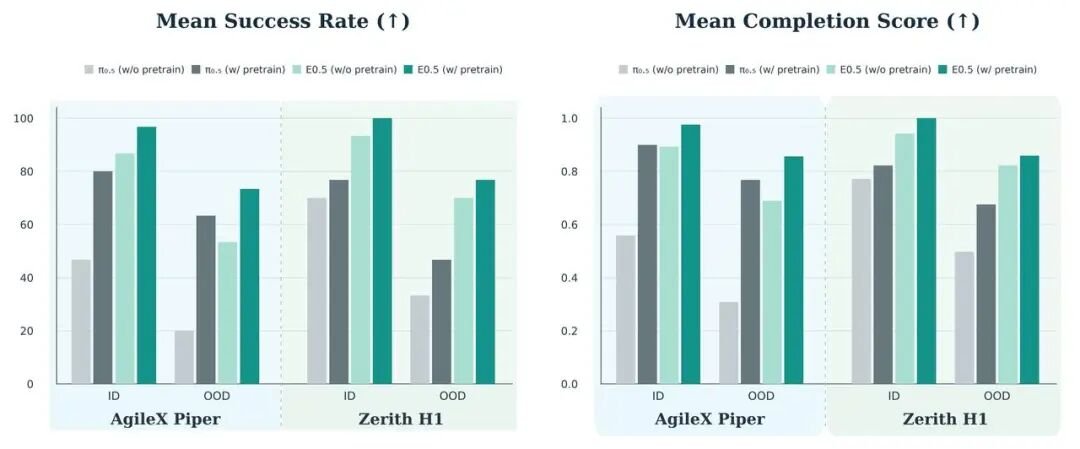
The company reports a real-robot improvement over pi-0.5, the widely used open vision-language-action baseline. That comparison is the one to watch, since pi-0.5 is the reference point most labs in this field measure against, and a margin over it is a claim about control rather than about presentation.
Publishing the code alongside the paper is a strategic choice as much as a scientific one. In a field where several Chinese teams are building the training substrate for embodied AI at once, the group that sets the default architecture inherits the ecosystem, and the group that keeps its weights private has to win on product.
The open question is compute. A 3D backbone is more expensive to train and to run than a video backbone, and the paper says nothing about inference cost on a robot’s own hardware, which is where most of these architectures eventually fail.
Editor’s note: This is an adapted translation of the original OFweek report. It has been trimmed and restructured for readability for an international business audience. The full original (in Chinese) is at https://robot.ofweek.com/2026-11/ART-8321206-8120-30709495.html.