AgiBot used its innovation day on 29 October to disclose a number that few Chinese robot companies publish. First-half 2026 revenue came in at close to RMB 2 billion, a figure above what Unitree and UBTech reported for the same six months, and comparable to Unitree’s performance across a full nine months.
The trajectory behind it is steep. Revenue was measured in the hundreds of thousands of yuan only a few years ago, reached RMB 1.05 billion in 2025, and has now roughly doubled again in half a year.
Volume is settled
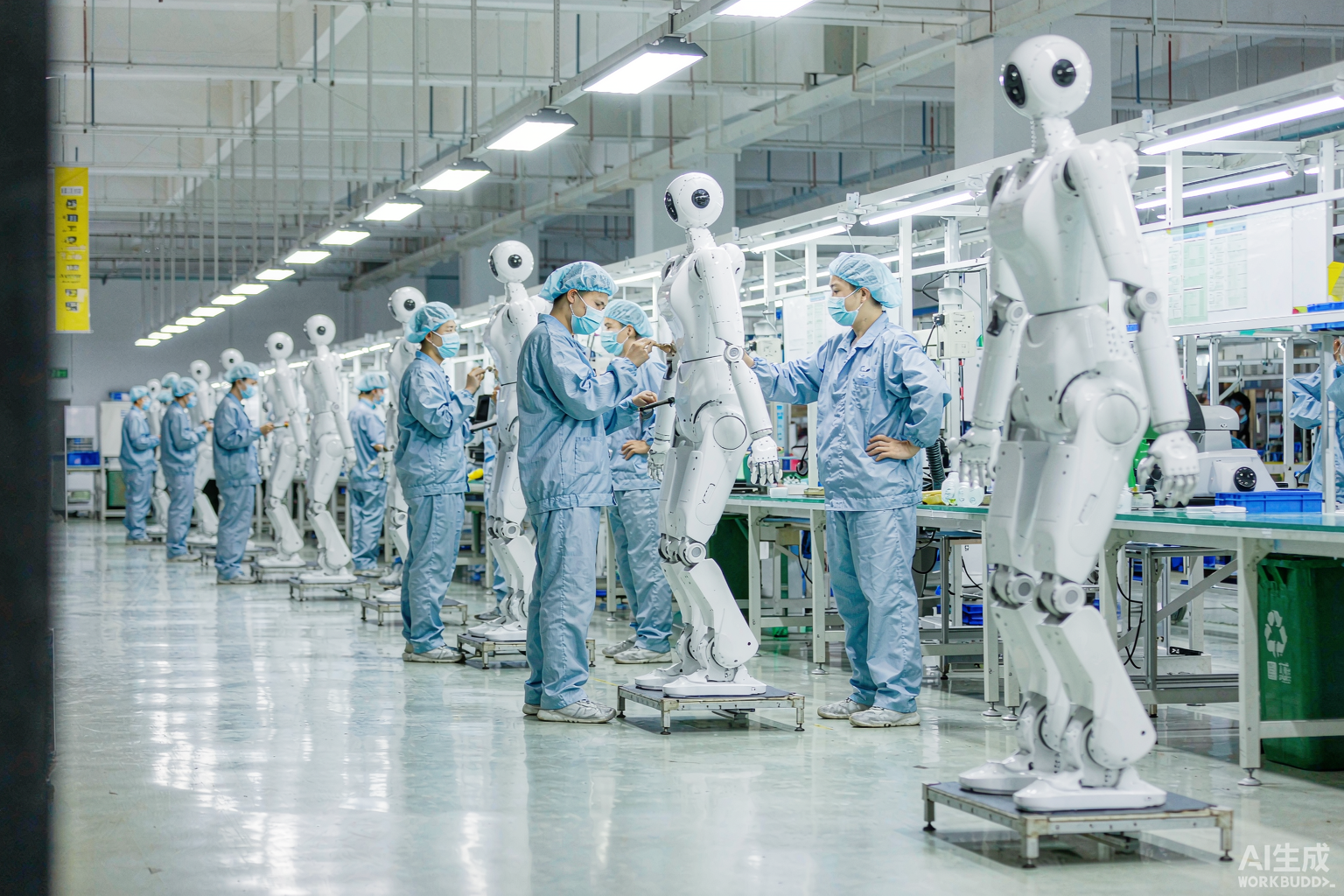
Counterpoint’s data puts AgiBot at 9,700 units shipped in the first half of the year, a 43.1 per cent share of the global humanoid market. By September, the cumulative number of humanoids off the line had passed 20,000.
That is the harder achievement, and it is worth being precise about why. Building one prototype that walks is an engineering exercise. Building thousands that leave a factory in consistent condition requires an entirely different apparatus: supplier qualification, incoming inspection, process control, service and spare parts. AgiBot has said that in its early period it could not find component suppliers already set up for production at that scale, and had to work with partners to develop the processes alongside the parts.
The company also represents one of two routes the industry is taking. Some builders perfect the hardware and motion first and add intelligence afterwards. AgiBot started from large models and worked downward into a physical body. Neither is obviously right. What both reveal is that the basis of comparison has changed, from videos of a robot balancing or jumping to whether it can hold a sorting or assembly task through a full shift.
The part that is not published
AgiBot has not released profit figures, and the reason is not mysterious. Spending on AI research, engineering salaries and supply chain commitments keeps consuming the capital the revenue brings in. The company is in an expansion phase where scale is being bought, and it is not alone in that.
The more informative disclosure is about where the orders come from. A significant share of the sector’s demand still originates with research institutions and data collection programmes, procurement that moves with budget cycles rather than with production schedules. Orders from industrial lines that run every day remain a limited share of the total.
That distinction matters more than the revenue line. A research purchase buys a machine to generate data. An industrial purchase buys a machine to do work, and it is repeated only if the work pays. Converting the first kind of order into the second is the commercial problem in front of every humanoid builder in China, and AgiBot’s RMB 2 billion does not answer it.
Even with hardware volume proven, two operational questions stay open: whether a humanoid can work reliably for long periods in an unstructured environment, and what it costs to maintain one when it does. Coming off the line is not the same as finishing the commercial test.
An attempt to price output instead of units
AgiBot used the same event to propose a different measurement, which it calls effective intelligent work hours. Rather than counting robots shipped, the framework combines the number of active robots, the hours they operate autonomously, and the ratio of output to input, to estimate the productive value delivered in the physical world.
The company says the method is already being trialled in live projects, including a cultural district in Chengdu, the Changlong resort operation, a production line at Longqi and a Shangri-La hotel.
The motive is transparent. If a buyer is asked to compare a robot against a human wage, units shipped is a poor argument and hours worked is a better one. But an output metric defined by the seller has an obvious weakness, which is that it can be defined in whatever way flatters the seller. Independent verification, not the framework itself, is what would make it credible.
What 20,000 units actually prove
The number proves that a Chinese supply chain can manufacture humanoids at volume. That is a real and non-trivial finding, and it took less time than most forecasts allowed.
It does not prove that the industry has found its customer. A robot that leaves a factory at the 20,000th unit and goes into a research lab has validated the manufacturing system. A robot that goes into a hotel and stays there for two years, on a service contract, at a cost below the labour it replaces, has validated the business. China’s humanoid sector has done the first at scale and is still working on the second, one site at a time.
Editor’s note: This is an adapted translation of the original OFweek report. It has been trimmed and restructured for readability for an international business audience. The full original (in Chinese) is at https://robot.ofweek.com/2026-10/ART-898890-12003-30709378.html.