Agility’s Digit 5 removes the safety cage and takes USD 300 million of orders
Agility Robotics has released the Digit 5, and the claim it makes is a specific one. The company says it is the first humanoid robot able to work closely alongside people without a physical safety fence.
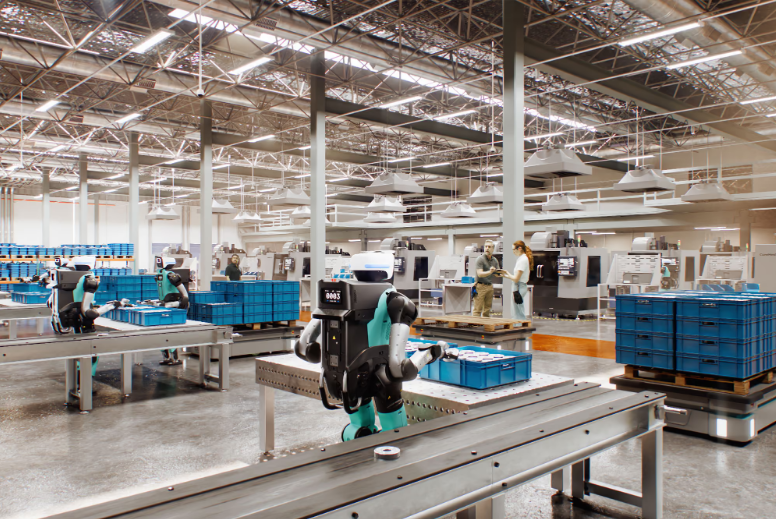
Digit 5 has taken more than USD 300 million of multi-year orders, with sales planned to begin in North America in the first half of 2027. The safety architecture is straightforward rather than procedural. The robot slows or stops when a person approaches. If the person keeps closing, it crouches close to the floor and cuts power to its motors before contact occurs.
Digit 5 is already deployed at nine customer sites, including Schaeffler, GXO Logistics and Toyota Motor Manufacturing Canada. The fleet has accumulated more than 65,000 hours of operation, and at a single GXO logistics facility it has moved 100,000 totes. The robot stands 1.81 metres tall and weighs 129 kilograms, lifts 22.7 kilograms repeatedly, runs 90 minutes on a battery with nine-minute fast charging, and supports more than 20 hours of work a day.
Agility is listing through a merger with Churchill Capital Corp XI at a valuation of USD 2.5 billion.
Removing the fence removes a cost centre
Few people in the industry have costed a fence properly. The hardware for an industrial fence is a few thousand RMB. The cost behind it is systemic. Production lines have to be re-planned, safety light curtains, interlocked doors and emergency stops all have to be fitted, fencing has to be re-laid every time the product changes, and the rhythm of human-robot collaboration is sliced up by the enclosure.
What is less visible is that a fence caps the return on a robot. A robot locked inside a cage can only do a fixed job at a fixed station. Moving it means dismantling, reinstalling and recommissioning. Counted that way, deployment can cost more than the robot itself.
Digit 5 removes not a physical barrier but a hidden cost centre. Agility chief executive Peggy Johnson said Digit 5 is removing one of the biggest barriers to scaling humanoids in industrial settings. The practical translation is that a customer no longer has to build a cage before the robot can work. It stands next to the worker instead, and the deployment cycle compresses from months of line rework to days of commissioning.
That shift re-anchors how the primary market prices these companies. Agility’s USD 2.5 billion through the special purpose acquisition company is not a high number in this sector, where Figure AI is valued near USD 40 billion and Tesla’s Optimus sits inside a trillion-dollar market capitalisation. But Agility’s figure rests on real revenue, with USD 1.8 million of net revenue in 2025 and USD 300 million of cumulative three-year orders. Against peers valued in the tens of billions with no paid deployment data at all, the logic is that it can do the work, so it has income. Removing the fence widens the deployable footprint from a sorting station inside an enclosure to an end-to-end logistics flow across a warehouse, so the same robot can do roughly twice the work.
Two links carry the effect into listed markets
The first is safety sensing. Digit 5’s 360-degree human detection depends on a sensor array and an independent safety controller. The core requirement is that when human behaviour is unpredictable, the robot has to react in milliseconds, which means sensors must not only see but judge. Six-axis force sensors and AI vision modules are the most directly exposed links in that chain.
The second is collaborative safety certification. Agility leads the ANSI/A3 TR R15.108 project and contributes to ISO 25785-1, the standards that define safety requirements for dynamically stable industrial mobile robots in North America and internationally. In effect Agility is helping write the rules for what counts as a safe humanoid. Whoever helps write the standard holds the entry point for the next round of product certification.
Chinese suppliers are approaching collaborative safety from another direction. Dobot’s safety skin technology already allows close human-robot collaboration without fences, with some models rated IP68. Dobot is extending upward from collaborative robotic arms, perfecting the safety of the hand first and moving towards whole-body mobile manipulation. Agility is working downward from a bipedal humanoid, stabilising the legs first and then giving the hands more to do. The two paths will eventually meet, but Agility’s head start in whole-machine safety certification will be hard to close in the near term. That is also why listed-market pricing is likely to favour humanoid companies that can pass whole-machine safety certification rather than component specifications alone.
The fence is gone, so the entry fee for humanoids in factories has fallen. The real question becomes how much a factory will pay once the robot can work beside a person.
Editor’s note: This is an adapted translation of the original OFweek report. It has been trimmed and restructured for readability for an international business audience. The full original (in Chinese) is at https://robot.ofweek.com/2026-09/ART-898890-12005-30703672.html.