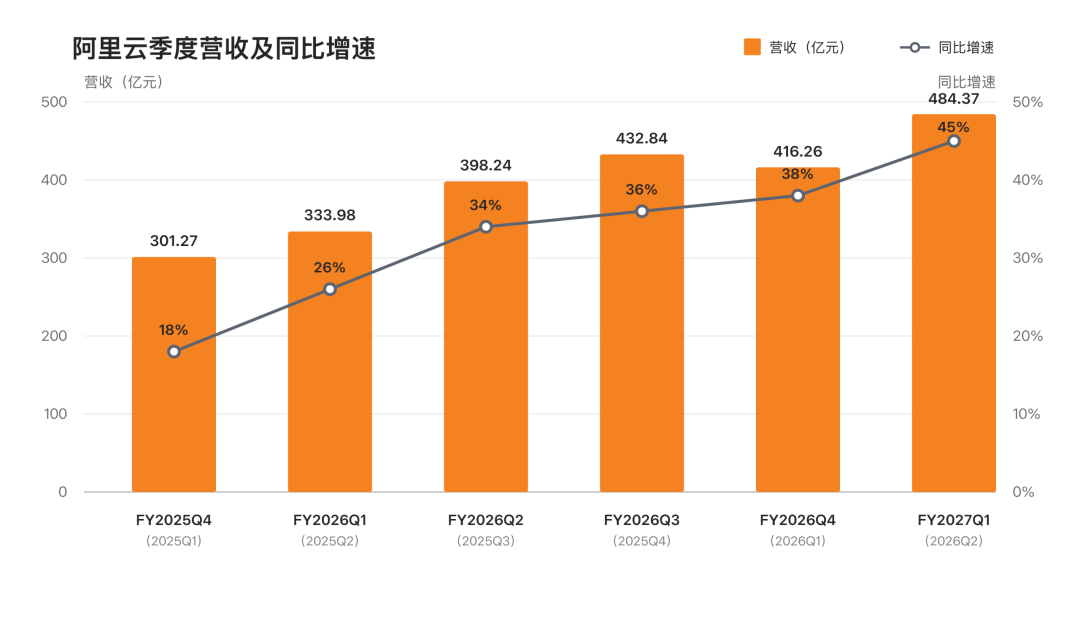
Alibaba’s latest results make one awkward point: while the spotlight sits on model and app layers, the shortest-term AI profit is in cloud and silicon. In the first quarter of fiscal 2027, the April to June 2026 period, Alibaba Cloud revenue reached 48.74 billion yuan, about 6.8 billion dollars, up 45 per cent year on year.
Eddie Wu said on the call that demand is accelerating and that the AI compute shortage will likely persist until 2030. Alibaba’s three-year 380 billion yuan investment plan is on track, with 67.1 billion yuan of capex this quarter and 190 billion yuan cumulatively. The more models are used, the richer the shovel sellers get.
The surprise was profit. Cloud adjusted EBITA rose 133 per cent with margin at 11.6 per cent, the kind of number that lifts the whole domestic cloud sector’s valuation. Two drivers: rising Model-as-a-Service revenue, as AI coding alone pushed China’s market from 399 million yuan in 2025 toward 1.17 billion yuan by end of 2026, and full-stack co-optimisation of chips, interconnect, storage and scheduling.
T-Head’s in-house silicon is expanding its share of Alibaba’s data centres. The new Zhenwu M890 supernode is already serving over 650 customers. Gartner shows Alibaba Cloud’s China IaaS share rising from 30.1 per cent in 2024 to 32.8 per cent in 2025 as rivals slipped.
The strategic comfort is the full stack. Whether AI value flows to chips, cloud, models or apps, Alibaba sits on every layer. When model companies’ endgames stay unclear, capital backs the vendors who win regardless of who wins.
Editor’s note: This is an adapted translation of the original Leiphone report. It has been trimmed and restructured for readability for an international business audience.