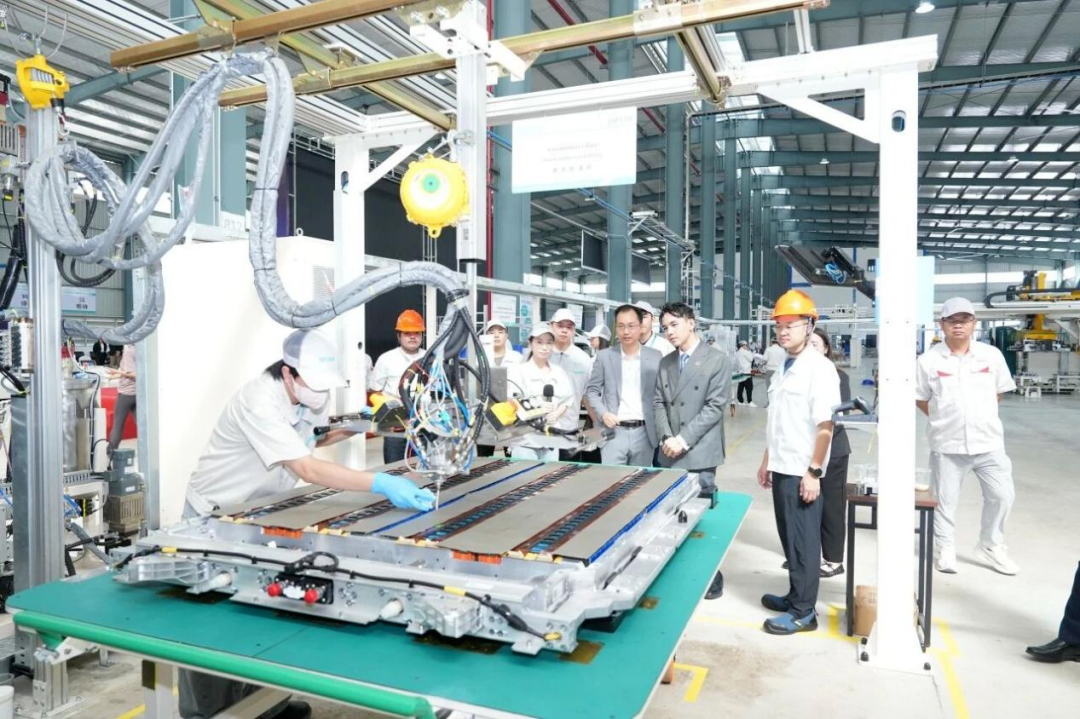
Anwha (Shanghai) Automation Engineering has delivered, installed and started up the first battery pack assembly line at a major Chinese automotive group’s plant in Chonburi, Thailand. It is the customer’s first wholly owned battery pack factory outside China, and the line supplies packs for vehicles assembled locally.
Anwha’s scope covered the entire programme: overall line design, equipment manufacturing, integration and commissioning, overseas site installation, and support through start of production. The line uses a flexible manufacturing layout, adapted to the customer’s pack process and quality management system, with automated and digital control of assembly and testing.
The quietest part of the EV supply chain
Battery pack assembly rarely gets attention because it is not cell manufacturing. There is no gigafactory, no cathode chemistry, no yield curve on a new electrode line. It is the step where cells, modules, busbars, cooling plates, the battery management system and the enclosure become a component that bolts into a car.
It is also the step that has to be local, because packs are heavy, hazardous to ship and expensive to transport across borders. When a Chinese carmaker builds or rents a plant in Thailand, Brazil or Hungary, a pack line has to exist inside that building.
Whoever supplies that line sets the process, the cycle time and the quality gate. In this case, a subsidiary of Shanghai Electric.
Seven countries already
Anwha was founded in 2011 and sits inside Shanghai Electric Group. Its core business is automated assembly, inspection equipment and whole-line planning, with product lines covering battery module and pack assembly, motor and motor controller assembly, powertrain assembly, and manufacturing execution systems.
The company says it has already delivered projects in Thailand, Indonesia, Korea, Spain, Italy, Uzbekistan and Brazil, which maps closely onto where Chinese vehicle and battery manufacturers have been building capacity.
That is the pattern worth noting. Chinese industrial automation firms are following their customers abroad, and in doing so they become the standard carrier: a pack line built to a Chinese process specification, installed in Thailand, running on a Chinese MES. The equipment travels first. The standard follows.
Editor’s note: This is an adapted translation of the original Gasgoo report. It has been trimmed and restructured for readability for an international business audience. The full original (in Chinese) is at https://auto.gasgoo.com/news/202611/13I70477845C103.shtml.