Nvidia spent a decade selling shovels to the robot industry. In the space of eight weeks it started selling the mine as well.
On 9 November, at the CoRL robot learning conference in Austin, the company presented GR00T 2, its second-generation robot foundation model. On 21 October, at GTC Berlin, it extended the Isaac platform with Isaac OS, a runtime framework, plus Isaac Lab 3.0. And at the same Berlin event it showed Agile ONE SN, a 1.4-metre humanoid built with Germany’s Agile Robots, pre-integrated with Nvidia compute and software.
Taken separately, three product updates. Taken together, a change in what Nvidia sells.
What GR00T 2 actually scored
The headline numbers from Austin: across 50 manipulation tasks, GR00T 2 completed 40 at least once without any task-specific demonstration. Given five demonstrations, average success reached 95 per cent.
Those results come from a controlled test environment and do not prove general manipulation. What they do show is a direction. The model is being trained to transfer skills across tasks and across robot bodies rather than being retrained from scratch for every job.
Nvidia also named two deployment cases. Foxconn is testing GR00T 2 on server manufacturing automation. MicroAGI is using it to swap Ethernet cabling.
That is a different position from the one Nvidia held at its March GTC, when the partner list read as a who’s who of customers: ABB, Fanuc, Kuka on the industrial side, Figure, AgiBot and Skild AI on the new side. All of them bought Nvidia technology. Now one of them, Skild AI, is watching its supplier ship a rival foundation model two months after Nvidia published a case study praising Skild’s S1.
Isaac OS takes the integration work
A trained policy is not a working robot. Someone has to connect the model to cameras, sensors, motion control and the specific hardware underneath, and that integration work has historically been the robot company’s own problem.
Isaac OS enters that layer. It is not a full replacement for ROS and Nvidia does not claim it is. But it gives developers a single pipeline from trained model to deployed machine, and it moves Nvidia into a step that robot firms previously owned end to end.
Deepu Talla, vice president of robotics and edge AI, has described a further stage. In an interview with The Information in March, he sketched a future where one AI agent coordinates a fleet of robots, breaking an overall goal into tasks and dispatching them. That is coordination software, not a chip.
Agile ONE SN closes the loop
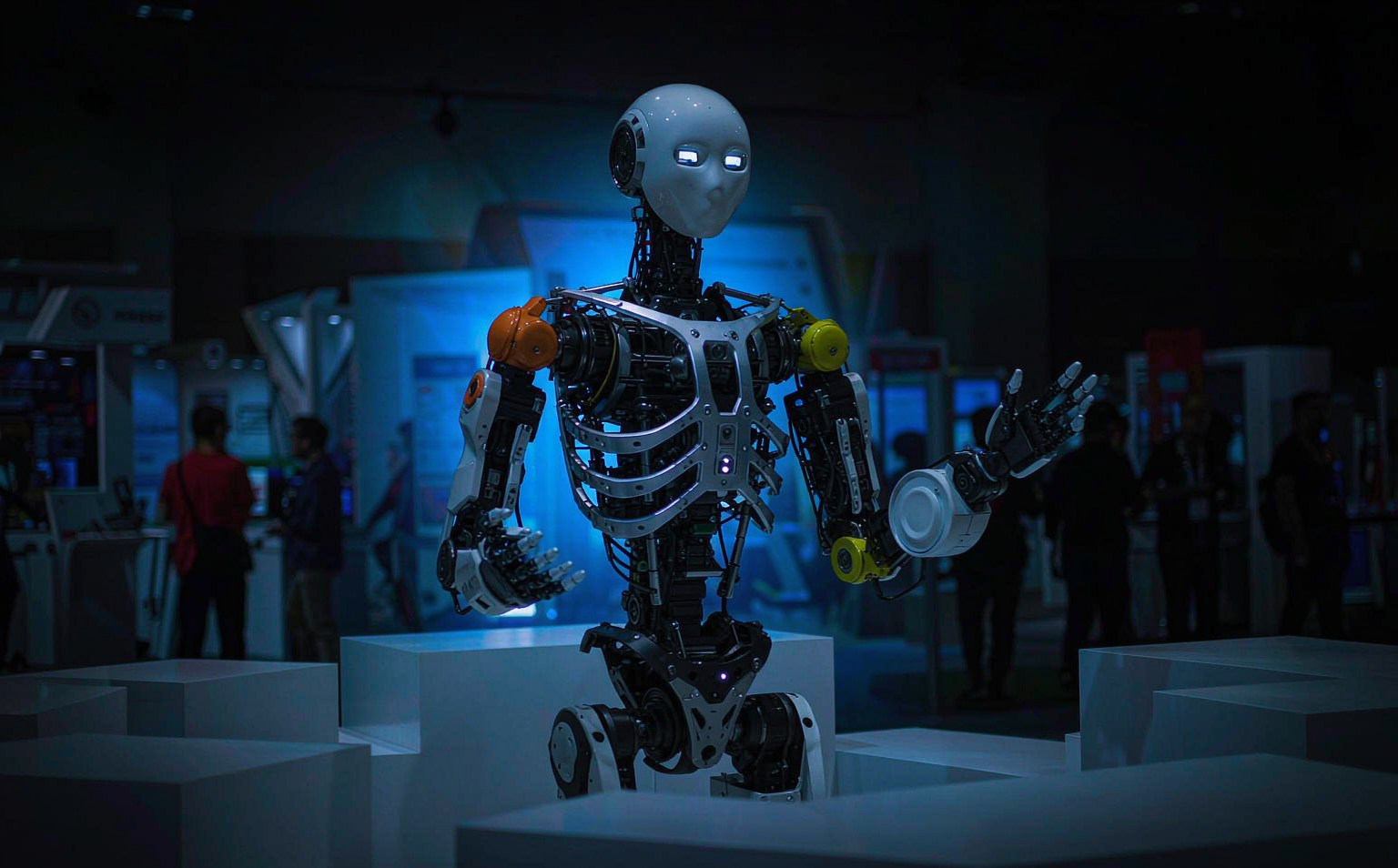
The reference platform is the piece that ties the stack together. Agile ONE SN carries a Jetson Thor compute module, a five-fingered dexterous hand, pre-installed Isaac GR00T technology and an integrated development environment. Nvidia says preparation time falls from weeks to days.
The hardware comes from Agile Robots. The compute and AI software come from Nvidia. But compared with the old model of supplying a chip, a model and a toolkit separately, Nvidia is now involved in designing a robot from software configuration through to the development environment.
Chen Zhaopeng, founder and chief executive of Agile Robots, frames the goal as adaptability: a machine that fits different environments, holds multiple skills and eventually does real work. Getting developers past the integration phase is the precondition.
The people who run it
Jensen Huang resigned as chief executive, president and director on 12 November after 33 years. Colette Kress, the long-serving finance chief, is interim chief executive, and senior director Harvey C. Jones has taken the chair. The board is searching for a permanent successor.
The robotics organisation he leaves behind has no single owner. Deepu Talla runs the Jetson and Isaac ecosystem. Rev Lebaredian runs Omniverse and simulation, the team building the virtual environments where robots learn before they touch a real factory floor. Jim Fan and Yuke Zhu lead the GEAR research group behind the GR00T series. Spencer Huang, the founder’s son, is director of robot product, listed as product lead on the GR00T N1 paper where Fan and Zhu are research leads. Madison Huang is senior director of physical AI product marketing.
Nvidia has not published reporting lines, headcount or budget for any of it.
The question that moves to the customer
For research institutes and small robot firms, a pre-integrated stack removes months of low-level work. For companies that raised money on the promise of owning their own model and software, it raises a harder question: which parts of the stack still have to be built in-house, and which can sit on someone else’s platform?
Nvidia still needs Skild AI and Agile Robots and a long tail of startups to carry the technology into real sites. But the relationship is no longer a clean supplier-customer split. Nvidia sells the compute, builds the foundation model, supplies the runtime, and co-designs the reference body.
That is very close to being a robot company’s entire technical stack, sold by the company that also sells the chips.
Editor’s note: This is an adapted translation of the original OFweek report. It has been trimmed and restructured for readability for an international business audience. The full original (in Chinese) is at https://robot.ofweek.com/2026-11/ART-8321205-12003-30711721.html.