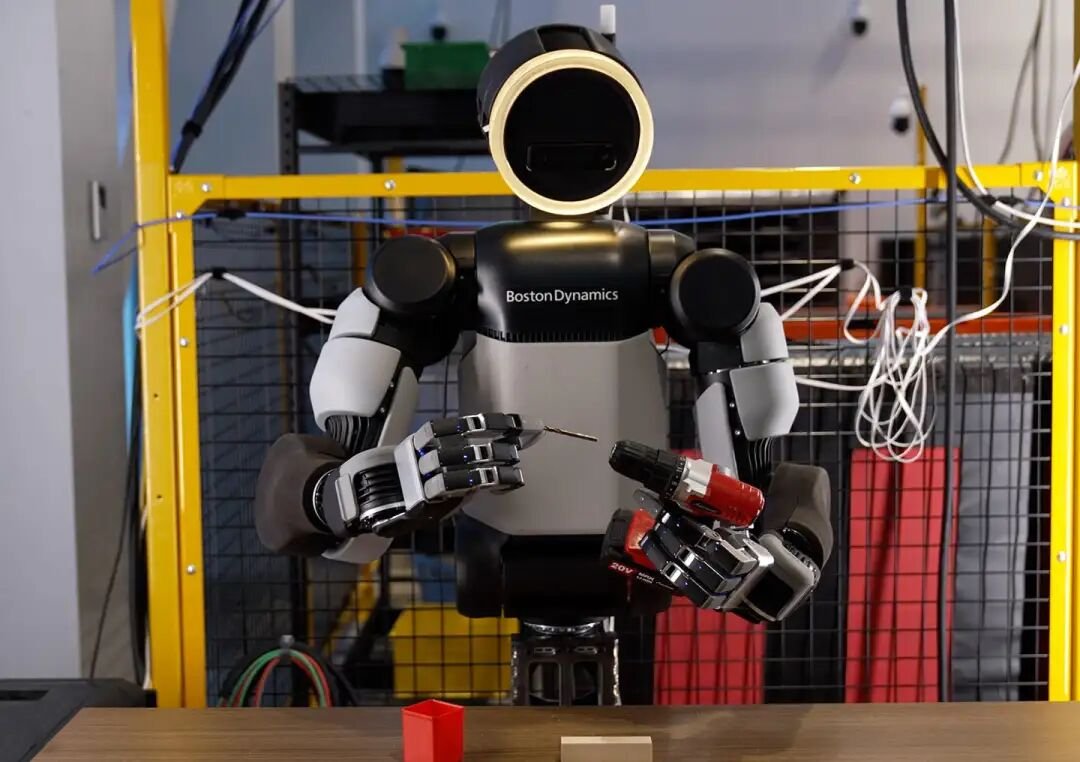
On 1 October Boston Dynamics published the dexterous hand design for its next-generation Atlas. Four fingers, 13 degrees of freedom, direct-drive joints, a single actuator type across the whole hand, and dense pressure tactile sensors across fingertips and palm. It can roll small objects between thumb and fingers, flip something inside its palm, and hold a drill handle while one finger pulls the trigger.
At the same time, at Hyundai Motor Group’s robot metaplant application centre in Georgia, Atlas is being trained on real work: parts sequencing and material handling.
The Chinese tech press picked the story up on 2 October and mostly argued about numbers. Thirteen degrees of freedom is roughly double the previous generation. Sensor density is higher. Back-drivable actuators change what the hand can do safely. All true, and none of it is the actual news.
The experiment: tape two fingers together
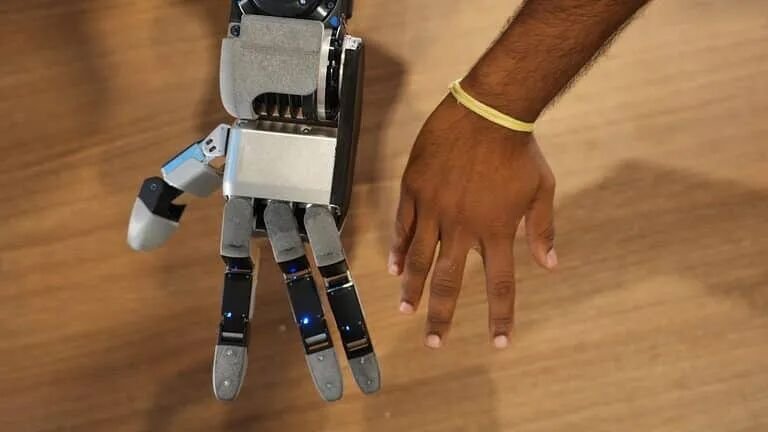
The news is what chief technology officer Zachary Jackowski asked his team to do. He had them tape their pinky to their ring finger and work a full day that way.
This is documented in Boston Dynamics’ own blog, as the design process behind the hand. Before fixing the configuration, the team argued hard about whether to keep a pinky. Mechanical intuition said five fingers is the human standard, and an extra finger should mean more capability.
The experiment said otherwise. With pinky and ring finger bound together, the team found almost nothing they could no longer do. Cups still got picked up, screws still got turned, buttons still got pressed. In most operations the pinky was redundancy, not function.
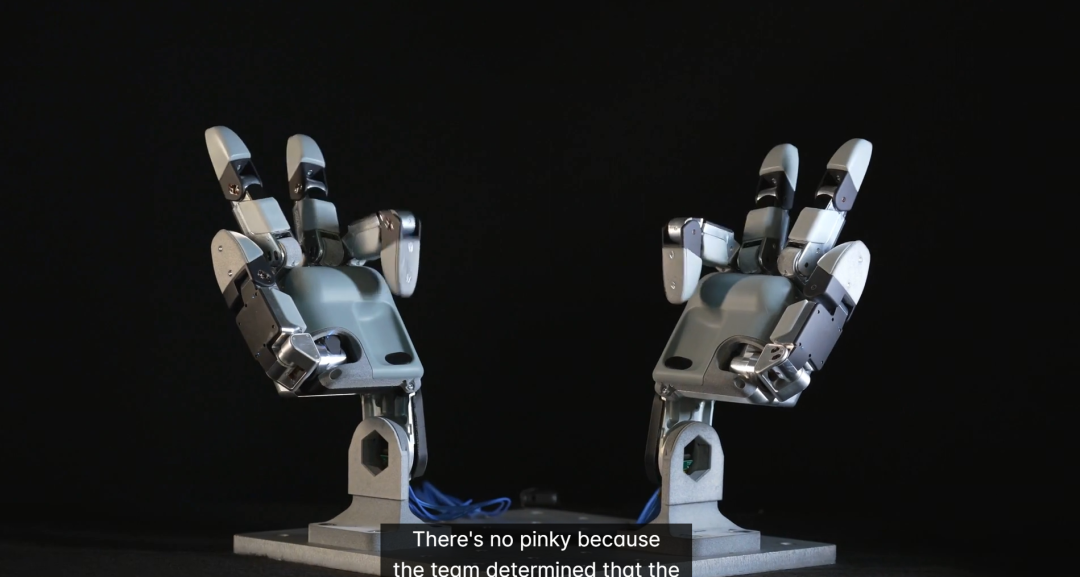
Mechanical engineer Dylan Thrush put the trade-off plainly. An extra pinky costs three more actuators, the cabling and control channels that come with them, additional structural volume, and one more component that can fail in repeated industrial use. The marginal gain in flexibility did not cover that cost.
The reasoning is a Boston Dynamics signature: run the experiment, then set the design, rather than starting from intuition and going looking for evidence.
From grasping to manipulating
The previous Atlas hand was a three-finger, seven-degree-of-freedom design built to grasp a wide range of objects. Grasping is outcome-oriented. If the object is held securely, the task is done.
The new hand is a four-finger, 13-degree-of-freedom design built to manipulate. Manipulation is process-oriented. The hand must hold the object, then adjust it, rotate it, pass it to another hand, or operate a tool while gripping it.
Consider a drill. Grasp-era hands could manage the first step, holding the drill. What they could not do is pull the trigger, because that requires one finger to leave the grip posture and apply force in a different direction. That in turn requires independent finger control, an opposable thumb, and a palm that can still sense a small slip while loaded.
The 13 degrees of freedom are allocated as four in the thumb and three each in the remaining fingers. Four degrees in the thumb let it oppose any finger for stable pinching. Three degrees in the others lets them spread and close, which matters when the handle is not cylindrical and the fingers have to adapt to the grip surface.
The divergence from Optimus
Set the new Atlas hand next to Tesla’s Optimus Gen 3 hand and the two philosophies separate cleanly.
Tesla’s hand is five fingers and 22 degrees of freedom, pursuing maximum fidelity to the human hand. The logic is coherent. Human hands shaped human tools, so a robot hand close enough to a human hand can use those tools directly and learn from human video.
Boston Dynamics went the other way. Its hand is slightly larger and stronger than a human hand but has one finger fewer. Dropping the pinky drops three actuators, a control channel, and one component that can fail during repeated industrial operation. What comes back is simpler manufacturing, lower cost, higher reliability and easier repair.
IEEE Spectrum described it precisely: the new Atlas hand looks clumsy, and clumsy may be exactly what it needs to enter the real world.
Neither route is wrong. Tesla is betting that fidelity buys generality, which suits consumer and home settings where the robot must fit human space. Boston Dynamics is betting that simplification buys reliability, which suits plants and production lines where the robot must survive shifts of repetitive work.
The hand as an admission
Note the language Boston Dynamics used in its own blog. It did not call the hand powerful or advanced. It called it a solution aimed at real work.
Real work means dust, oil, vibration and temperature swings. It means thousands of grasps and releases a day. It means occasional collisions and mistakes. It means a maintenance technician can open an actuator with a screwdriver, swap a part, and have the robot back on the line in ten minutes.
Every decision in the hand answers that question. Direct-drive joints. Fully encapsulated actuators. No fragile cabling running across a joint. Back-drivability so a joint yields under impact rather than resisting it.
Boston Dynamics spent years building a hand that made people gasp. This time it built a hand that lets people stop worrying about it.
Editor’s note: This is an adapted translation of the original OFweek report. It has been trimmed and restructured for readability for an international business audience. The full original (in Chinese) is at https://robot.m.ofweek.com/2026-10/ART-8321201-8110-30707357.html.