Yangwang, BYD’s luxury brand, held the global debut of its ultra-luxury executive flagship sedan in Abu Dhabi on 7 November. It is the first time the brand has launched a car abroad with its full identity rather than as an export model, and the choice of the Emirati capital is the point.
The car, Dingyao, comes in an executive version and a limited Shanshui Dingyun edition. The limited car is on pre-order at an estimated RMB 2 million, with deliveries from the second quarter of 2027. That puts it directly against Rolls-Royce and Bentley, a segment where Chinese manufacturers have never had a customer.
What is actually in it
The dimensions are 5,600 by 2,030 by 1,590 millimetres on a 3,500 millimetre wheelbase, with rear-hinged coach doors and a grille patterned on ancient Chinese ceremonial vessels. The interior uses Suzhou embroidery and Hetian jade in the limited edition. The design argument is that Chinese luxury should be narrated through Eastern culture and current technology rather than through inherited heritage.
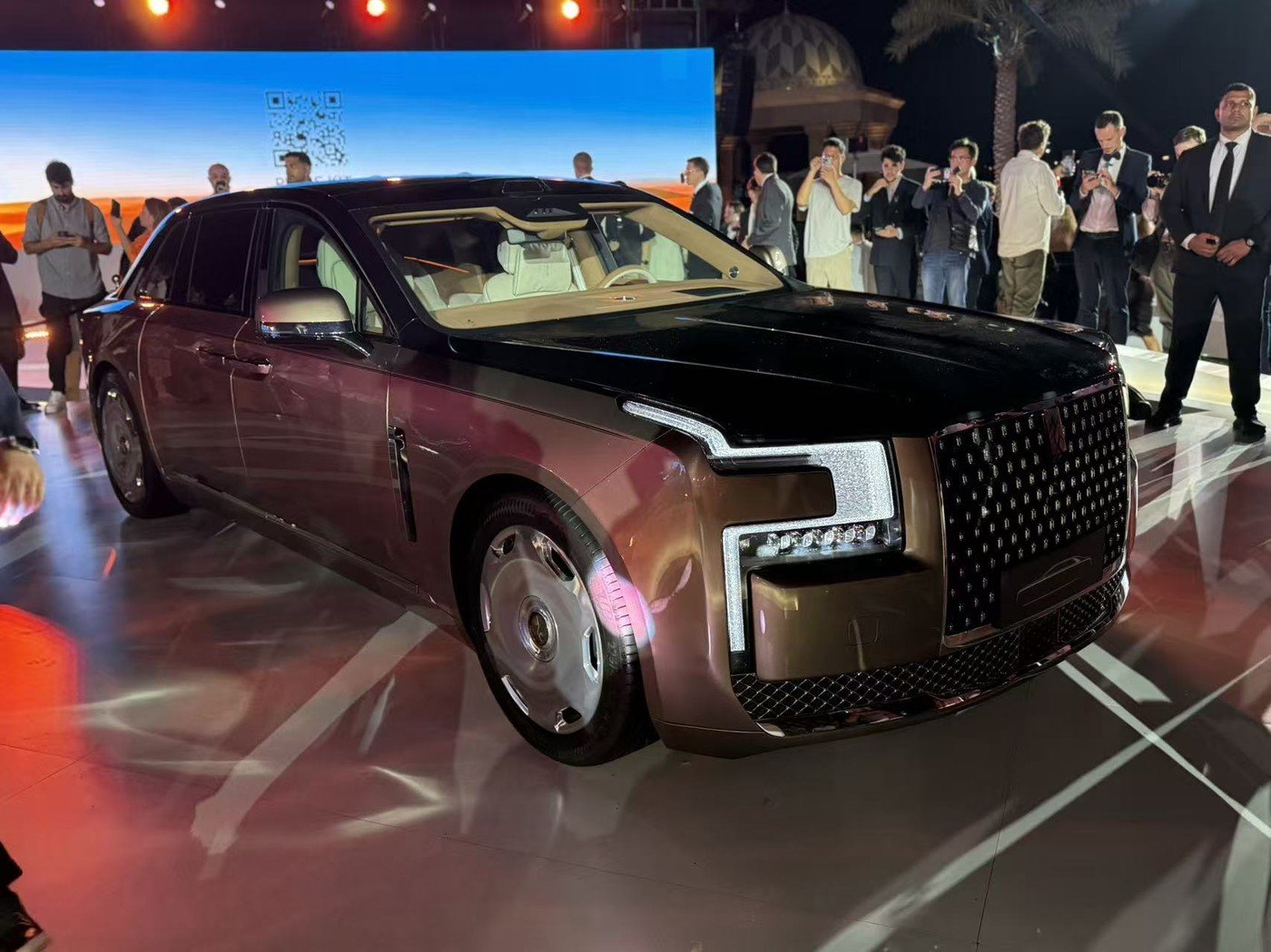
Underneath, the technology is the argument. The car runs BYD’s Yi Si Fang four-motor independent drive system, which can hold a straight line after a high-speed tyre blowout and float briefly in an emergency. A new generation of the Yunian active body control system reads the road ahead and adjusts the suspension in real time. The driver assistance stack uses God’s Eye with BYD’s own Xuanji A3 chip, covering highway and urban navigation plus parking. A second-generation Blade battery with fast charging gives a CLTC range above 1,000 kilometres.
The export curve behind the launch
BYD’s passenger electric vehicle exports went from 55,900 units in 2022 to 1,049,600 in 2025, and reached 1,507,400 in the first ten months of 2026, already above the whole of last year. The UAE is a small slice of that at 11,495 units in the first three quarters, but it is a representative one.
For most of the past five years Chinese car exports competed on electric powertrains, supply chain efficiency and price. That formula has a ceiling. Selling a RMB 2 million sedan in a market where the customer already owns a Rolls-Royce requires something the price argument cannot supply, which is brand permission.
A launch in Abu Dhabi is a cheap way to buy that. The Gulf has a mature ultra-luxury market, no domestic competitor to protect, and a clientele that buys on presence rather than on total cost of ownership. If the brand cannot hold a price there, it will not hold one in London or Los Angeles either.
The risk is symmetric. A flagship that does not sell is survivable at 300 units a year. A flagship that sells badly in the market chosen to signal global ambition is a story the competition will use for a decade.
Editor’s note: This is an adapted translation of the original 36Kr report. It has been trimmed and restructured for readability for an international business audience. The full original (in Chinese) is at https://36kr.com/p/4062540807099270.