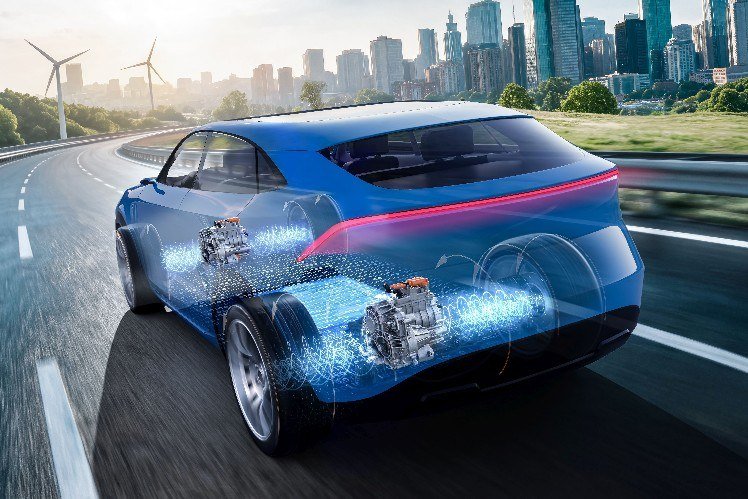
ZF has developed a compact three-in-one electric drive unit called the High Revolution Drive. Its motor runs up to 30,000 rpm, which at the same power output allows a smaller and lighter package and reduces the amount of magnetic material the motor needs.
The physics is straightforward. At a given power level, a higher rotational speed requires less torque, and torque is closely tied to rotor volume. A smaller rotor means a smaller motor, less mass and a lower permanent magnet content.
Turning speed into torque
A two-stage spur gear transmission with a ratio of about 18:1 converts the high motor speed into usable wheel torque. The version shown in ZF’s materials produces 200 kW of peak power and 3,500 Nm of peak torque at the wheel.
Running an entire system at that speed is not a motor-only problem. Bearings, cooling, inverter switching and noise all have to work together, which is where ZF places its argument. Thomas Meiser, who heads the e-drive division, said the High Revolution Drive draws on the company’s system integration experience, and that ZF is not optimising components in isolation but coordinating motor, power electronics and transmission as one system.
Why the platform matters
The concept is built on ZF’s existing SELECT platform, which the company says allows carmakers to adopt it in new models more quickly and at lower development cost.
That is the commercially decisive detail. A 30,000 rpm motor is an engineering headline. A 30,000 rpm motor that a mid-size carmaker can order as a configured variant of an existing platform is a product. Most of the European industry’s drivetrain roadmap for the late 2020s is constrained less by ambition than by the cost of a new development programme.
The supply chain reading
Electric drivetrain costs have been treated as a battery problem for most of the past decade. The motor and inverter are now where the remaining material risk sits, and heavy rare earth content in permanent magnets is the most exposed part of that bill.
Reducing magnet mass through higher speed is one of the few routes that does not depend on a new mine, a new chemistry or a recycling chain. It depends on gear manufacturing precision, bearing life and thermal management, all of which sit inside the competence of established European suppliers.
ZF has not published a production date or a first customer for the High Revolution Drive. Until a carmaker commits a model to it, the 30,000 rpm figure remains a capability statement rather than a supply chain fact.
Editor’s note: This is an adapted translation of the original Gasgoo report. It has been trimmed and restructured for readability for an international business audience. The full original (in Chinese) is at https://auto.gasgoo.com/news/202611/9I70477381C409.shtml.