Recursive self-improvement became the internal scoreboard every Chinese model lab wanted to show in 2026, and one of the hottest themes in domestic venture capital. A business plan carrying the phrase self-training is reportedly worth a valuation premium of at least 20 per cent.
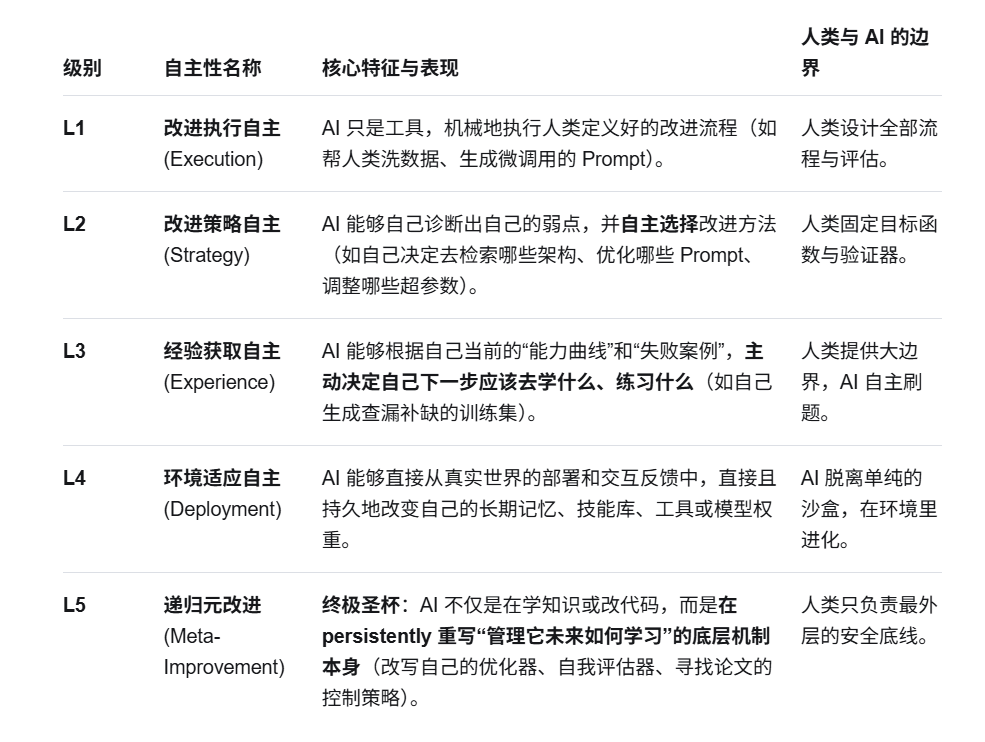
Real RSI is supposed to mean more than AI improving AI. It should mean experience that compounds, so the method of learning itself evolves. In September, 35 researchers from Shanghai Jiao Tong University, Tsinghua, ByteDance, SenseTime and elsewhere published a paper titled The Last AI Built by Humans, grading the field on five levels.
The conclusion is uncomfortable. Most frontier systems sit somewhere between L1 and L2. L3 and L4 appear in isolated vertical pockets such as software engineering and scientific discovery. A genuine L5 closed loop exists only in a handful of constrained laboratory prototypes.
Measured against that ruler, the RSI results Chinese labs showed off in September and October cover training pipelines, inference systems, GPU kernels and agent harnesses. None of them dares to let an AI rewrite the underlying model weights.
Zhipu: a production stack built by an agent
Zhipu is the first Chinese case where RSI went into production. Its first step deliberately avoided the weights and landed on the least glamorous layer, the inference system. Then it moved to the agent harness. One cuts cost, the other raises throughput, and both are engineering.
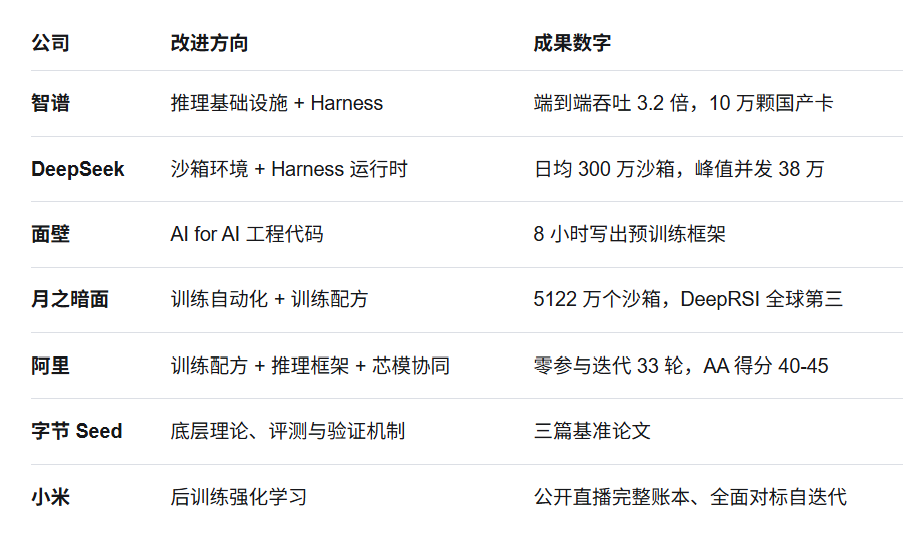
On 17 September, Tang Jie published a long post titled Toward Recursive Self-Improvement. An infrastructure agent driven by GLM-5.3 had, on a cluster of 100,000 domestic chips, built a production-grade inference service for GLM-5.3-Flash from nothing in two weeks. It held all live traffic while pushing end-to-end throughput to 3.2 times the starting baseline, and matched mainstream Nvidia GPU hardware utilisation and cost per token.
Running on that self-built stack, the anonymously released GLM-5.3-Flash consumed more than 62 trillion tokens in six days. Successful optimisations are abstracted into reusable skeletons and stored, so the next bottleneck of the same shape is answered from the library.
Zhipu’s Hong Kong shares rose 8.29 per cent that day. The market paid for the claim directly.
In late October, Tsinghua and Zhipu followed with HarnessPro, again with Tang Jie signing. The target was the harness itself, the layer that governs prompt design, tool calls, compute budgeting and task routing. Letting an AI rewrite it risks a system that peeks at the answers and produces high scores with no capability. HarnessPro never touches the answer key: a diagnostic agent finds the bottleneck, a test-generation agent synthesises its own stress cases, and a planning agent rewrites framework code against either a cost or a performance objective, with accuracy and execution cost optimised together. With zero answer access, pass rates on hard coding tasks rose and cost per task fell 53 per cent.
Tang’s summary of the mechanism is the most quotable line in the field this year. What drives the loop is not intelligence. It is the closed loop itself. Give a system something to improve, a judge that can verify it, and a feedback path that survives, and performance is pushed toward its ceiling.
Zhipu’s ambition goes further. At its half-year results in August, Tang defined the next model, GLM-6.0, as fully self-trained, and said about 60 per cent of its net USD 5 billion raise would go into that system. In Singapore in early October he set out three routes for GLM-5.4 and 5.5: pretraining data reaching several trillion tokens, pushing parameters from roughly 740 billion to at least a trillion, deeper reinforcement post-training across SFT, RLHF and RLVR, and longer-horizon reasoning and agent capability.
He is also candid about the hard part. The difficulty is not continuing to scale, he said. It is making a model reliably judge when to stop, when to correct itself, and how to evaluate its own training results.
DeepSeek: three million sandboxes a day
DeepSeek attacked the training ground instead of the model. RSI is high-density trial and error, and if every generation needs engineers to rebuild the environment, no amount of model intelligence helps.
On 19 September, DeepSeek and Tsinghua released DSec, an automated sandbox cluster with 30,000 CPU cores and 250 terabytes of memory that produces about 3 million sandboxes a day. Four tiers of isolation, from light function calls to full virtual machines, respond in seconds and are consumed on demand. Agents build environments, environments produce stronger agents, stronger agents feed better environments, and every environment stays as a reusable asset.
DeepSeek also rebuilt its harness. The open-sourced DeepSeek Harness treats everything as a plugin, including tools, logs and the core runtime, so an agent can upgrade while running and roll back with one command. The Cordis mechanism behind it, described in a paper with Peking University, solves the two problems that make hot-swapping dangerous: how to roll back on failure, and how to rewire dependencies when a plugin is pulled.
On 21 October came DeepEvolve, an agent that learns to forecast. It separates retrieval from prediction, distilling reusable forecasting skill from a limited number of live trajectories so noise in the input does not corrupt the lesson.
ModelBest: eight hours to parity
ModelBest points its RSI at the software used to build AI, the layer where Chinese engineers spend months tuning kernels for domestic silicon.
Its Forge programme began in May under the principle of more environment, less instruction. In the first step, an AI wrote a large-model pretraining framework, ForgeTrain, from scratch. It reached parity with Nvidia’s Megatron-LM in eight hours and overtook it in 2.5 days. The human equivalent is three to five senior engineers for more than six months.
In the second step it went down to the kernel. ForgeKernel, published on 27 October, took first place on both Huawei’s and Nvidia’s official kernel leaderboards, delivering 1.6 to 5 times the speedup of the runner-up on Ascend 950 series hardware. In the third, it began rewriting parts of industrial simulation and scientific computing.
Moonshot, Alibaba, ByteDance, Xiaomi
Moonshot poured compute into long-horizon autonomy. Kimi K3, released in July with 2.8 trillion total parameters, was trained and evaluated on an AgentEnv sandbox system that created more than 51 million sandboxes and used over 1.5 million images, eventually moving to Firecracker microVMs after conventional containers kept crashing under load. Automation runs at three layers: the model debugs its own multi-step tasks, a resident agent picks from 26 recovery playbooks when training destabilises, and a reward model scores each self-training recipe so bad recipes are dropped.
On 14 October, the DeepRSI benchmark gave models 48 hours to conduct autonomous research across 15 real machine-learning tasks. Kimi K3 scored 820, third globally and the highest-placed Chinese and open model, ahead of Grok 4.7 and Gemini 3.8 Flash and behind Claude Fable 5.1 and GPT-6 Astra, at a run cost of USD 159, roughly a quarter of Claude’s.
The failure mode arrived fast. Within 48 hours of K3.1 Pro shipping on 26 October, Moonshot issued an apology: agents had been given too much latitude, sub-agent calls ran away, and user quotas were burned. It cut redundant calls and refunded 25 per cent of monthly quota to every subscriber. Every lab betting on autonomy faces the same contradiction. Once long-horizon agency is switched on, token consumption is very hard to hold.
Alibaba’s Qwen went after the training recipe. At Yunqi on 22 September it showed Qwen3.8-Max building its own training pipeline and running for more than a month unattended across 33 effective iterations, generating its own data, designing its own controlled experiments and filtering samples through smaller models. Its Artificial Analysis score moved from 40 to 45. On the inference side, Qwen3.8 autonomously ported the next-generation Flash architecture to T-Head’s new GPU and tuned SGLang, lifting single-instance throughput 96 per cent. Eddie Wu put RSI into Alibaba’s long-term technical roadmap, a first for a Chinese big-tech chief executive, and offered a scale estimate: machine thinking today is under 3 per cent of humanity’s, with room to reach 1,000 times it.
ByteDance Seed took the sceptical route, publishing a Self-Developing Agents programme with Georgia Tech and arguing that most systems described as RSI are half-closed loops where the scoring rules, verification tools and optimisation direction were all drawn up by humans. Its Golden Verifier concept names the problem: agents overfit to their own evaluations, learning which action scores well without converting that into durable capability.
Xiaomi went the other way and staged a six-day, six-night livestream of reinforcement learning. MiMo-V2.6, released open source on 22 September, scored 46 on Artificial Analysis, first among open models and above Kimi K3 at 44 and GLM-5.3 at 45. The Pro run cost USD 2.62 million and the Flash run USD 850,000, each completing 30 iterations and generating 750,000 training trajectories, with native million-token context and 156.8 million samples per round.
The honest reading
Nothing here touches the weights. The most aggressive players circle inside a minimal closed loop, and what they actually modify is training data, harnesses, inference systems, sandbox environments and post-training reinforcement learning.
That is not a failure of imagination. It reflects the distance between the RSI vision and engineering reality. Let an AI modify its own weights carelessly and the system walks into hallucination and loss of control. What the labs have instead built is the machinery around the model: a hundred thousand chips running a self-optimising stack, three million sandboxes a day, a pretraining framework written in eight hours, a fifty-three per cent cost cut on coding tasks.
Individually those look like plumbing. Collectively they are the industrial base for the thing everyone says they are building.
Editor’s note: This is an adapted translation of the original Leiphone report. It has been trimmed and restructured for readability for an international business audience. The full original (in Chinese) is at https://www.leiphone.com/category/yanxishe/UIbgVZxTjEoMswaE.html.