GLM-Omni appeared first in a paper, not a product launch. The work is a joint effort between Tsinghua University and Zhipu AI, with Tang Jie as corresponding author, and it has already been attached in public discussion to the GLM-5.5 name, though the paper makes no such claim. What it does provide is the technical substrate and a set of results on unifying visual understanding with image generation.
One number in it stands out. After training on image generation, GLM-Omni placed a specified number on a jersey correctly 72 per cent of the time. Researchers then took the generated image away and asked the model, in words, what number the jersey carried. The accuracy was 2 per cent.
The model could reproduce a piece of knowledge in a picture and could not retrieve it in a sentence.
Building a world nobody has seen
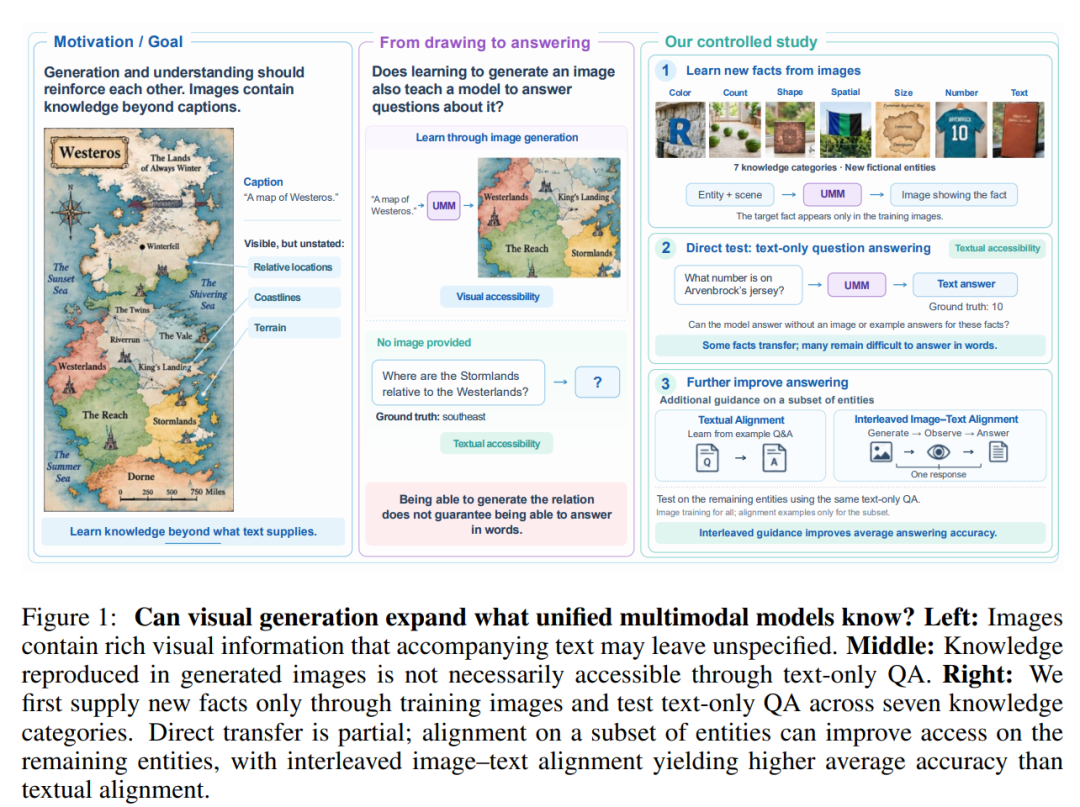
Testing this properly means ruling out memory. Ask a model to draw a real team’s jersey and it may produce the right number because it read about that team. So the researchers built MagicWorld, a synthetic universe of entities that have never existed, each assigned a colour, a number and spatial relationships.
In one example, a fictional jersey called Arvenbrock carries the number 10. During training the text prompt only asks for the jersey. The number 10 appears only inside the target image. Afterwards, the model is asked directly what number Arvenbrock wears.
Seven task families were constructed: colour, count, shape, spatial arrangement, relative size, numerals, and written text. Fifty knowledge items per family, 350 in total, each rendered across backgrounds and viewpoints, filtered down to 8,552 training samples. Training text was audited to remove answer leakage and attribute imbalance.
The task types separate kinds of knowledge deliberately. Shapes and colours come from finite categories. Spatial arrangement requires understanding relations between objects. Jersey numbers and book titles require memorising a specific character sequence.
Three architectures were compared. BAGEL keeps understanding and generation in separate expert branches. SenseNova-U1 models image pixels directly. GLM-Omni starts from GLM-4.1V-Thinking and attaches a discrete image tokeniser based on X-Omni. A further 10,000 text QA pairs unrelated to the target knowledge taught the models the answering format without giving away answers.
The size of the gap
BAGEL averaged 31.43 per cent visual accuracy and 8.86 per cent in text. GLM-Omni reached 54.00 per cent and 14.57 per cent. SenseNova-U1 reached 61.14 per cent and 20.00 per cent. On numerals, SenseNova-U1 hit 88 per cent visually and zero per cent verbally.
Image generation rewards any association that helps reconstruct pixels. Text answering needs a route through the language output path, and shared parameters do not mean those paths are connected.
Some knowledge was not learned at all. BAGEL and SenseNova-U1 both scored zero on spatial arrangement in the visual condition, so later training has to separate failure to learn from failure to retrieve.
Three attempts to close it
The first was Textual Alignment. Half the entities in each category received ten text QA examples; the other half got none and served as the test set, so the model had to transfer a method rather than memorise answers. BAGEL rose from 8.86 to 15.43. SenseNova-U1 rose from 20.00 to 28.00. GLM-Omni fell from 14.57 to 12.57. SenseNova-U1 went from 20 to 68 per cent on shape and hit 100 per cent on relative size. All three stayed at zero on numerals and book titles for the held-out entities.
The pattern is informative. Shape and size have transferable comparison rules. A jersey number is a unique character string attached to one entity, and learning the sentence pattern does not help.
The second attempt was Interleaved Image-Text Alignment, which puts generation and answering into a single training sequence. Faced with a jersey question, the model generates the jersey first, then composes the answer from what is in the picture. GLM-Omni’s average text accuracy rose from 12.57 to 26.86 per cent, with shape at 64 and spatial arrangement at 40. BAGEL reached 17.14 and SenseNova-U1 28.57.
Is the gain from image supervision or just from more text reasoning? An ablation on GLM-Omni kept everything and masked only the image loss in the interleaved samples. Accuracy collapsed from 26.86 to 13.71 per cent. The image reconstruction signal is doing real work on the language path.
The third attempt accepted the asymmetry. Visual Chain-of-Thought lets the model generate the target image during reasoning, read the attribute out of it, and then answer. GLM-Omni went from 26.86 to 41.14 per cent. Numerals, where all three models were at zero, moved to 4, 36 and 20 per cent. In one case SenseNova-U1 answered 69 directly and 31 after drawing and reading the image.
What it costs and what it leaves open
Generating an image as an intermediate step is expensive, and if the generated image is wrong the answer inherits the error. Book titles did not improve at all under visual chain of thought. The knowledge here also comes from a controlled synthetic world, so behaviour in messy real scenes remains untested.
The broader point is uncomfortable for anyone shipping unified models. Two years of architectural convergence have produced systems that see and draw in one set of weights. This paper measures how much of what they see in order to draw can be spoken, and the answer is between a fifth and a half.
Merging the modules was the easy part. Making their knowledge interchangeable is the part still open.
Editor’s note: This is an adapted translation of the original Leiphone report. It has been trimmed and restructured for readability for an international business audience. The full original (in Chinese) is at https://www.leiphone.com/category/ai/LjPPo6aqhHUrRMFg.html.