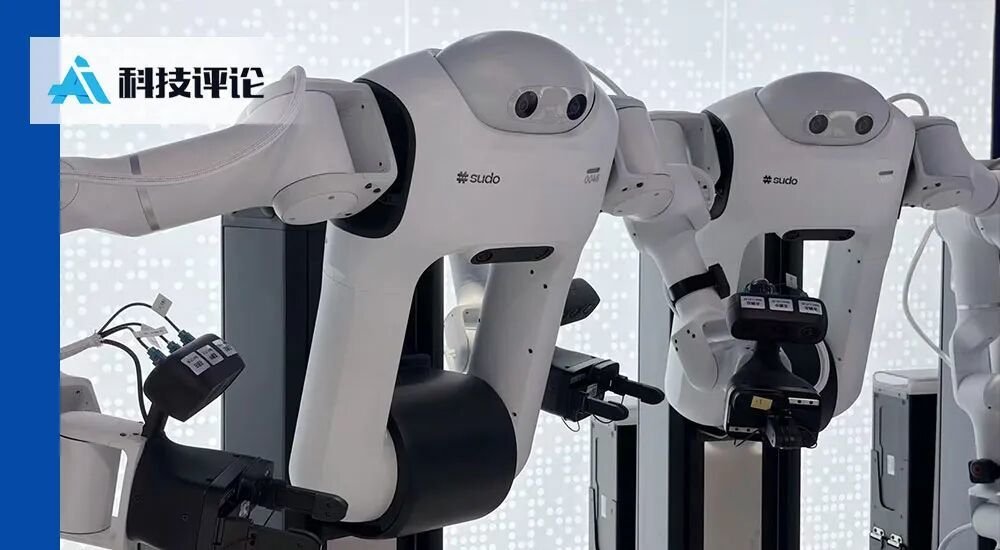
At WAIC 2026 in Shanghai, China’s embodied-AI zone was full of robots making coffee, taking photos and dancing. Sudo Tech’s booth drew crowds for the opposite reason: its robots quietly did unglamorous things — grasping objects, wrapping items in cloth with two hands, inserting parts into matching holes — with conspicuous stability, success rates and generalisation.
The Chinese startup is barely a year old and already valued at RMB 20 billion (about $2.8 billion). The premium rests largely on its founding team. Founder Su Hao is a chair professor at Fudan University and founding dean of its General Physical Intelligence research institute. He led the creation of ShapeNet and PointNet — foundational works in 3D computer vision — and built the SAPIEN and ManiSkill robot-simulation platforms. His Google Scholar citations exceed 150,000. Co-founder and CEO Han Zheng brings Microsoft Research Asia and startup experience; research VP Xu Zexiang was a research scientist at Adobe Research working on 3D generation and spatial intelligence.
Sudo first went public in April with its full-stack embodied-AI platform, sudo R1. In a 60-minute demonstration video, a robot continuously grasped more than a hundred previously unseen objects — transparent glassware, reflective metal parts, soft fabrics, irregular toys — with a success rate approaching 100%. It repeated the feat live at ICRA and CVPR in June, handling objects randomly placed by audiences.
At WAIC, the company showed more than ten skills spanning precise placement, deformable-object manipulation, bimanual coordination, mobile grasping and autonomous navigation — from household scenes to industrial lines. Hardware lead Chen Runze frames the approach around what Sudo calls “atomic abilities”: basic capability units in the physical world. The thesis is that robot competence should not come from engineers retraining a model for every new task, but from accumulating foundational abilities that compose into complex skills — the way humans who learned balance, grasping and force control can quickly handle unfamiliar tasks.
In his WAIC keynote on July 17, Su Hao argued that physical intelligence lacks not more isolated task demos but the aggregation of scattered knowledge into a systematic understanding of the physical world. The layer closest to manipulation is the hardest to learn by observation: “Knowing what to do, and having hands that can actually do it, are two different things.”
Sudo’s data strategy is also contrarian. While rivals bet on first-person video, human-hand motion capture or teleoperated real-robot data, Sudo trains its robots primarily in simulation first — building on Su’s decade of work on sim-to-real platforms. The team argues simulation’s real value is providing a growth environment reality cannot replicate: exposure to vast varieties of objects, lighting, materials and task combinations that lets a model build basic physical-world understanding before it ever touches a real object.
A one-year-old company at a RMB 20 billion valuation invites obvious bubble questions. But Sudo’s pitch is unusually falsifiable: watch whether the atomic-abilities library keeps compounding, and whether near-100% grasp generalisation holds outside exhibition halls.
Read the original report (LeiPhone)
*Translated and adapted from LeiPhone (https://www.leiphone.com/category/ai/7NBqAPnPNa3p2OD4.html).*