China has finally fixed a date. The Ministry of Industry and Information Technology has opened public consultation on the approval draft of a mandatory national standard covering safety requirements for automated driving systems. It replaces a recommended standard with a legal floor for L3 and L4, and it is scheduled to take effect on 1 July 2027.
The change of one word does a great deal of work. Under a recommended standard, compliance was a choice. Under a mandatory one, a non-compliant product cannot be built or sold, and selling it anyway is an offence. Several Chinese cities have also begun issuing L3 road-test and demonstration-operation licences. Compliant volume production is now on a countdown.

Three pillars moved at once
The competitive logic has shifted with it. What used to matter was how quickly a feature reached a car. What matters now is safety, stability and the ability to keep iterating across a whole product life. Architecture choice decides who stays at the table, and it cannot be judged on whether it is adequate today. It has to still be compliant and upgradeable in five years.
Algorithms have gone through a paradigm change. Autonomous driving used to be rule driven, with engineers writing code to define scenarios and responses. That road ends in a corner-case list nobody finishes. The mainstream has moved to AI-native approaches: end-to-end models, world models, vision-language-action models and reinforcement learning. The model is expected to understand the world and infer physical consequences rather than follow a hand-written rulebook.
Data requirements changed with them. Once models became data driven rather than rule driven, the demand moved from volume to quality, and specifically to long-tail coverage. Leading players who accumulated real road data early have built systematic data loops, and their iteration speed keeps widening the gap. The window for everybody else is closing.
Both shifts point the same way. L3 and L4 need stronger perception, decision making and execution, real-time fusion of multiple sensor streams, and live inference on large models. Desay SV senior chief engineer Peng Xueming told the 2026 China Auto Forum that algorithms, data and compute are all approaching a threshold at the same time.
Everyone has a date, nobody has the same one
Xpeng chairman and chief executive He Xiaopeng has offered an aggressive read: L4 and even L5 within three to five years, running safely and smoothly across all scenarios. Two years ago, he said, he did not really believe L4 or L5 would land, but the pace of physical AI has outrun his expectations.
Horizon Robotics founder Yu Kai has given a more granular schedule. Full hands-off driving by 2028, eyes-off L4 by 2030, and by 2035 the endpoint where a passenger can sleep. Peng frames the coming period as a five-year endgame in which the industry structure sets rather than the technology matures.
The timetables differ, but the consensus lands somewhere between 2030 and 2035.
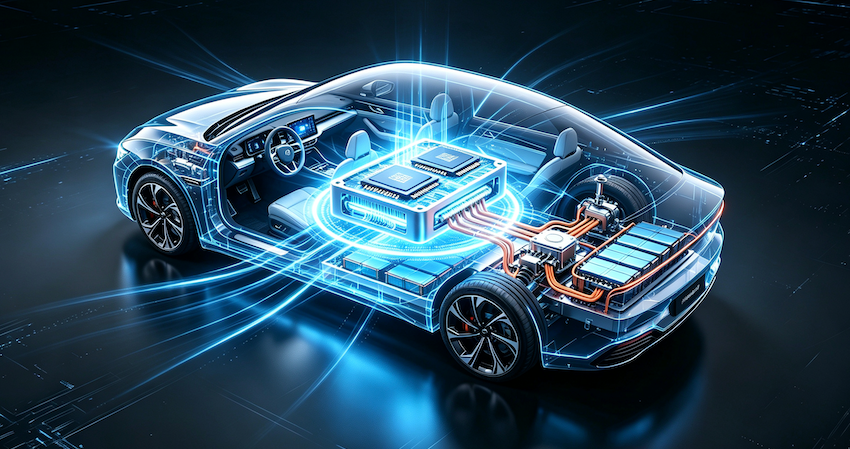
The number carmakers are already buying against
On the hardware side, big-compute silicon is already shipping. Li Auto’s flagship L9 Livis carries the company’s own Mach M100, rated at 1,280 TOPS per chip, two of them for 2,560 TOPS. The top retail trim of the Xpeng GX runs three in-house Turing chips for 2,250 TOPS, and the robotaxi version uses four for 3,000 TOPS.
These cars are still L2. The silicon is not. Buying that much compute for an L2 product is a statement about what these companies expect to be selling in three years, and about headroom rather than sufficiency.
Peng puts a figure on it: 2,000 TOPS is the entry threshold for AI-native L3. For L4, he argues, the whole-vehicle AI agent has to move towards more than 6,000 TOPS across the domain.
Big and small, or big and big
No single chip on the market provides that. The bridge to L3 has been a big-brain, small-brain design: two chips of different capability running separate software stacks, with the large one handling core computation and the small one carrying safety redundancy when the main domain fails.
For L4 that pairing looks thin. The main computing domain needs far more than L3 requires, and the redundancy requirement rises as well. Two large chips may be the answer.
This is what Desay SV is building, and it calls the design a big-brain, big-brain architecture. The principle is that the primary domain performs the duty while the secondary domain provides the floor. Two high-compute chips share a single software stack, with fault isolation achieved through hardware partitioning rather than a second stack. The main unit handles domain-wide perception and core decisions. The secondary unit independently carries safety redundancy. Both share the same data loop, simulation and over-the-air update system.
The advantage shows up over time. The design meets L3 multi-redundancy safety standards and transitions to L4 without a rebuild. A big-and-small design, by contrast, carries two algorithm sets, two toolchains, two validation systems and two maintenance regimes. Moving it to L4 most likely means a platform reconstruction, re-adapted algorithms, a rebuilt toolchain and a fresh validation system.
Peng’s framing is financial. Big-and-small is paying by instalments, with a low deposit and open-ended top-ups. Big-and-big is paying once, expensive up front and settled afterwards. Safety, though, is not only a cost question. Redundancy, compliance and sustained iteration all need a compute base underneath them, and a short-term price argument should not sit above either.
For European suppliers and carmakers watching a Chinese standard become law in July 2027, the useful signal is not the regulation itself. It is that the domestic industry has already started buying silicon against a number that no regulator has published.
Editor’s note: translated and adapted for RobotBelt from Chedongxi. Read the original report here.