China’s Ministry of Industry and Information Technology published the 410th batch of its road vehicle production catalogue on 7 August. The filing is a compulsory disclosure rather than a marketing event, which is why the industry reads it so closely. Dimensions, motor outputs, battery chemistry and cell suppliers all appear before a car is launched.
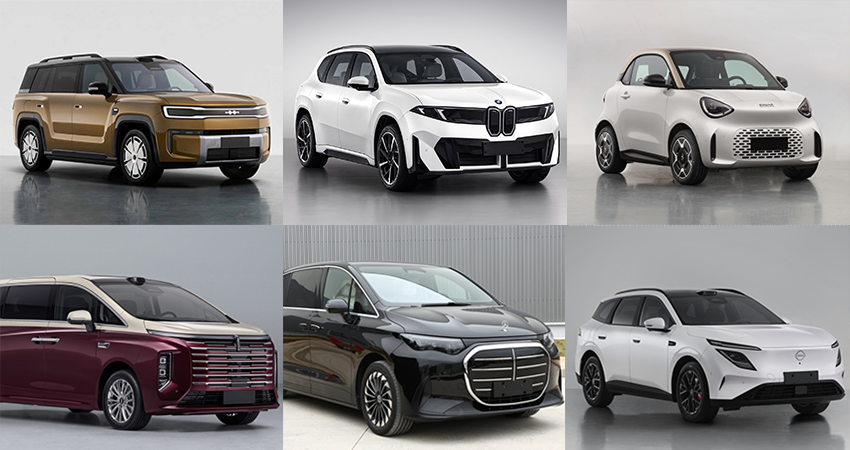
This round is unusually rich for European brands. Mercedes-Benz filed an electric MPV. BMW filed the long-wheelbase iX3 for China. smart filed a two-seat city car under 2.8 metres long.
Mercedes-Benz VLE, an electric seven-seater
The VLE is a battery-electric MPV measuring 5,310 by 2,000 by 1,922 mm on a 3,340 mm wheelbase, with seven seats and kerb weights of 3,030, 3,080 or 3,220 kg depending on version. Its grille treatment follows the electric GLC already on sale.
Buyers get a single-motor version rated at 200 kW, or a dual-motor version pairing a 200 kW front unit with a 105 kW rear unit. Top speed is 170 km/h. The pack uses nickel manganese cobalt cells from CATL, assembled by Fuding Contemporary Amperex. Optional images show a two-plus-two-plus-three layout with a folding third row.
BMW iX3, second time around
The Brilliance BMW iX3 40L is the Chinese long-wheelbase version of BMW’s Neue Klasse debut model, and this is its second appearance in the catalogue. Against the April filing it has switched to semi-flush door handles.
It measures 4,885 by 1,895 by 1,634 mm on a 3,005 mm wheelbase, seats five and weighs 2,255 kg. The dual-motor layout combines a 116 kW front motor with a 235 kW rear motor for a 200 km/h top speed. Cells are nickel manganese cobalt units from CATL, with the pack built by BMW Brilliance itself.
smart #2, a two-seater under 2.8 metres
Rare in a market that keeps growing its cars, the smart #2 is a two-seat battery-electric measuring 2,751 mm long, or 2,764 mm in one variant, by 1,669 by 1,555 mm. The wheelbase is 1,875 mm and kerb weight is 1,130 kg.
A single 60 kW motor drives it to a 140 km/h top speed. Lithium iron phosphate cells come from CATL, with the pack assembled by Zhejiang Jiyao Tongxing Energy Technology.
The Chinese entries
BYD’s Fangchengbao brand filed another boxy off-roader, the Ti9. It runs 5,270 by 1,999 by 1,850 mm, or 1,880 mm with roof equipment, on a 3,130 mm wheelbase, with six seats and a kerb weight of 2,865 or 2,965 kg. The plug-in hybrid pairs a 1.5-litre engine producing 115 kW with two 200 kW motors, one on each axle, for a 220 km/h top speed. The 66.48 kWh lithium iron phosphate pack uses cells from Guangxi FinDreams and is assembled by Shenzhen BYD. WLTC electric range is 310 km.
Great Wall’s Wey brand filed the Gaoshan 8 and Gaoshan 9 MPVs together, with a heavily revised front grille and what appears to be a sensor near the high-mounted brake light. The Gaoshan 9 measures 5,410 by 1,960 by 1,890 mm on a 3,275 mm wheelbase, seats six and weighs 2,960 kg. Its plug-in hybrid system uses a 2.0-litre engine rated at 175 kW, with nickel manganese cobalt cells from SVOLT. Top speed is 205 km/h. The Gaoshan 8 is a size down.
Dongfeng Nissan filed the NX7, a plug-in hybrid SUV that reads as a smaller NX8 and carries a roof-mounted lidar. It measures 4,785 by 1,920 mm, or 1,932 mm, by 1,660 mm, or 1,665 mm, on a 2,815 mm wheelbase, seats five and weighs 1,915 or 2,000 kg. A 1.5-litre engine rated at 73 kW works with a single 170 kW motor, top speed 180 km/h. The 40.95 kWh lithium iron phosphate pack uses cells from Times FAW Power Battery, assembled by Dongfeng. WLTC electric range is 225 or 220 km.
The batch also contains a refreshed BYD Seal 07 and a new AITO M8 whose range-extender version can be specified with a 75 kWh pack.
What the filing says about the second half
Retail volumes across the Chinese market have been subdued for the first seven months of 2026, and the industry is now heading into the autumn selling season it calls golden September and silver October. Batch 410 suggests that carmakers have responded to a soft market by accelerating rather than pausing.
For European readers the more interesting detail is who is filing. Mercedes-Benz, BMW and smart are all pushing China-specific electric models through a Chinese approval process, with Chinese cells, on Chinese timelines. The competitive question is no longer whether European brands can build electric cars for China. It is whether they can do so at the cadence the local market now treats as normal.
Editor’s note: translated and adapted for RobotBelt from Chedongxi. Read the original report here.