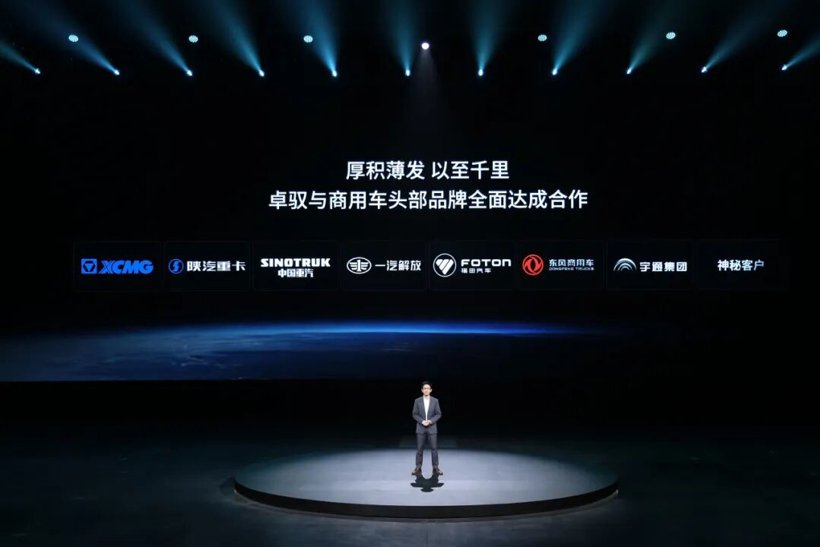
Zhuoyu Technology launched a commercial-vehicle technology brand, Pansing, in Zhuhai on 29 October, alongside disclosed progress with seven Chinese truck and bus manufacturers covering heavy trucks, coaches and light trucks.
https://robotbelt.com/wp-content/uploads/2026/10/16_0-1.jpgThe partner list
The seven partners are XCMG, Shaanxi Auto, Sinotruk, FAW Jiefang, Foton, Dongfeng Commercial Vehicle and Yutong Bus. Production is already under way in one case. The Shaanxi Auto Delong X5000 fitted with Pansing PDS 4 has been in volume production since June, and several hundred vehicles are now operating on express-parcel trunk routes.
Further launches are scheduled for the end of the year. XCMG’s Hanjing new-energy heavy truck is due for delivery, while Sinotruk’s SITRAK and Dongfeng’s Tianlong KH are expected to enter production. Foton’s Auman Galaxy 5 is also planned for a year-end launch.
Borrowing a car brain
The technical approach is a port, not a fresh build. Zhuoyu transferred a passenger-car driving model, trained on more than 30 billion km of accumulated car driving data, onto commercial vehicles. It then adapted that model using 400 million frames of heavy-truck-specific data, with scenario augmentation and vehicle dynamics work, to produce a highway NOA function for tractor units.
Pansing ships in two versions. PDS 4 targets heavy-truck trunk logistics. PDS 5 is built on a native multimodal foundation model and is intended to extend highway and urban NOA to coaches, light trucks and vans.
https://robotbelt.com/wp-content/uploads/2026/10/16_1.jpgThe economics, not the autonomy
Zhuoyu disclosed measured fuel savings of 4.5 to 7.5 per cent from its reinforcement-learning economy algorithm. On the company’s own arithmetic, that is roughly RMB 20,000 to 30,000 saved per vehicle per year, enough to recover the cost of the assistance system inside twelve months.
That figure, not the autonomy narrative, is what moves a haulage operator. Fuel is the largest controllable cost line in Chinese trunk logistics, and margins are thin enough that a 5 per cent saving changes a fleet’s decision in a single procurement cycle.
What is still unproven
Zhuoyu had already announced its commercial-vehicle cooperation during this year’s Beijing auto show, and the Zhuhai event filled in the technical specification and production status. The seven agreements sit at different stages, spanning model nomination, production and delivery. Actual installed volume and operating performance remain to be seen.
The strategic read is that China’s commercial vehicle incumbents are buying driver-assistance capability from outside rather than building it, in the same way their passenger-car peers did. The supplier that wins that role collects a position across the entire heavy-truck fleet.
Editor’s note: This is an adapted translation of the original Gasgoo report. It has been trimmed and restructured for readability for an international business audience. The full original (in Chinese) is at https://auto.gasgoo.com/news/202610/29I70476308C601.shtml.