On 13 July, the Brussels-based group Transport & Environment published a 44-page report titled The presence of Chinese carmakers in the EU car market. It runs from 2020 to 2035 and answers a narrower question than the headlines do. Not whether Chinese cars are selling in Europe, but whether the anti-subsidy duties changed the volume.
The answer is that the duties worked on the companies they were designed to reach and did not work on the ones that kept coming. Chinese-brand battery-electric imports held at roughly 350,000 units a year. The mix inside that number moved hard.
The volume did not fall. The logo did change
China-made BEV imports into the EU ran below 20,000 units in 2020 and reached about 330,000 in 2023. Duties landed in 2024 and the figure stayed at about 330,000, then drifted to roughly 350,000 in 2025. Almost nothing happened at the top line.
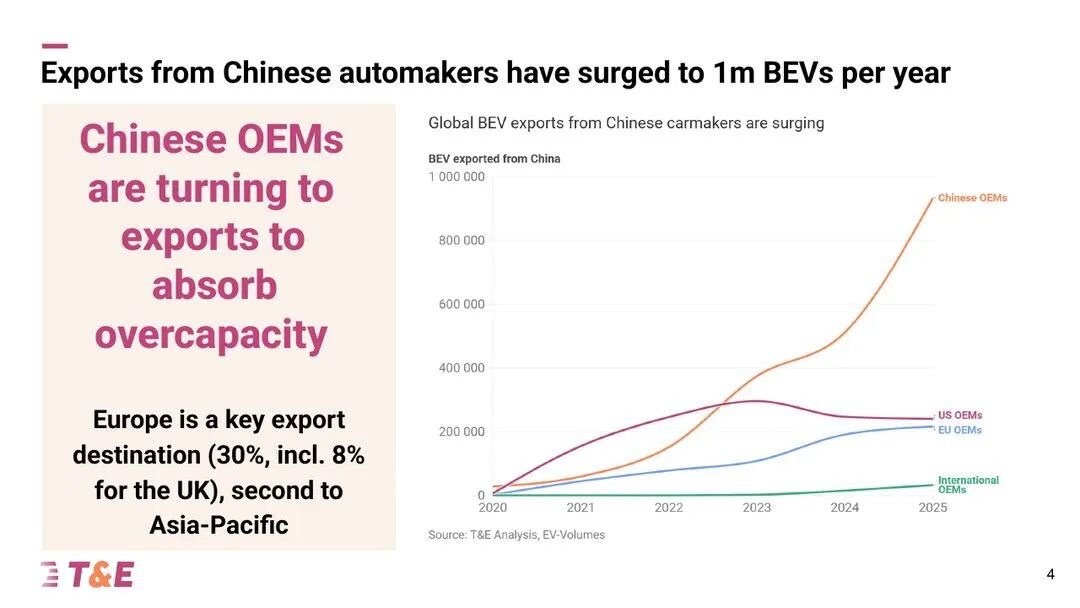
What moved was nationality. Tesla cut its Shanghai-to-Europe flow once Grünheide opened in 2022. Volvo pulled the EX30 back to European production after 2024. The space they vacated went to Chinese brands, whose share of China-made imports rose from 15 per cent five years ago to 54 per cent now.
In the first quarter of 2026, BYD alone was 24 per cent of China-made BEV imports into the EU. Tesla was 20.6 per cent. Then XPeng at 6.6 per cent, MG at 6.3, BMW at 6.2, Volkswagen at 5.8, Polestar and Renault Group at 5.1 each, Volvo down to 1.9.
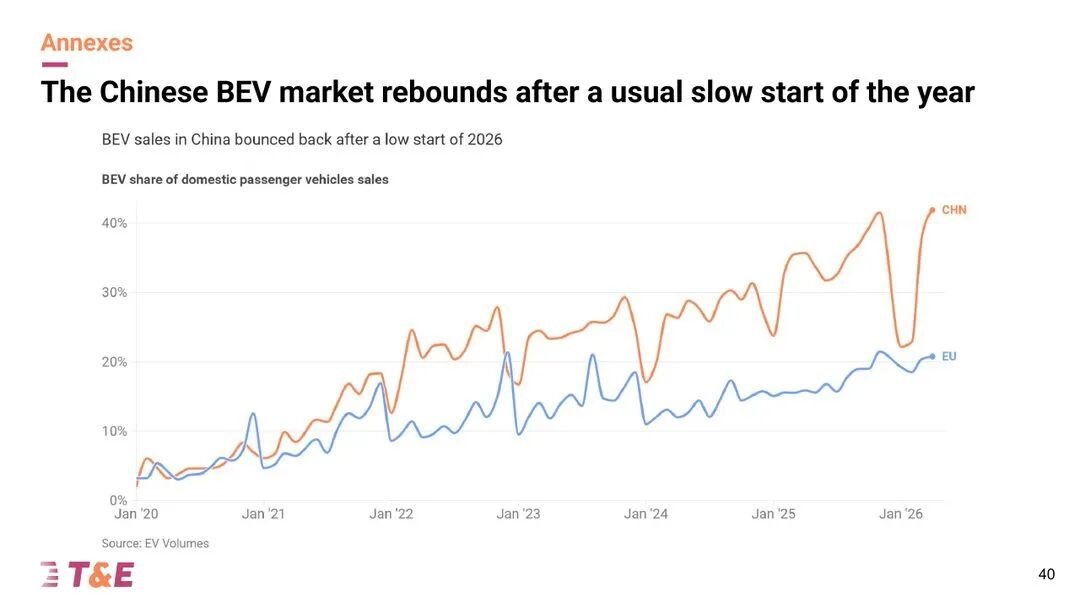
Share of the total EU BEV market tells a different story, and this is where the report is careful. China-made BEVs peaked at about 22 per cent of EU BEV sales in 2024, fell to about 19 per cent in 2025 and 17 per cent in the first quarter of 2026. Volume held while share fell because the European BEV market itself grew when the 2025 CO2 targets tightened.
A tariff spread of 18 points rewrites a brand’s curve
Page 12 carries the report’s cleanest natural experiment. BYD, at the low end of the duty range, more than doubled its imports in two years, from roughly 13,000 units to 76,000. SAIC, at 35.3 per cent, halved from a 2023 peak of about 74,000 to roughly 35,000. The firms that did not cooperate with the investigation also paid 35.3 per cent, and their volumes doubled from a base below 10,000 units, which is the part the rate alone cannot explain.
Price is the reason the pressure did not disappear. Across segments A to E, Chinese brands averaged 21 per cent cheaper than European brands after duties. The report does not say whether those are list or transaction prices and does not adjust for equipment.
What the duties never covered
Plug-in hybrids sat outside the scope, and the import share from China went from 37 per cent in 2024 to 49 per cent in 2025 to 60 per cent in the first quarter of 2026. Chinese-brand share of imported PHEVs went from 11 per cent to 53 per cent in the same period. In April 2026 the BYD Seal U, sold in China as the Song Plus, was the best-selling PHEV in the EU.
Chinese carmakers sold about 550,000 vehicles in the EU in 2025 and almost half were combustion cars, 97 per cent of them imported. In the EU combustion market that is still only a 4 per cent share, so the tariff-free channel is large in Chinese volumes and small in European terms.
The report also counts the factories. Ten production projects have been announced in Europe since September 2023, four of them in Spain: Chery in Barcelona, Leapmotor in Zaragoza, SAIC in Galicia, Geely in Valencia. Adding Hungary and Turkey gets to 11 sites and about 700,000 units of capacity by 2033, an average of 60,000 per plant. Ten of the 15 sites listed are brownfield. Cumulative 2024 to 2033 output splits 46.2 per cent BYD, 22.4 per cent Chery, 13.6 per cent Leapmotor, 8.9 per cent Geely, 4.8 per cent XPeng.
Localisation does not replace imports in this arithmetic. China-made BEVs still account for about 60 per cent of Chinese-brand BEV sales in Europe in 2035, and the import line roughly doubles from 290,000 units in 2026 to 700,000 in 2033.
The battery door has a 1 to 3 per cent duty on it
This is where the report stops describing and starts arguing. EU lithium-ion imports from China went from about USD 4 billion in 2020 to nearly USD 30 billion in 2025, a seven-fold increase, on customs code 850760 and excluding cells that arrive inside finished cars. Of the roughly 149 GWh installed in EU-sold electric vehicles that year, 79.3 GWh was European-made, 51.3 GWh Chinese and 18.7 GWh other imports.
European cell output was about 170 GWh against demand near 400 GWh. Korean firms produced 73 per cent of it, LG Energy Solution 48 per cent, Samsung SDI 17, SK On 8. Chinese firms produced 11 per cent and European firms about 16 per cent, led by Volkswagen’s PowerCo at 5. On T&E’s 2030 projection of about 920 GWh, Chinese-owned plants account for roughly 225 GWh, more than any other single group once high-risk European projects are set aside.
Cost is the reason. Using BloombergNEF’s BattMan model, T&E puts European nickel cells at about USD 94 per kWh against a Chinese cost 37 per cent lower, and LFP at USD 79 per kWh against 40 per cent lower. Two-thirds of that gap is within reach of European plants, and the report says plainly that reaching it requires scale that only industrial policy can buy.
The four recommendations follow. Open an anti-subsidy case on batteries and extend duties up the value chain to cathode active material and precursor. Block circumvention through countries with EU trade agreements, which on the report’s own reading covers the Turkish and UK plants in its table. Pass the Industrial Accelerator Act and the corporate fleet rules to create a market. Keep the 2030 and 2035 CO2 targets.
The political use of the document is not hidden. Weaker CO2 targets shrink the denominator, and on unchanged Chinese volumes the Chinese-brand BEV share rises from about 15 per cent to 30 per cent by 2035 without a single extra car being sold. That is the argument aimed at the European Parliament as it debates the revision, and it is worth reading as an argument rather than a forecast.
Editor’s note: This is an adapted translation of the original OFweek report. It has been trimmed and restructured for readability for an international business audience. The full original (in Chinese) is at https://www.ofweek.com/auto/2026-11/ART-70103-8420-30712130.html.