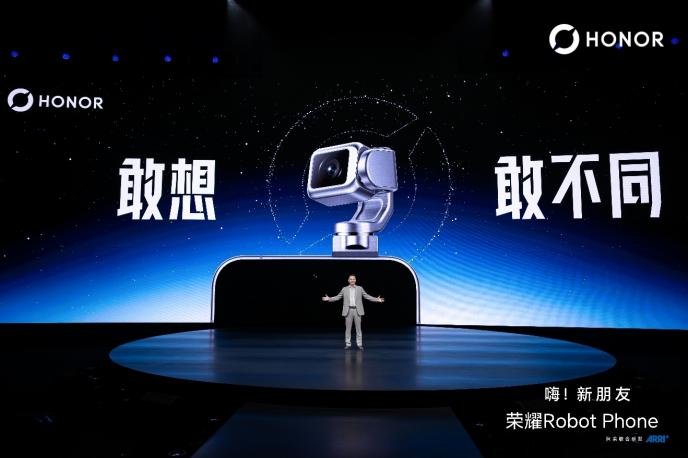
On 12 August, Honor held a global launch event at the Nansha Greater Bay Area sports centre in Guangzhou and unveiled the Robot Phone, what it calls the world’s first robot phone. The flagship combines a four-degree-of-freedom titanium gimbal, a system-level agent architecture and ARRI cinema imaging. The 12GB-plus-512GB version is priced at 9,999 yuan and the top 16GB-plus-1TB at 12,999 yuan. Pre-orders passed 400,000 units on launch day, a record for a Honor flagship.
The choice of the Greater Bay Area is deliberate. Nansha links the Pearl River Delta’s precision manufacturing, imaging supply chain and AI developer ecosystem through the Shenzhen-Zhongshan bridge, and sits against Shenzhen’s complete smart-terminal industry chain. For a product built around a complex mechanical gimbal, that cluster is the difference between a concept and a shippable device.
Three breakthroughs rewrite the interaction
The phone enters a market under pressure: global replacement cycles have stretched past 33 months and high-end share above 600 US dollars hit a record 29 per cent, yet Apple and Samsung still dominate overseas. Honor’s answer is a new category rather than a spec war.
On hardware, the industry-first four-degree-of-freedom titanium gimbal integrates more than a hundred precision parts at plus-or-minus 0.005 millimetre accuracy, with a 2.6-gram motor, 360 degrees per second tracking and high torque density, all class-leading. The gimbal auto-tracks people, sways to music and reframes shots, turning the phone from a static screen into a sensing, acting agent.
On AI, the device runs a new Agentic OS with a debut YOYO Pro robot mode, co-optimised with Alibaba’s Qwen model for on-device compute. YOYO executes long instructions and cross-app actions, reads gestures and emotion through multimodal perception, and auto-focuses live streams. An open YOYO skill store exposes more than 100 system-level capabilities; Honor demonstrated the phone controlling a physical rover, bridging digital intelligence and the physical world.
On imaging, Honor co-developed with century-old film brand ARRI, adding its own image chip, ARRI LogC3 film curves, eleven cinematic looks, 10-bit video and 4K at 120 frames per second. A 200-megapixel main camera on a three-axis mechanical stabiliser gives ordinary users cinema-grade footage.
A differentiated high-end track
For Honor, the Robot Phone is the key result of its human-centric AI strategy. The 400,000 pre-orders validate demand for a new interaction form and lift the brand’s ceiling above generic Android flagships. The launch also previewed the Magic9 series in September, extending the agent-and-imaging matrix.
For the industry, Honor is the first to mass-produce precision robot mechanics inside a phone, showing a path from screen-bound AI to the physical world. By linking hardware, a system agent and a pro imaging ecosystem, it pushes competition from spec racing toward embodied, all-scene interaction, and accelerates the consumer robot-phone category.
Editor’s note: This is an adapted translation of the original Shenzhen News report. It has been trimmed and restructured for readability for an international business audience.