Huachao Shenkong, also called BCI-Sonics, has closed a 200 million yuan Pre-A round led jointly by Sequoia China and Yunqi Capital, with BilinXing Investment, Yuanhe Holdings, Xuhui Sci-Tech Innovation Investment and Deshi Investment joining, and earlier backers Matrix Partners China and Delian Capital re-upping. Xunguang Capital served as exclusive strategic financial adviser. Including prior angel and angel-plus rounds, the company has raised nearly 300 million yuan since its 2025 founding.
The Shanghai-based firm builds non-invasive AI brain-computer interfaces around three pillars: ultrasound neuromodulation, multimodal brain reading and AI neural decoding, organised into research, clinical and consumer product lines. Its stated aim is to become China’s benchmark for non-invasive AI BCI and, on that base, a Neuro AI company fuelled by brain data.
Why non-invasive ultrasound, not implants
The BCI investment thesis is moving from concept to industrialisation. IT Juzi data shows China’s BCI financing passed 60 deals and 7 billion yuan in the first half of 2026, already above the 49 deals and 2.723 billion yuan of all 2025. Policy backs it: seven ministries, including the Ministry of Industry and Information Technology, issued a BCI special policy in June 2025, the 15th five-year plan lists BCI as a future industry, and in June 2026 the drug regulator published two BCI medical-device guidance documents, with Hubei, Shanghai and Guangdong adding pricing, insurance and industry support.
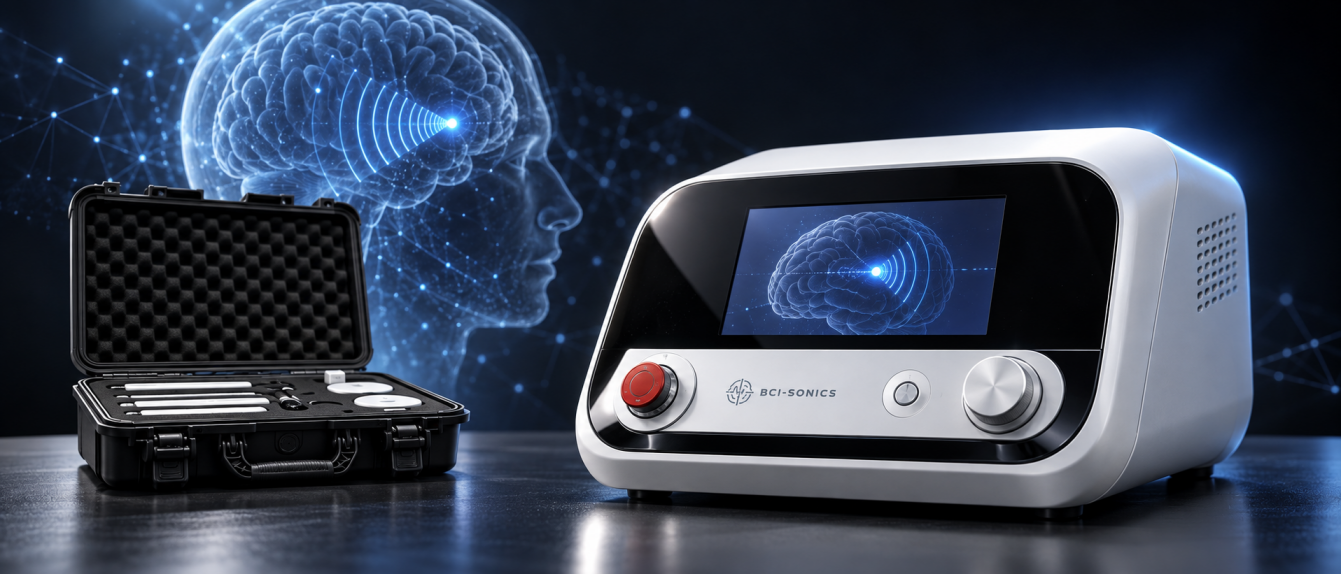
On technique, invasive BCI has China’s first medical-device registration certificate but craniotomy limits it to severe patients. Traditional non-invasive routes such as EEG and transcranial electrical stimulation are capped by spatial resolution and depth. Low-intensity transcranial focused ultrasound, tFUS or LIFU, is the only physical pathway that is simultaneously non-invasive, deep-reaching and millimetre-precise, which is why global capital concentrated here: Merge Labs, co-founded by Sam Altman with OpenAI involved, raised a 252 million dollar seed and in September 2026 signed a multi-year ultrasound-chip licence with Butterfly Network, while Nudge, founded by Coinbase co-founder Fred Ehrsam, took a 100 million dollar A round led by Thrive Capital and Greenoaks for an earphone-form device targeting addiction, chronic pain and cognitive enhancement.
Write, read, decode: the closed loop
Huachao Shenkong’s system splits into three layers that close a loop. Writing the brain uses ultrasound: low-intensity transcranial focused ultrasound penetrates the skull to modulate deep nuclei and superficial cortex with quantifiable dose. The engineering core is phase correction, because individual differences in skull thickness, density and curvature distort the sound field and shift the focus. The firm built its own transcranial phase-correction algorithm that completes individual calibration in a short time, making its near-commercial device one of few domestic tFUS or LIFU systems with that ability.
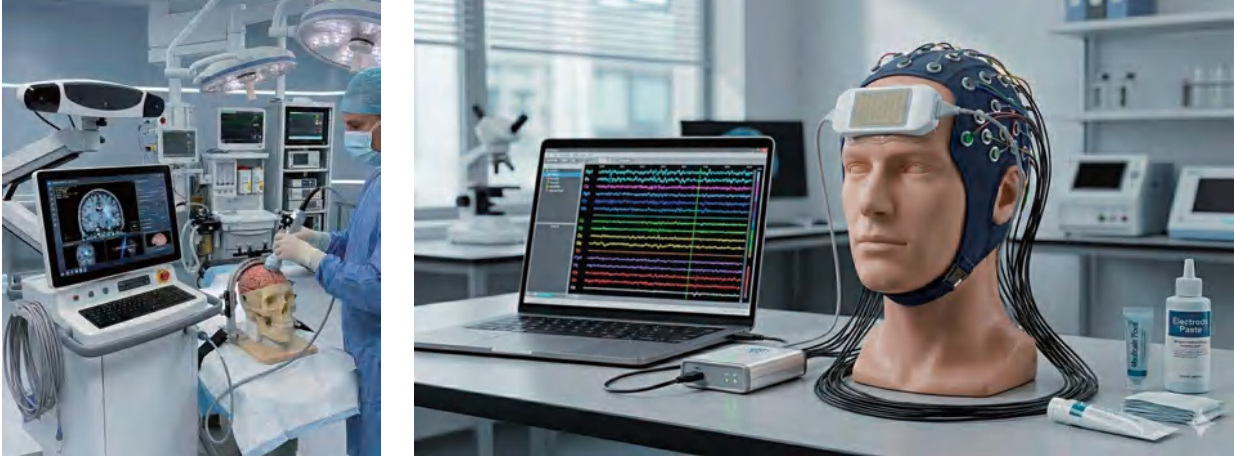
Reading the brain uses multiple modalities: functional ultrasound imaging and EEG at the core, joined by fMRI and PET, with passive cavitation detection monitoring acoustic safety in real time. The modalities trade off time resolution, spatial resolution and depth, together feeding high-dimensional brain-state input to the AI. Decoding uses an AI neural model that identifies the current brain state, drafts an individual stimulation plan and tunes parameters from neural feedback, forming a read, understand, regulate, feedback, re-optimise loop. Two productised carriers are an AI platform that turns stimulation-parameter choice from experience-driven to model-driven, and the Cortex Atlas interactive brain map released in September 2026.
Three product lines: explore, cure, enhance
The research line serves neuroscience, positioning to explore the brain. At the Chinese Neuroscience Society annual meeting in September 2026 the firm released a non-invasive closed-loop BCI system, the ultrasound neuromodulation parameter AI platform and the Cortex Atlas. The clinical line serves hospitals, positioning to cure the brain, with indications spanning pain, Parkinson’s disease, Alzheimer’s disease, addiction and sleep disorders, plus ultrasound opening of the blood-brain barrier for drug delivery to brain tumours and neurodegenerative disease. It has started multi-centre investigator-initiated trials with top tertiary hospitals and is advancing the device-registration path.
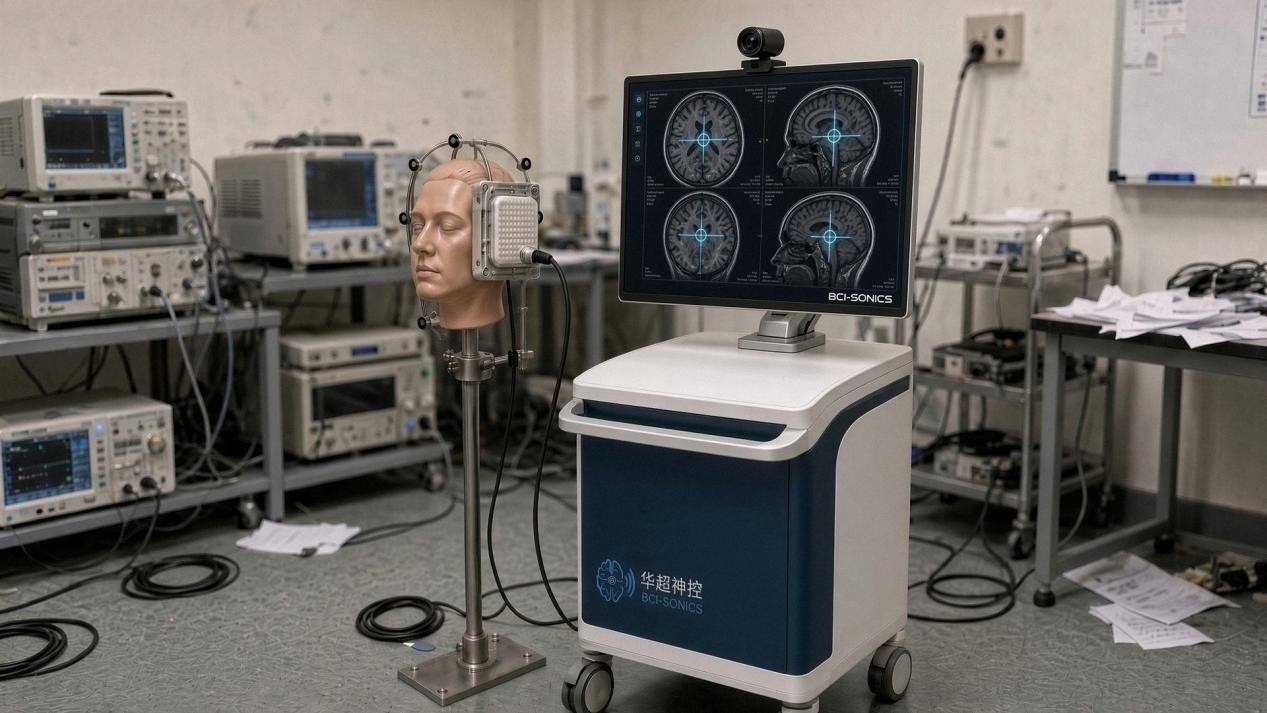
The technology line serves homes and ordinary consumers, positioning to enhance the brain, as a wearable BCI terminal around sleep, focus and emotion, with the goal that everyone owns a brain-computer device. The firm’s FUS-BCI series has completed two generations with safety reports, the closed-loop ultrasound system is planned to enter clinical use in the first quarter of 2027, and the consumer closed-loop product is in batch validation, while multimodal reading, a Neuro AI platform and CNS drug-device combinations progress with international pharma partners.
From sensors to a Neuro AI company
In Huachao Shenkong’s plan, all three device types share one identity: sensors that collect brain data. Each stimulation and response, each multimodal signal, samples how the brain works. As devices scale across labs, hospitals and homes, the firm accumulates brain data across populations, states and interventions, building a data, model, efficacy flywheel.
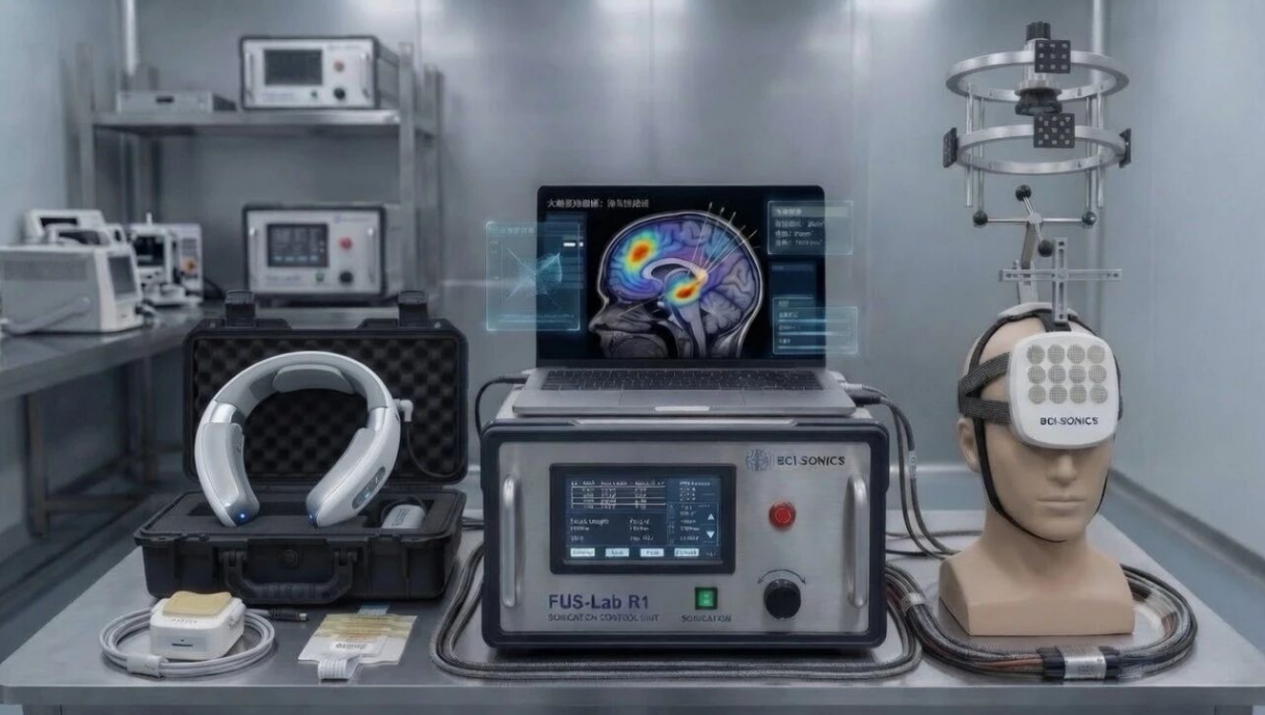
On that base the long-term goal is a Neuro AI company: first a digital-twin brain and neural world model that predicts individual response to stimulation, then a Human AGI. Today’s large language models learn the text humans wrote. The firm wants future AI to learn brain activity directly, a stance it calls Neuroscience for AI. The AI-infrastructure portion of the new round funds compute, data platforms and model research.
The team and the investor consensus
Founder and chief executive Li Xin is a serial entrepreneur with a joint biomedical-engineering doctorate from the Chinese Academy of Sciences and Germany’s Fraunhofer IGD, who joined GE Healthcare in 2015 and rose to lead its global research-and-development centre in China. The core team comes from Tsinghua University, Imperial College London, Shanghai Jiao Tong University and Zhejiang University across neuroscience, acoustics, medical imaging, AI, materials, clinical translation and commercialisation.
Sequoia China framed brain science and AI as a long, important frontier and backed the non-invasive route as serving verifiable research and clinical need while building Neuro AI foundations. Yunqi Capital pointed to ultrasound as the base of a next-generation fusion scheme that breaks through in complex medical scenes first, then reaches consumers as data accumulates. The co-lead by two top China funds signals that leading domestic institutions have formed a consensus on the non-invasive route’s prospects in China, even as the field still must prove clinical and consumer delivery at scale.
Editor’s note: This is an adapted translation of the original LeiPhone report. It has been trimmed and restructured for readability for an international business audience. The full original (in Chinese) is at https://www.leiphone.com/category/aihealth/cZ1cYOXpoBGSfj45.html.