Humanoid rental in China has fallen to around RMB 1,000 a day, down more than 70 per cent from early 2025. Robot dogs rent below RMB 500. More than 90 per cent of the rental stalls in Huaqiangbei have closed, and the top of the market has slid from the RMB 10,000 tier.
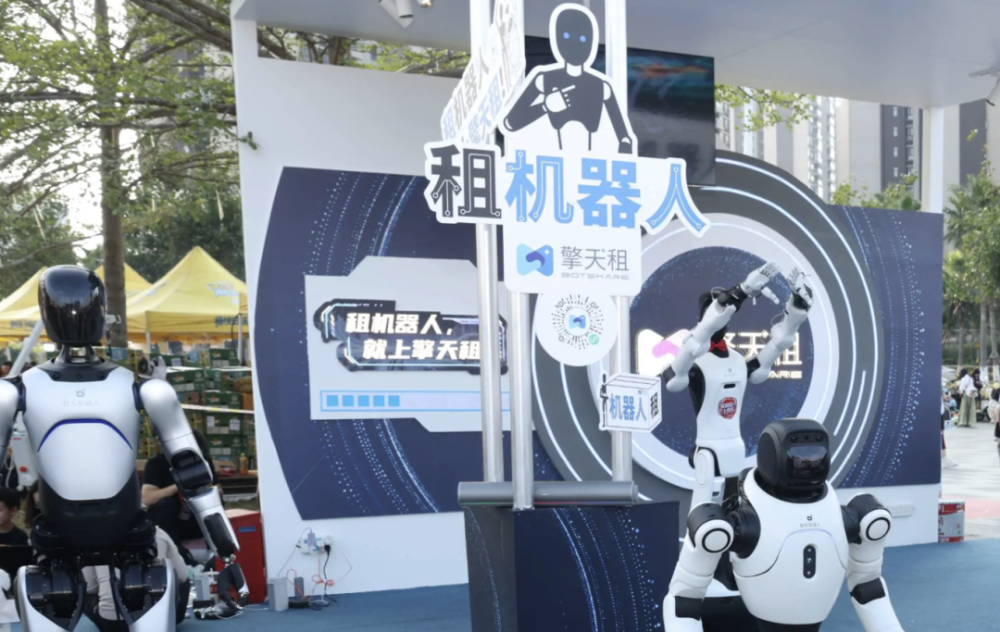
Ordinarily a year of falling prices would send investors to the sidelines. It did the opposite. Qingtianzu opened a city partner programme aiming for 600 recruits and received about 20,000 applications. JD put humanoids and quadrupeds on its self-operated shelves.
Editor’s note: This is an adapted translation of the original OFweek report. It has been trimmed and restructured for readability for an international business audience. The full original (in Chinese) is at https://robot.ofweek.com/2026-11/ART-8321206-8420-30710852.html.
Supply explains the slide, demand explains the bottom
Unitree and AgiBot each passed 5,000 units in 2025 for combined shipments above 10,000. In 2026 supply accelerated further. GGII forecasts domestic humanoid shipments of 62,500 units this year, more than three times 2025.
But the floor is set by the demand pool, and that pool is shallow. Rental did not open a new market. It changed the transaction from buying to renting inside the same shallow market. Counterpoint Research puts more than 60 per cent of 2026 first-half robot sales into entertainment performance and research education. Qingtianzu’s first-quarter rental mix was about 34 per cent performance and 31 per cent commercial sales, roughly 65 per cent in the same two buckets.
The new customers rent attention, not labour. A mall opening needs footfall, a company annual dinner needs a stage, a village birthday banquet needs a face. The robot is a visual prop. Once the crowd has photographed it, nobody pays twice for the same experience. Rental brought those buyers into the pool and did not keep them there.
The arithmetic on a single booking is thin. A Shanghai operator quoted by Naibo reckoned that at RMB 1,000 a day, after labour, transport, depreciation and insurance, a job nets about RMB 300. The old logic of buying stock to amplify returns becomes a liability once the rate halves.
Inventory is what really moved the platforms in
By the first quarter of 2026, industry surveys cited by Titan Media estimated that 30 to 40 per cent of new humanoid output had become finished inventory. Every unit sitting in a warehouse is cash that cannot turn. The individual operators who once absorbed that output at a markup were the first to break.
So the manufacturers built their own rental arms. Qingtianzu launched in December 2025 under AgiBot’s control, followed by JD’s self-operated channel. The model pushes hardware to franchisees below market price, pulls demand with one-renminbi flash rentals, and removes commission and first-quarter cost to lower the entry barrier.
The deeper reason is a capital one. Investors value a robot company on technology, but also on shipment volume and scenario coverage. Hardware parked in a warehouse tells no story. A rental platform that puts thousands of units into malls, exhibitions and stores across the country produces real active-device counts and real transaction volume, even if the platform itself loses money on subsidies. Qingtianzu launched at the end of 2025 and reached a valuation of RMB 7 billion after its A+ round in May 2026.
For AgiBot, which has started a Hong Kong listing process, a controlled rental platform that makes utilisation visible is part of the capital narrative. Rental is functioning as a buffer layer, discounting tomorrow’s demand into today’s shipments so the upstream has time.
The buffer is finite, and the pivot is already visible
A buffer run on novelty runs out. In May, Qingtianzu named RaaS system building and industrial scenarios as its next direction, trying to move machines from the spotlight into manufacturing, park operations and warehousing.
The books are different there. Industrial buyers want continuous operation, fine manipulation and very low failure rates, and they only pay for output that counts. Guangzhou Changlin Intelligent already rents machine labour to factories with on-site operations staff and settles on qualified output rather than machine-days. It is selling a slice of production, not a piece of hardware.
That is the only structure where rental stops being a way to move inventory and starts being a way to price work. Everything before it was demand borrowed from the future at a discount.