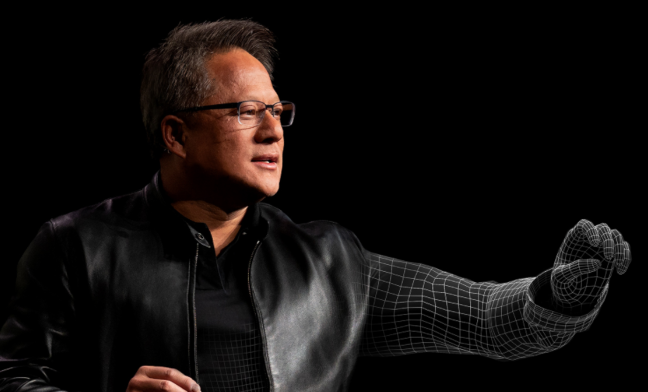
In a recent Bloomberg interview, NVIDIA chief executive Jensen Huang said the semiconductor industry will need to grow roughly 5 to 10 times over the next decade to support the next wave of computing. The bet rests on who — and what — will be using computers.
“In the future we will have AI agents and robots that use computers,” Huang said. “Not 1 billion people using computers, but 100 billion agents and billions of robots, all using computers. Computers were not only built for humans to use; they were built for computers to use.” He stressed the 5-to-10x figure is a personal estimate, not a forecast set in stone.
The logic underneath: traditional coding is receding and engineers building AI agents take the stage. On NVIDIA’s May 2026 (fiscal 2027 first-quarter) call he called the move from generative to agentic AI — systems that perceive, reason, plan and act — the industry’s “next major stage.” When agents become the ones calling APIs, the defaults break: rate limits, session memory and sub-millisecond routing all need rebuilding for machine-to-machine traffic.
The thesis also frames the scramble for compute that has China, South Korea and the United States racing to secure high-bandwidth memory and fabs. Huang named South Korea the “golden age” node for AI build-out, paired with NVIDIA’s more-than-$500 billion partnership with SK Group — covering next-generation HBM from SK Hynix and a co-developed HBM4 roadmap. Every link in the chain, from chip to datacentre to robot army, gets rebuilt and scaled.
The 5-to-10x expansion is the infrastructure tax of a world run by hundreds of billions of autonomous agents. Huang’s $500 billion Korea bet is what that tax looks like in practice.
*Translated and adapted from Bloomberg (https://www.163.com/dy/article/L2VPQJTQ05561FZU.html).*