A joint venture between Shenzhen’s Leju Robotics and Guangdong Dongfang Precision has opened a humanoid-robot mass-production factory in Foshan with an annual capacity of 10,000 units — one of China’s first scaled humanoid lines to move from demo to industrial base.
The hard part of mass production is not speed. “It is not about making many or making fast,” a technical lead at the venture, Oriental Genesis Robotics, told People’s Daily. “Mass production is hard because you must make them stable and consistent.” Humanoid bodies amplify tiny variances — a slightly loose screw throws off walking and grasping — and missing component standards make uniform output difficult.
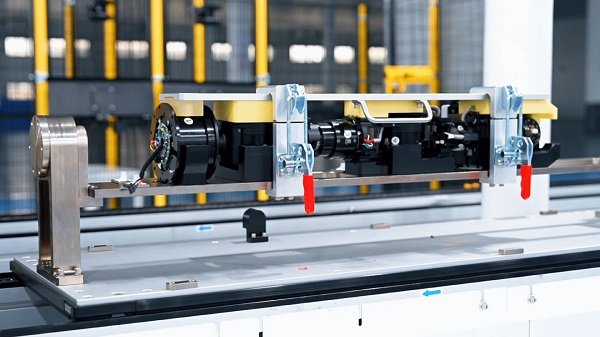
The line attacks that with automation. Material cabinets open only after ID verification and auto-weigh and count every part. Three classes of AGV move heavy frames, small components and pallets; modular synchronous stations assemble limbs, torso and head in parallel. Leju assistant vice-president Cao Yu says a model switch takes minutes: swap the end-effector and a joint module, and the software loads the matching assembly parameters.
Every unit gets a “pre-shift physical”: a push test for stable standing, a 180-degree waist turn, gait and stair validation under high-precision monitoring. Nothing ships until it passes.
The factory sits on top of a maturing supply chain. Shougang’s 0.2mm robot-specific electrical steel — the result of 600-plus formula trials — cuts iron loss 20 to 30 percent; about 100 tons of it go into every 10,000 robots, a future multi-billion-yuan market. Shanghai shops are even sewing robot “skins” for Unitree and AgiBot. The takeaway: China’s humanoid ecosystem is shifting from impressive prototypes to the boring, essential work of building them by the thousand.
*Translated and adapted from People’s Daily (https://news.cctv.cn/2026/07/29/ARTI29ejrPJVOvJsk01kdicn260729.shtml).*