On 17 September, LeJu Robotics released LET2.0, a multi-machine consistency dataset built on its 10,000-unit humanoid line and scaled training ground. It is the first time real data from the same robot model has been merged and reused across machines, moving real-world data from one robot, one use to many robots, shared use. The first batch opens 2,000 real KUAVO entries.
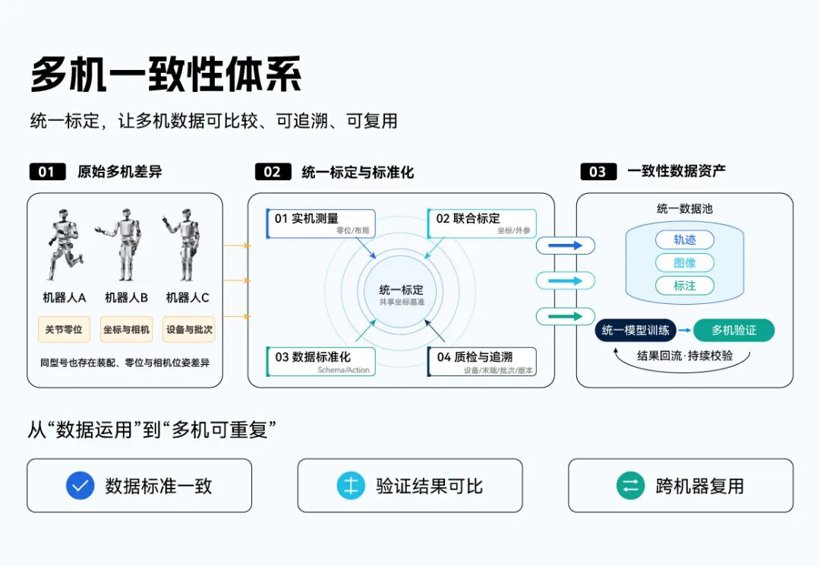
The problem it targets is consistency: identical models differ because of assembly tolerance, joint zeroing and camera placement. LET2.0 imposes unified calibration, collection standards and quality traceability so data from many machines can be merged. The first batch covers courier-bag picking and workpiece sorting. In cross-machine validation, two calibrated KUAVO 5W units running the same model for parcel sorting hit 88.9 per cent and 86.1 per cent success, proving the data transfers across bodies.
The dataset spans home service, commercial service, industrial operation and warehouse logistics, with three data types: basic operation, whole-body locomotion, and force and tactile sensing. Every entry records pose, trajectory, vision and depth. Developers reach the data and toolchain through the OpenLET community, which supports the full loop from application and training to deployment and evaluation.
Editor’s note: This is an adapted translation of the original Gasgoo report. It has been trimmed and restructured for readability for an international business audience. The full original (in Chinese) is at https://www.gasgoo.com/apps/50640d4b55d5cba175fb84f15d679f19/robot/news/70472371-%E4%B9%90%E8%81%9A%E6%9C%BA%E5%99%A8%E4%BA%BA%E5%8F%91%E5%B8%83let2-0%E5%A4%9A%E6%9C%BA%E4%B8%80%E8%87%B4%E6%80%A7%E7%9C%9F%E6%9C%BA%E6%95%B0%E6%8D%AE%E9%9B%86/.