
Why a robot route
MengShi Tech has closed a Series A+ round above RMB 100 million, with investors including Liding Capital, Hangzhou Heda and Huifu. Hangzhou Heda is a local state-owned investor that came in after the company relocated to Hangzhou’s Qiantang district, and a Series B is still in progress. The deal signals that the autonomous-mining track is moving beyond selling self-driving kits toward a robotised transport-operation model.
Most autonomous-mining firms position themselves as autonomous-driving solution vendors. MengShi chose the transport-robot path from the start, a stance rooted in its founding team. Founder Qiu Changwu holds a robotics PhD from Shanghai Jiao Tong University and his first venture focused on industrial-robot control systems. When he founded MengShi in 2018 the vision was already to build a world-class intelligent-robot company.
The capital trajectory tracks the route. An angel round in 2018 came from Yijin Capital with strategic investment from Breton. The 2021 Pre-A was led by Weichai’s industry fund, which cared about real deployment. The 2022 Series A brought financial investors Liding Capital and Galaxy Ventures. The A+ added local state capital, widening the mix from industry and financial players to local government.
In September 2026 MengShi’s Huzhou smart-manufacturing base began operation, focused on high-end equipment and robot manufacturing, aiming for self-produced core products and import substitution. That further cements its identity as a robot company rather than a software integrator.
Can the tech reuse pay off commercially
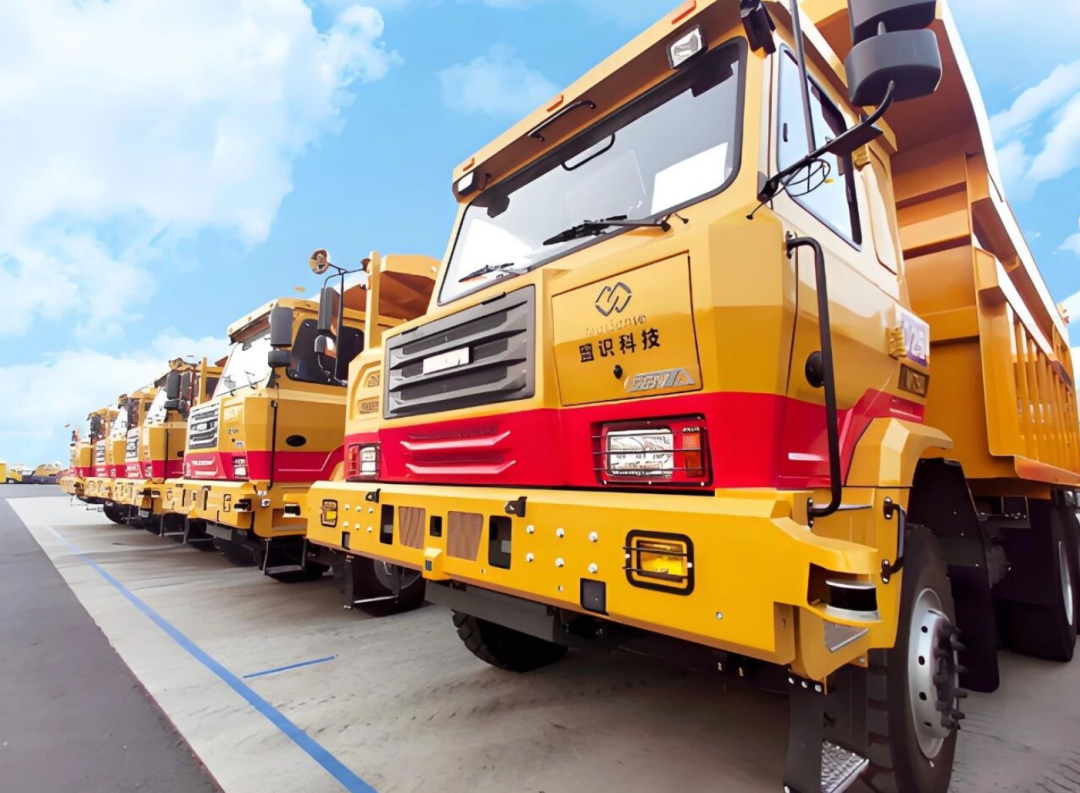
Defining an autonomous ore truck as a transport robot rests on a simple logic: the vehicle is just the hardware, while the real asset is the full perception, decision and execution system. That drove MengShi’s full-stack architecture: its self-developed VCS vehicle-control system, FOS scheduling platform, CSS cloud operations system and simulation platform reuse across mines, ports and factories at over 85 per cent, and support diesel, electric, hybrid and hydrogen powertrains. This cloud-edge-end tiered architecture values fleet coordination and cross-scene transfer more than single-vehicle perception.
On results: the Tongling project became China’s first fully unmanned mining operation. The Ruoqiang Zhicun Lithium project runs the longest-haul unmanned operation in the country, running round the clock at a loaded speed of 40 km/h. At Bachu in southern Xinjiang, 33 hundred-tonne electric autonomous trucks work routinely, and the Altyn project deploys an air-space-ground smart mine. On the port side it joined Weichai and Shandong Port on dry-bulk unmanned transport, and its Shanghai Lingang factory-to-warehouse electric trucks have run stably for years, cutting on-site staff by 80 per cent, lifting comprehensive benefit by 15 per cent and adding 20 per cent to operating hours.
To date MengShi’s signed autonomous-driving projects exceed RMB 1 billion with over 30 customers. While many projects stall at small pilots, routine operation of scaled fleets is the clearest line between a demo and a real business, because dust, rough roads and day-night cycles dilute paper performance until only large fleets running long enough reveal a system’s true level.
Is the transport model the answer
The sector has passed technology validation. The pain point is no longer “can it run” but “does running make money”. Many vendors sell systems and retrofit kits in one-off deals that end at delivery, leaving the mine to build its own operations and scheduling team, so benchmark projects rarely replicate. MengShi chose the smart-transport operator role: it goes deep into on-site transport, even exploring a “finance plus equipment plus scene” leasing model, and uses Morocco as a pivot into African and European mining logistics.
The risk is real. Deep operation means heavy on-site staffing, and a heavy model demands cash reserves, supply-chain control and field service. The raised money must turn into more steadily profitable operating projects or the story stalls.
The track is splitting into two: one route sells software kits and stays light-asset. The other goes deep into transport operation and becomes part of the production chain. Neither is absolutely better, but survivors must show customers a workable economic case. This A+ round means capital will fund the “robot plus transport operation” experiment, but funding is fuel, not outcome.
Editor’s note: This is an adapted translation of the original OFweek Robotics report. It has been trimmed and restructured for readability for an international business audience. The full original (in Chinese) is at https://robot.ofweek.com/2026-09/ART-8321202-12003-30705431.html.