In October, Suzhou Limiaoda Intelligent closed two funding rounds, B1 and B2, for close to RMB 500 million in cumulative capital. A third, B3, is already oversubscribed by several institutions. The company was registered in Xiangcheng district in June 2025.
What makes the round unusual is not the speed. It is that a company barely a year old says orders and letters of intent for 2026 already approach RMB 1 billion, and that Micron, one of the three largest memory makers in the world, accounts for several hundred million of that on a cumulative basis.
What the robot actually does
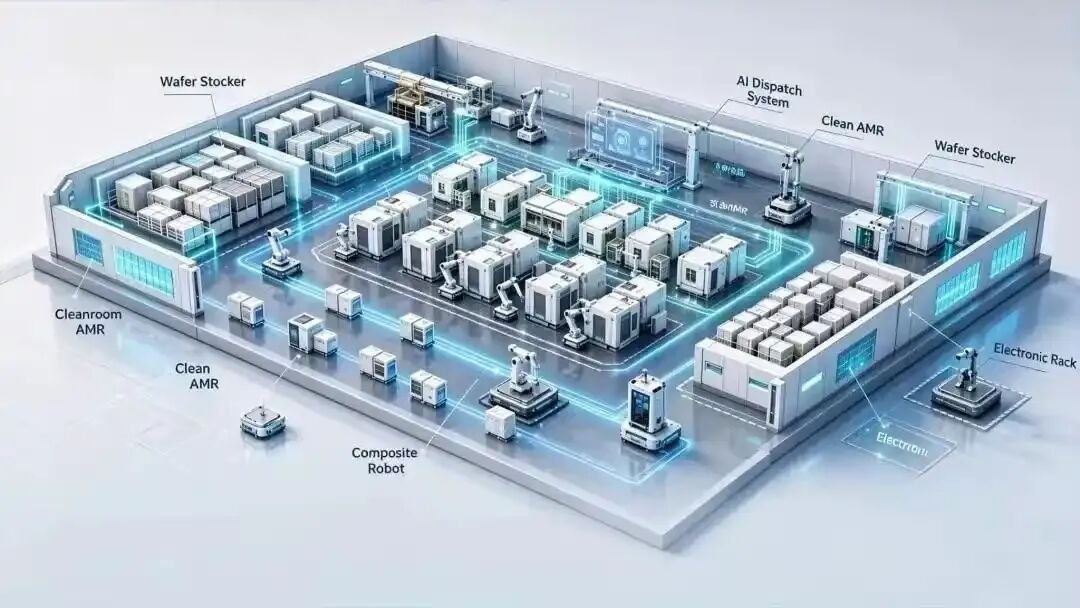
Limiaoda does not build general-purpose humanoids. It builds systems for the jobs inside semiconductor cleanrooms and laboratories that people cannot do, should not do, or cannot be paid enough to do: picking wafers out of one process tool and loading them into the next, moving cassettes between stages, and running the logistics that connects them.
The scope runs from wafer fabrication through packaging, testing and assembly, packaged with smart logistics so that a chip plant can approach a lights-out operation. The customer list includes Foxconn and Wistron on the electronics manufacturing side, where the same handling problem appears at lower specification.
The timing is not a coincidence. Micron’s expansion is running on a scale that forces suppliers to scale with it. Its new Singapore wafer fab carries a ten-year investment plan of about USD 24 billion. The New York megafab is budgeted at up to USD 100 billion. High-bandwidth memory capacity is being added in parallel. Every one of those buildings needs handling equipment that never gets tired, never introduces particles and never needs a shift change.
Why a newcomer got the order
The usual answer would be price. The more persuasive one is that the incumbent suppliers of cleanroom automation are not short of demand and are not built for the pace at which Chinese fabs are now being fitted out.
Limiaoda’s claim rests on vertical integration. It writes its own motion control algorithms, designs its own components, and layers an AI-for-science foundation model underneath, then delivers the whole thing as a system rather than a catalogue of parts. The company holds more than 200 patents and software copyrights.
It also arrived with a balance sheet that made the risk acceptable to a buyer. It raised an A+ round of more than RMB 100 million in March. The B rounds came this month. Capital has been added four times in twelve months, which for a hardware company selling into fabs is less about growth than about proving it can carry inventory and service obligations.
The founder’s three restarts
Liu Yusong took a master’s in finance from Southwest University in 2014 and went into quantitative analysis at a foreign bank. In 2015 he returned to Chongqing with RMB 1.2 million of seed money, then moved the business to Suzhou to build intelligent voice customer service. In 2021 he partnered with Yue Shiyi, who had spent more than 30 years in computer-aided drug discovery, and founded Limiaoda Pharmaceutical Technology to apply AI to drug development.
The 2025 pivot to robotics was less of a jump than it looks. The group behind it was assembled in December 2021 by a Zhejiang University PhD team and returning overseas researchers, so the technical base predates the robot company. Each of Liu’s restarts kept the same premise: take an expensive technique and make it serve a specific, unglamorous scene.
Suzhou was a deliberate choice for the same reason. The city holds three trillion-yuan industrial clusters in electronics, equipment manufacturing and new materials. The customers and the supply chain sit within driving distance of each other.
The market being priced
Frost and Sullivan expects China’s smart laboratory market to grow from RMB 10.7 billion in 2025 to RMB 61.8 billion by 2030. The lights-out laboratory sub-segment inside it is projected to climb from RMB 500 million to RMB 10.6 billion over the same period, a compound annual growth rate of 81.3 per cent.
The sector has already been given a separate valuation by public investors. Dana Tech holds 34.2 per cent of China’s lights-out laboratory market and has filed for a Hong Kong listing, marketed as the first AI-for-science stock.
The risks are worth stating plainly. The near RMB 1 billion figure is orders plus intent, not recognised revenue. The Micron number is cumulative rather than annual. Customer concentration is high, delivery has not been independently verified at scale, and the B3 round is still being signed. Penetration of smart laboratories in China remains below 5 per cent, which is an opportunity and also a measure of how early this is.
What the company has demonstrated is narrower and more durable than a funding headline. It showed that embodied AI does not have to start with a humanoid that walks. It can start with a job where the alternative is a person in a sealed suit, and where the buyer measures success in particles per cubic metre rather than in videos.
Editor’s note: This is an adapted translation of the original OFweek report. It has been trimmed and restructured for readability for an international business audience. The full original (in Chinese) is at https://robot.ofweek.com/2026-10/ART-8321202-12003-30709033.html.