Most embodied model launches come with a polished video: an arm performing a few clean motions, cut at the right moment. Poke Robotics did the opposite. It published RoboAPI, an embodied interface aimed at the physical world, and invited the whole industry to try it.
Alongside it came Poke-Aurora, the company’s own world-action model, and the first public output from a firm founded this year.
One prompt, and the arm works
The gesture targets the sorest point in the field. Robot model demos are impressive and almost unusable. A university lab that wants to run an open embodied model has to collect data, fine-tune, validate, collect more data, and loses a month in the loop.
Configuration is a wall of its own. Different arms carry different structures, sensors and control schemes, and changing any one of them can break a model. Even on a single machine, generalisation usually holds only for the objects and scenes seen in training.
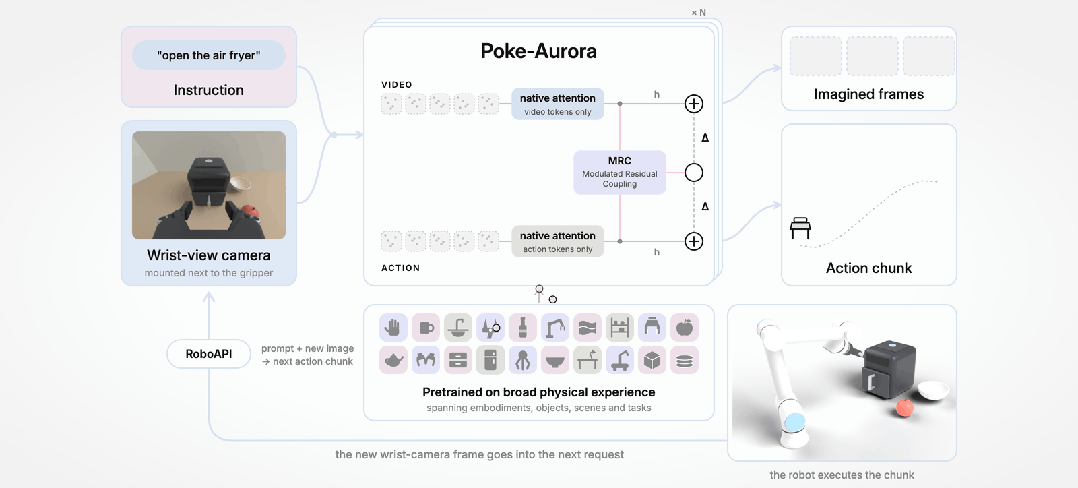
RoboAPI tries to remove both walls by packaging the model as an interface that can be called directly. According to the company, a developer connecting RoboAPI to a supported arm does not collect data or train a model. One prompt issues the instruction, and the arm completes an untrained task in an unfamiliar environment.
In Poke’s own large-scale evaluation, Poke-Aurora reached 86.0 per cent success on object transfer and tidying, 54.1 per cent on pose and shape alignment, and 87.7 per cent on environment interaction and tool use. The comparison set, GPT6 Astra and two open-source embodied models, all scored under 35 per cent.
To make the stack portable, Poke defined a wrist fisheye camera plus end-effector pose control configuration, inspired by UMI, anchoring observation and control at the gripper. That cuts the setup cost sharply. RoboAPI is free for non-commercial use.

The founder left a RMB 20 billion company to do this
Xu Huazhe is an assistant professor and doctoral supervisor at Tsinghua University’s Institute for Interdisciplinary Information Sciences, part of the group Chinese media calls the four who came back from Berkeley. He took his undergraduate degree at Tsinghua, his PhD at UC Berkeley and a postdoc at Stanford, then returned to work on general embodied intelligence. Before Poke he was co-founder and chief scientist at Galaxea, a humanoid company whose valuation passed RMB 20 billion on close to RMB 3 billion of cumulative funding.
He left at Galaxea’s peak with one thesis: general robots have to reach homes. In his view a robot only earns that right after being tested in enough real environments to survive their variety. RoboAPI is the first step in pushing the model into those environments.
The industry is handing the model to users
Turning models into APIs is becoming the default. In October alone, a startup spun out of Nvidia’s DreamZero team released a public robot foundation model API, and another US company launched a zero-shot API for dual-arm gripper robots. The routes differ and the direction does not: let users examine the model instead of watching a demo.
The same month brought a colder data point. An evaluation suite called AA-Robotics found that even GPT6 Astra, driving an arm directly, needed roughly half an hour per task while a human needs about 20 seconds. That is close to one per cent of human speed, and it argues for purpose-built embodied models over general ones.
How far is the kitchen
China has produced world-model startups in bulk. According to 36Kr, 23 were founded in seven months. Hot money and bubble talk arrived together, and while an industry certifies itself with edited video, the two are hard to separate.
An open API moves the authority to judge to the user, which at least creates an anchor that can be tested repeatedly. Xu’s own forecast is that a usable home robot will appear in China within two years, while full generalisation will not arrive quickly. Poke’s answer is to focus on ten things and do them properly.
The developer who connects to RoboAPI and files a bug report is doing more for that timeline than another launch video would.
Editor’s note: This is an adapted translation of the original OFweek report. It has been trimmed and restructured for readability for an international business audience. The full original (in Chinese) is at https://robot.ofweek.com/2026-10/ART-8321201-12003-30709565.html.