The embodied-intelligence industry does not lack robots that perform one beautiful demo. What it lacks is robots that repeat the same task ten thousand times in real scenes and stay stable and reliable. Running stably is not one single technology but a complete system covering perception, data, model and execution.
PaXini recently disclosed a 1 billion yuan strategic round, taking cumulative funding near 4 billion yuan. Backers span industrial capital, financial institutions, regional AI funds and market players. The lead includes a global consumer-electronics and semiconductor leader, by investor profile likely Samsung, plus Bank of China International, the Kunpeng fund and Hexin Fangce, with CDH Baifu, Chengdu Jiaozi AI fund, Jingming Capital and others joining and old shareholders adding more. At the same time PaXini moved its headquarters to Beijing and completed joint-stock reform. Together, these signal a shift from a technology firm to an industrial system able to deliver predictable robot capability at scale.
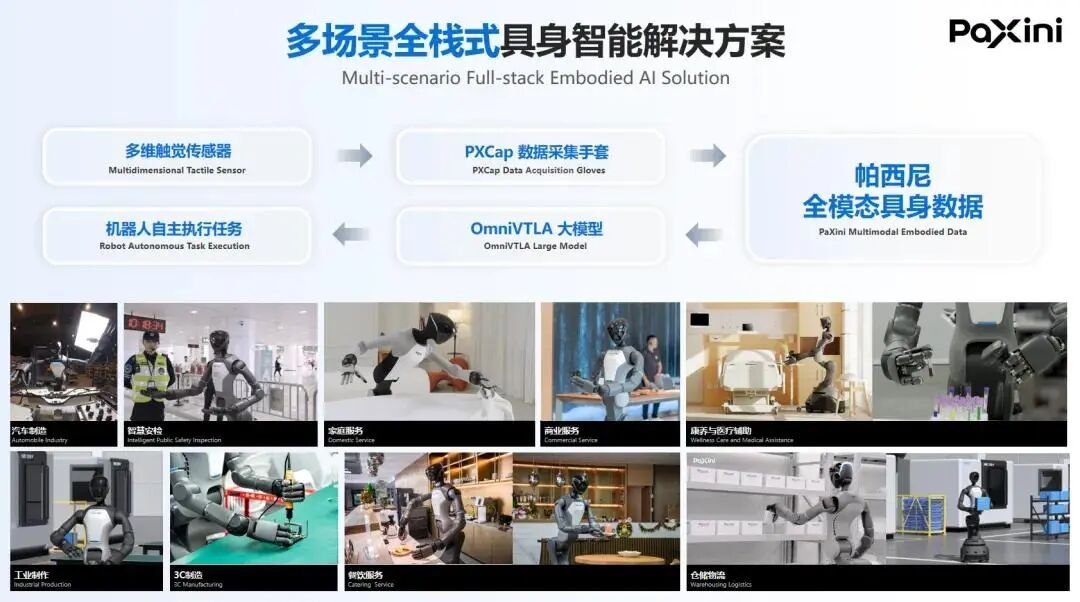
PaXini’s business already spans the full embodied chain: tactile sensing, full-modal data capture, dexterous hands and robot bodies, forming a complete perception-to-execution loop. This full-stack ability is exactly what the nearly 4 billion yuan backs: a system that moves robots from can do to can do it steadily.
The industry is entering failure pricing For years the easiest thing to spread was demo videos. Whether a robot can grab an egg, fold clothes or insert a part decided how fast a firm got attention. But in factories, warehouses and services, the customer’s question changes fast: how many times can an action repeat? Does it still work with different batches of material? If something goes wrong, does a human have to take over? One downtime, how long to recover?
Demo ability answers can the robot do it. Commercialisation answers can it keep doing it. The gap lives in physical contact. A robot can see a paper cup’s position and shape but cannot judge from one glance whether the wall is deforming or the liquid’s centre of gravity is shifting. It can plan an assembly path but may not know the bias load when parts touch. It may identify an object but drop it when friction changes.
These are not rare extremes but the norm of the physical world. In software, one error can be recalculated. In the real world, one robot error can mean damaged material, downtime, safety risk and human intervention, and cost amplifies fast. The commercial value of touch is precisely to send these contact changes back to the control system so the robot adjusts before failure.
Capital now watches a once-rare metric: per successful operation, what is the total cost, including depreciation, energy, deployment, calibration, failure, downtime and takeover. If touch cuts any one, its value can far exceed the sensor’s price.
What capital buys is not parameters but stable controllability. A robot hitting 99 per cent peak success is not commercially valuable if it only works with specific material, temperature and a specific debug engineer. Industry needs different devices, batches and times to converge, compressing result variance into a manageable range, what we can call the robot’s variance convergence. Accuracy decides whether it nears the right result, repeatability whether the same condition gives a near result, long-term stability whether the ability survives wear, temperature and repeated handling. Together they decide not a lab spec sheet but whether the customer can predict capacity, staff shifts and payback.
PaXini stresses sensors must understand the whole machine, essentially competing for predictability of the whole result. Understanding the whole machine means embedding mechanical structure, space, power, communication, control cycle and maintenance as constraints at design stage. How much data a sensor outputs is not the only point. what matters is whether the data arrives before the control window closes and drives the right next move.
Take PaXini’s PX-6AX GEN3 fingertip product: up to 717 channels of tactile signal, maximum 1,000 Hz output, IP68 protection and over 10 million measurement cycles. These figures come from PaXini’s lab and need real-model understanding. Their commercial value lies not in the numbers but in lower task variance, fewer takeovers and longer stable runtime. Capital buys not 717 channels but whether those signals make results more predictable.
Full-stack value is in assigning blame for failure Embodied firms love full-stack, but a long product line is not a moat and may bring scattered organisation and rising cost. Full-stack’s real value is explaining a failure. A failed grasp may come from sensor drift, wrong finger stiffness, misaligned tactile and joint data, slow controller or misunderstood contact state. Without unified coordination, a field fault becomes a long diagnosis where every module proves its output met spec yet the robot still fails, raising the customer’s hidden cost.
PaXini’s layout of tactile sensors, full-modal data, dexterous hands and bodies is worth watching not for product count but for whether it can decompose one failure along the whole chain: sensors record contact, the data system syncs touch, vision, joint state and trajectory, the actuator tests the control strategy, and after failure the firm can tell whether the problem was material, structure, calibration, communication, model or control, and fix it.
To capital this maps not to one product advantage but to learning speed: with each failure, does the firm leave reusable information. with each new scene, does deployment cost fall. with each batch shipped, does system stability rise. Long term these matter more than any single parameter.
Embodied firms are forming new physical data assets. Unlike language models fed by internet text or vision models by images, robots need data from real physical interaction. Tactile, motion and environment feedback cannot exist apart from hardware and task. The same object, operated by different sensing, end-effectors and control, yields very different data value. High-value data must record not just contact but the action process and task result, forming a complete interaction chain for model optimisation.
PaXini, through coordinated sensing devices, full-modal capture and robot terminals, keeps precipitating real-scene interaction into data assets for model training and capability optimisation. Public data shows that in the past year its self-developed tactile chips approached 1 million units consumed, and its full-modal data has been adopted by several embodied base-model firms and large internet-technology companies, showing its deployment and R&D entering a higher-frequency stage.
After nearly 4 billion yuan, PaXini enters scale-up. Funding size is neither technical proof nor early cash-out. With the 1 billion yuan strategic round, cumulative funding nears 4 billion yuan, the largest cumulative raise in global tactile sensing. Alongside funding, the Beijing HQ move and joint-stock reform matter more for collaboration density, as Beijing concentrates model, robot, research and application resources, shortening cross-organisation verification. Joint-stock reform signals a shift from founder-dependent startup to institutionally governed industrial entity.
Images
Editor’s note: This is an adapted translation of the original OFweek report. It has been trimmed and restructured for readability for an international business audience.