The embodied-intelligence industry does not lack robots that can deliver one pretty demo. What it lacks is robots that can repeat the same task ten thousand times in a real setting and still come back stable and reliable.
PaXini has disclosed a RMB 1 billion strategic round, lifting its cumulative funding to nearly RMB 4 billion. The investor line-up spans industrial capital, financial institutions, a regional artificial-intelligence fund and market players. The lead is read as a global consumer-electronics and semiconductor leader widely taken to be Samsung, joined by BOC International, the Kunpeng fund and others, with returning backers such as Zhilai Capital adding more. At the same time the company moved its headquarters to Beijing and converted to a joint-stock structure. Three moves at once say the firm has grown from a technology shop into an industrial system that can deliver predictable robot capability at scale.
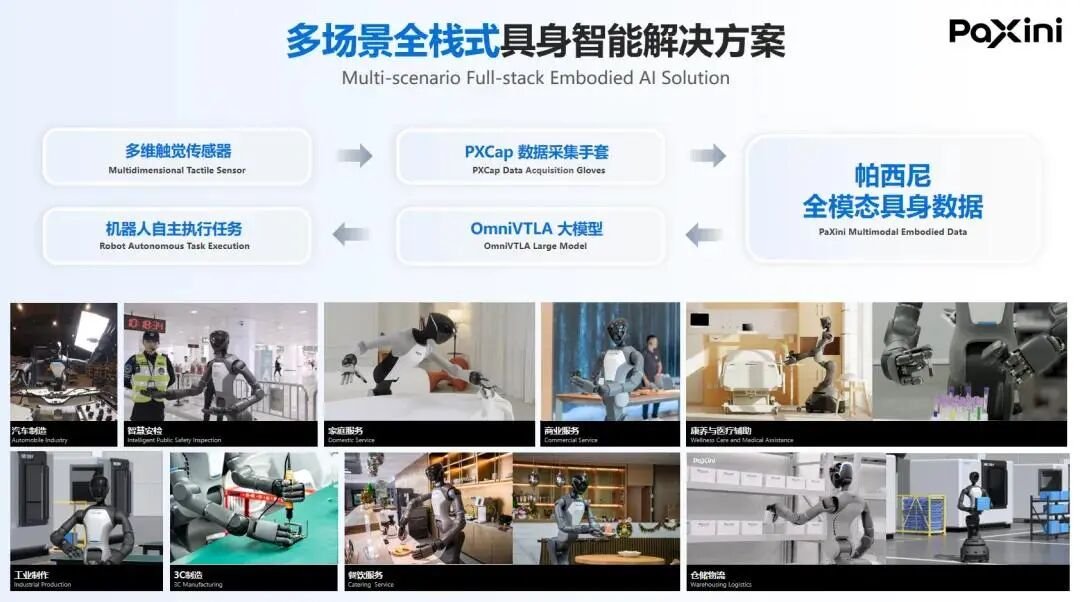
PaXini long ago spanned the whole embodied chain, building tactile sensing, full-modal data capture, dexterous hands and robot bodies into one loop from perception to execution. That stack is exactly what nearly RMB 4 billion is betting on, a system that takes a robot from “can do it” to “does it steadily”.
Embodied intelligence enters the failure-pricing stage
For years the easiest thing to spread was the demo video. Whether a robot can grab an egg, fold clothes or insert a part decides how fast a company wins attention. But inside factories, warehouses and service sites the customer’s question changes at once: how many times can one action run without stopping? Does it still work on a different batch of material? When something goes wrong, does a human have to take over? After one shutdown, how long to recover?
The demo answers “can the robot do it”. Commercialisation answers “can it keep doing it”. The gap lives in physical contact. A robot can see a paper cup’s position and shape, yet cannot judge from one glance whether the wall is deforming or the liquid is shifting. It can plan an assembly path yet may not know the bias a part develops on contact. It can recognise an object and still drop it when friction changes.
None of this is a rare edge case. It is the norm of the physical world. In software, one error means recompute. In a real robot, one error means damaged material, stopped equipment, safety risk and a human in the loop. Once error enters the physical world, cost compounds fast.
The business value of touch is precisely to send those contact changes back into the control system so the robot adjusts before it fails. Capital has started to watch a metric rarely priced alone: per successful operation, what is the total cost a robot truly pays, including depreciation, energy, commissioning, calibration, failure, downtime and takeover. If touch cuts any one of those, its value can far exceed the sensor’s purchase price.
Capital buys not specs but stable control
A robot that hits 99 per cent peak success on one task is not yet commercial. If that result needs one specific material, one temperature and one named engineer, the customer still cannot put it in a production plan. Industry needs performance across different machines, batches and times to converge, the variance compressed into a manageable band. Call it the robot’s variance convergence.
Accuracy decides whether the robot reaches the right result. Repeatability decides whether the same conditions give the same result. Long-term stability decides whether the ability survives wear, temperature drift and repeated handling. Together they decide not a lab spec sheet but whether the customer can forecast output, staff the line and price the payback.
PaXini argues a sensor must “understand the whole machine”, which is really a fight for predictability of the final result. “Understand the whole machine” does not mean the sensor thinks for itself. It means design folds in the mechanism, space, power, communication, control cycle and maintenance from the start. How much data a sensor emits is not the only point. What matters is whether the data arrives before the control window shuts and pushes the robot to the right next move.
Tactile tech splits into optical, capacitive, piezoresistive and magnetic paths, each with its own fit and limits. The commercial result is not decided by which concept ranks higher but by who best balances information density, response speed, size, durability and deployment cost in a given scene. Take PaXini’s PX-6AX GEN3 fingertip: the firm says it supports up to 717 tactile channels, a top output rate of 1000 Hz, IP68 protection and over 10 million measurement cycles. Those figures come from PaXini’s lab and must be read against the exact model and real duty.
Whether those numbers become commercial value depends in the end not on the digits but on lower task variance, fewer human takeovers and longer stable runtime. What capital truly buys is not “717 channels”. It is a robot whose result you can forecast.
Editor’s note: This is an adapted translation of the original OFweek Robot report. It has been trimmed and restructured for readability for an international business audience.