If past years of embodied intelligence were a contest of single-point skills, the clear signal from this year’s World Robot Conference is that competition is moving from one breakthrough to the completeness of a system. Sensors, dexterous hands and data still matter, but a robot that enters a factory, warehouse or home meets shifting position, deformation, occlusion and human interference. No single skill guarantees the task.

That makes full-stack the direction worth watching. Its value is cutting information loss between stages: can sensor data train the model directly, can the model’s policy reach the controls, can the robot’s new data flow back. At WRC, PaXini showed a vertical chain of hardware sensing, data capture, model training and scenario landing, a closed loop built around physical interaction.
Full-stack sensing as a human-like sense
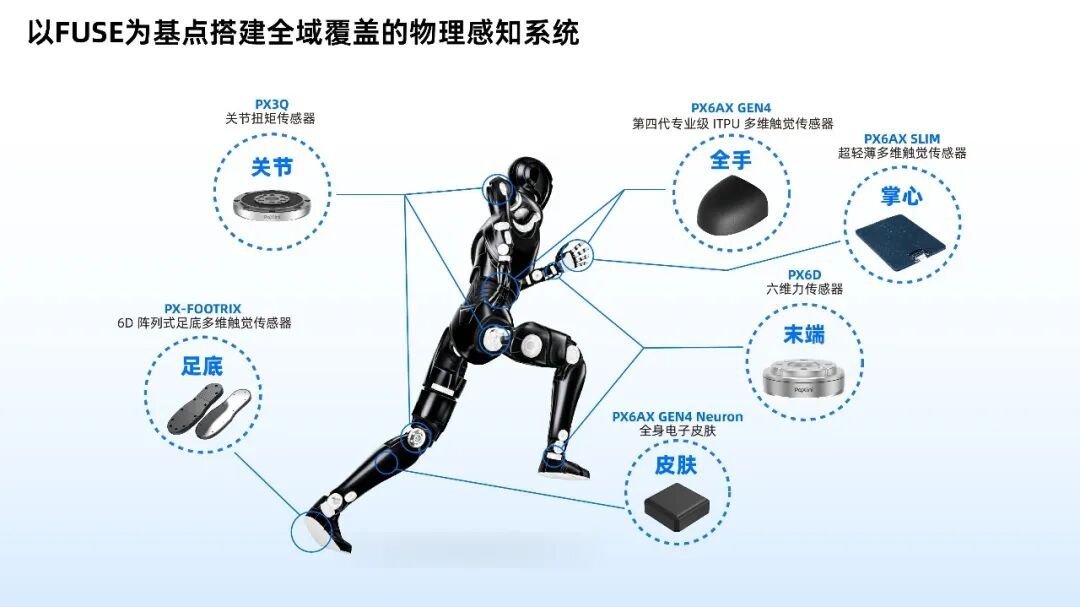
PaXini launched its fourth-generation GEN4 multi-dimensional tactile sensor family, with a self-developed GEN4 native true 6D tactile chip called FUSE, upgrading Elite, Core and Omega lines and adding three forms: the Superior flagship sensing unit, Neuron full-body electronic skin and a Gripper sensing module, for high-precision touch, whole-body coverage and industrial end-effector sensing. Neuron skin uses thin sensing cells and flexible wiring to fit arms, legs, shoulders and torso; PaXini offers 19 sensor sizes, extending touch from fingertips and palms to the body surface.
It also released the world’s first PX-FOOTRIX in-sole multi-dimensional tactile sensor, giving robots new foot feedback. Built on 6D array sensing with dense points and high-frequency sampling, it outputs both the three-axis force map of each foot region and overall six-axis force and torque. Vision can spot a step or slope ahead but cannot judge softness, friction or support before landing; a traditional end-force sensor measures total foot force but not the load map. PX-FOOTRIX supplies the after-landing physical feedback that tunes step, centre of mass and gait.
PaXini’s whole-body perception is not only skin. The PX3Q joint torque sensor reads joint torque change; the PX6D six-axis force sensor measures arm-end force and torque, sharpening force control. The covered, high-precision human-like scheme closes the full physical-sensing loop and underpins the later data and model stages.
Real data breaks the bottleneck
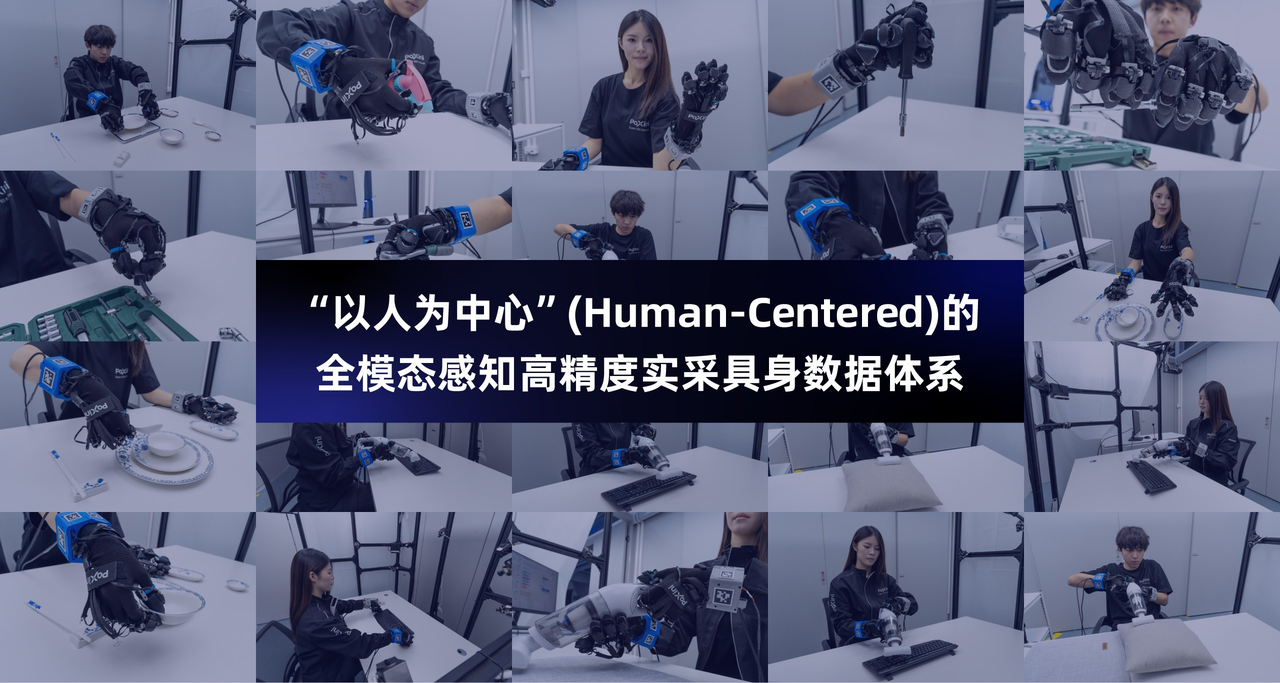
Sensing hardware answers where data comes from; the harder question is what data trains a model. Models from simulation or public sets often fail real physical interaction. PaXini’s Human-Centered full-modal high-precision real-capture system, built on whole-hand blind-spot-free tactile capture plus spatial vision and a Neural Mesh, fixes the incoordination of tele-op data and the sim-to-real gap. The new five-finger capture glove PXCap Pro is the main entry, fusing touch, vision and joint pose into consistent ground-truth data. Standardised and in-the-wild capture together build scaled supply of embodied data.
Closed-loop iteration gives robots generalisation
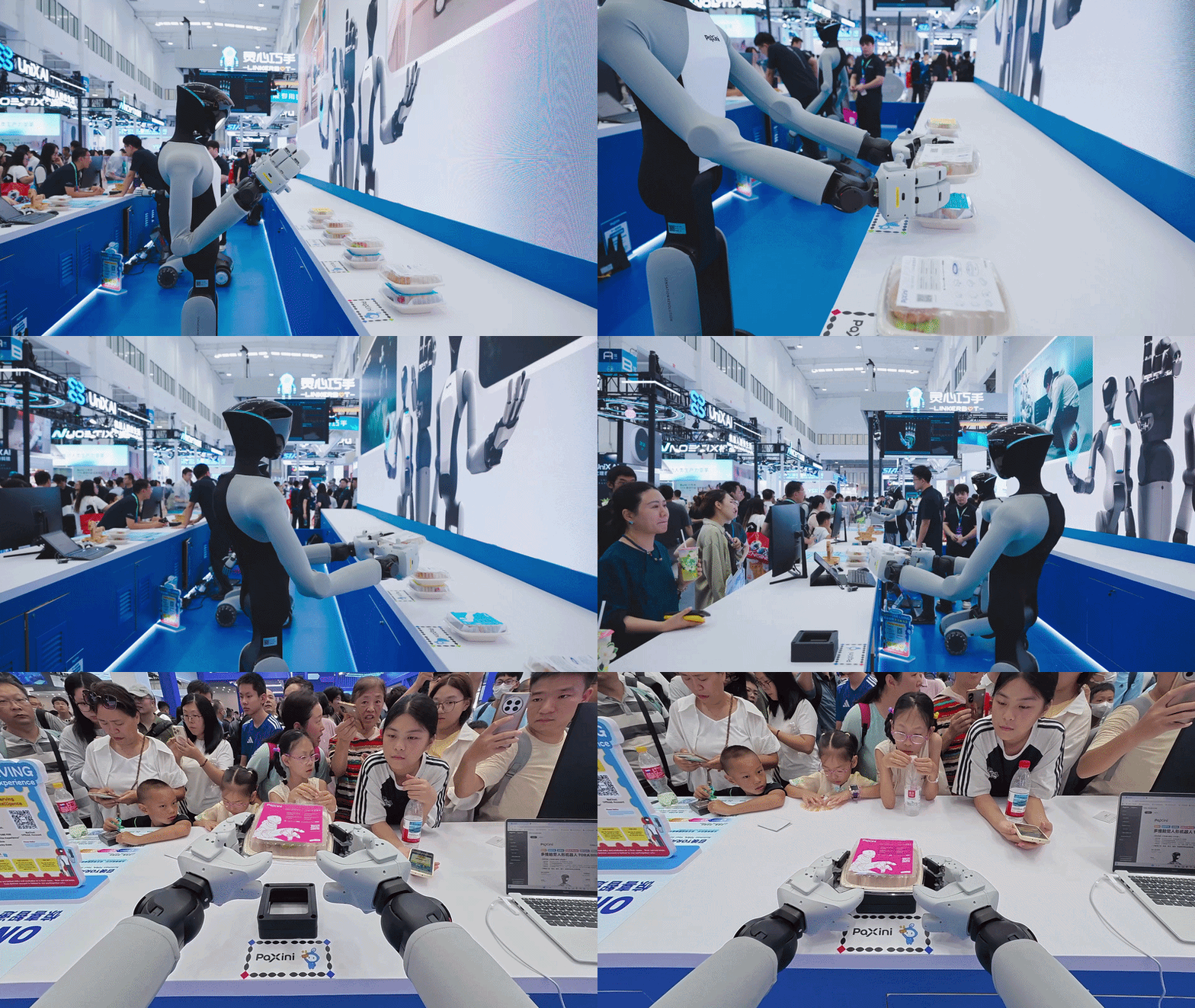
Sensors and data do not become capability by themselves. From tens of billions of tactile core data points, PaXini trains its OmniVTLA embodied model. At WRC, the TORA robot completed a full unattended task: a visitor drew a prize, the system issued the command, the robot planned the best path and delivered the box with fine manipulation, all fluid. PaXini humanoids have been tested at logistics, 3C electronics, vehicle plants and rail transit.
The iteration flywheel then runs: data improves the model, the model defines the body, the body produces real data. Every job a last-generation robot does becomes fuel for the next. On 19 August, PaXini hosted GEEN 2026, its global embodied ecosystem night, to link research, supply, scenario and capital.
More images from the source report:
Editor’s note: This is an adapted translation of the original OFweek Robotics report. It has been trimmed and restructured for readability for an international business audience.
Translated and adapted from OFweek Robotics (https://robot.ofweek.com/2026-08/ART-898890-8120-30699603.html).