Capital has decided that embodied AI is a data problem. The data says the industry is roughly where language models sat before GPT-3.
Dealroom’s October update counts 11 billion US dollars of venture funding into embodied AI startups in 2026, more than double the whole of 2025. The World Robot Conference in Beijing in August drew 373 exhibitors and 557,000 visitors over five days, double last year’s attendance.
The operating numbers are less impressive. IDC counted just over 18,000 humanoid units shipped worldwide in 2025. More than 85 per cent went to entertainment, education and research, data collection, and guided tours. Machines doing production work in factories and logistics remain a small minority.
From 270,000 hours to 500,000
In November 2025, Generalist AI released GEN-0, pretrained on more than 270,000 hours of real physical interaction data. The most-cited open dataset at the time, Open X-Embodiment, held about 6,000 hours. GEN-0 carried nearly fifty times more.
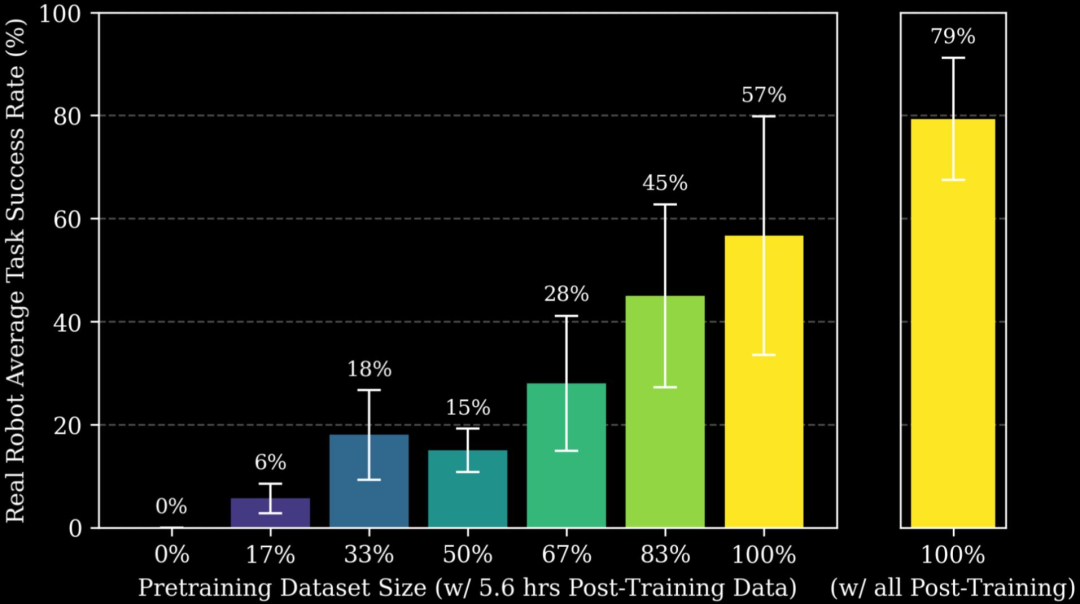
Five months later GEN-1 pushed the dataset to 500,000 hours. Task success moved from 64 per cent to 99 per cent, and the model executed three times faster. More importantly, it began to show cross-scene generalisation and autonomous error correction.
In August 2026 Generalist shipped GEN-1.5. After more than eight months of continuous pretraining the model started to behave like a language model doing in-context learning: shown a three to twelve second demonstration, it attempts a new task without any parameter update. Generalist calls it physical prompting.
Why 500,000 hours is GPT-2
Put the number against a human lifetime. Read 200 to 300 English words a minute for twelve hours a day across eighty years and you cover roughly 6.7 to 10.1 billion tokens. GPT-2 trained on about ten billion tokens. The two are the same order of magnitude.
Do the same for observation. Watch and learn from the physical world twelve hours a day for eighty years and you accumulate about 350,000 hours. GEN-1’s 500,000 hours is 1.43 times one human lifetime of observation.
The comparison is about data volume, not capability. But the volume trajectory is the point. GPT-3 used 300 billion tokens, about thirty times GPT-2. If embodied models need a similar expansion, the next stage from 500,000 hours is 15 million hours.
And volume is not the only constraint. A robot has to learn not just what it saw but how much force it applied and what that force produced. Take unscrewing a bottle cap. Most of the trajectory is moving, aligning and adjusting posture. What decides success is the force at the moment of contact, the correction after a slip, and the retry after a failure. Those moments are a small share of the recording and carry most of the learning signal.
Three ways to collect, one conversion problem
Robot data, recorded by teleoperation, matches the target hardware directly and suits fine manipulation. Tesla, Figure AI and AgiBot have all used it. It also depends on machines, operators and floor space, which makes it expensive and slow to scale to tens of millions of hours.
Human data, collected without a robot, uses handheld grippers and data gloves to record first-person video alongside hand or tool motion. Stanford and partners proposed the UMI approach in 2024. Sunday Robotics pushed it toward scale, recruiting what it calls memory developers to wear custom gloves doing housework at home. The company says it has close to ten million task trajectories and has trained ACT-1, the base model behind its home robot Memo. Generalist’s 500,000 hours came largely from wearable collection.
Ego video, first-person footage of humans, offers the largest scale. Nvidia’s EgoScale used more than 20,000 hours. In August 2026 Dyna Robotics released Dyna-2, expanding pretraining past one million hours. The hard part is that video carries no directly executable action signal. The model has to infer intent from pixels and map it onto control commands.
The pattern among leading labs is converging: pretrain on large human datasets, then adapt with a small amount of real robot data. The recipe ratios differ widely and no standard has emerged.
The data nobody recorded: contact
All three routes leave one category uncovered. Force and touch during contact decide many fine manipulation outcomes, and cameras cannot see them. The internet taught language models language. It never recorded how hard a person turns a cap, how cloth slides when a towel is folded, or at what angle a cup spills.
The experiments are starting to quantify the gap. In 2026 Panasonic, working with Berkeley and Nvidia, introduced T-Rex, which adds fingertip touch to a robot action model. Across twelve fine tasks including bulb screwing and page turning, average success reached 65 per cent. Remove the tactile input and it fell to 42 per cent.
Contact data is harder to scale than video because it needs sensors, synchronisation, calibration and cross-device adaptation. Three companies in the latest YC F26 batch attack it from different angles. Axonnic uses forearm EMG sleeves to reconstruct finger motion and fingertip force even when the hands are occluded, aimed at sewing and precision assembly. Hemlock uses a wrist band that reads muscle signals and pairs them with first-person video, leaving both hands free. Preload combines camera, tactile glove and EMG in one rig.
Who gets paid for the data
Three business models are forming. Data production networks own scenes, labour and collection capacity. Build AI collects first-person data inside real factories across textiles, precision manufacturing and repair, selling datasets and custom collection. XDOF builds low-cost dual-arm teleoperation rigs; its ABC-130K dataset, released in June 2026, holds more than 130,000 trajectories, roughly 3,500 hours of real interaction and nearly 200 dual-arm task types. Human Archive works through service networks in housekeeping, hotels and catering. JD.com plans to mobilise up to 600,000 people to accumulate ten million hours of real-scene video inside two years.
Deployment flywheels own operating robots and turn runtime into training data. Ambi Robotics has handled more than 150 million parcels in US warehouses, accumulating over 250,000 hours of production data, and trained PRIME-1 on it before productising an AI Skill Suite for automation partners. In November 2026 Serve Robotics launched Physical AI Services on the back of more than 2,000 deployed machines, selling access to operational data, anomaly screening tools and robot connectivity.
Processing and infrastructure turns raw capture into trainable, evaluable assets. Encord and Foxglove came at it from multimodal labelling and robot data observability. Nomadic AI uses models to search large multimodal corpora for rare scenes, model failures and coverage gaps. Roboto embeds into the development workflow, unifying video, sensor and system logs and using agents to locate faults and cut the relevant segments into training data.
None of these companies has settled format, action space or evaluation method. Until that standardises, the value question stays open. Eleven billion dollars of annual capital will eventually be tested by something blunt: can the machine hold a shift on its own, for eight hours, without an engineer standing beside it, recover from surprises, and repeat the same work tomorrow?
That test is far less spectacular than a backflip. It is also the only one that separates a data barrier from a data pile.
Editor’s note: This is an adapted translation of the original OFweek report. It has been trimmed and restructured for readability for an international business audience. The full original (in Chinese) is at https://robot.ofweek.com/2026-11/ART-8321205-12003-30711702.html.