1. The Ranking
2. Three Signals
Signal 1
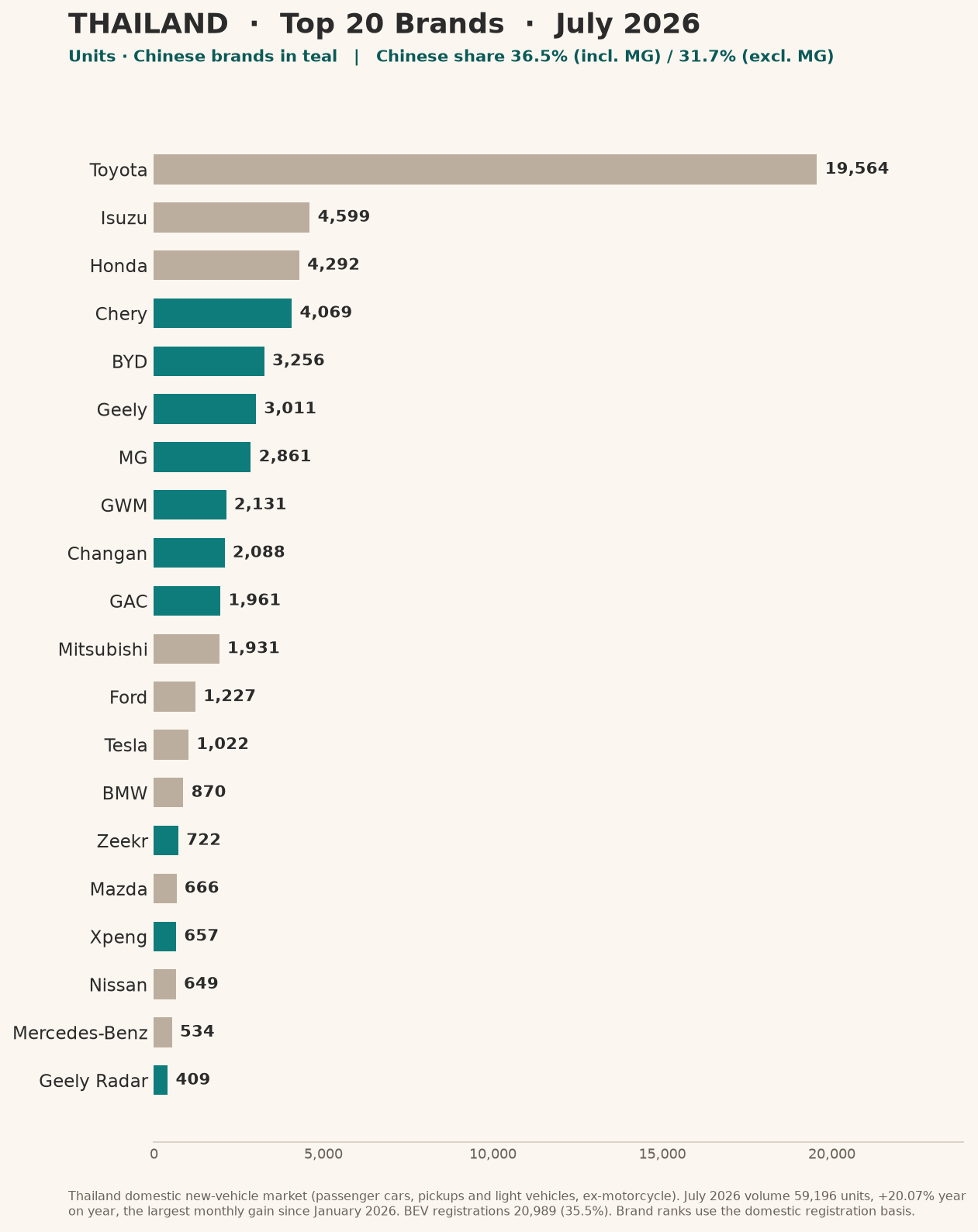
- Fact: Chinese brands took 36.5% of Thailand’s auto market in July 2026 (31.7% excluding MG), the highest share on record.
- Read: The block now fills every rank from four to nine, and it did that in a month Toyota alone took a third of the market.
Signal 2
- Fact: Three Chinese names passed 3,000 units in July: Omoda & Jaecoo 3,291, BYD 3,178 and Geely 3,011, against Honda’s 4,292 in third.
- Read: Chery’s sub-badge strategy and Geely’s multi-brand spread now out-sell most legacy marques on their own, and the bench behind them keeps widening.
Signal 3
- Fact: BEVs took 35.5% of July registrations (20,989 units, up 122%), and Chinese brands built 91.9% of the battery-electric passenger cars registered.
- Read: Thailand has handed the electric passenger segment to China and kept the pickups for itself.
3. The Take
Thailand in July was two markets sharing one road. Toyota sold 19,564 cars and took roughly a third of everything registered, with Isuzu on 4,599 and Honda on 4,292 behind it. The Japanese podium held. Everything below it did not.
Ranks four through nine were Chinese. Omoda & Jaecoo led the block on 3,291, BYD followed on 3,178, then Geely 3,011, MG 2,861, GWM 2,131 and GAC Aion 1,961. Six Chinese badges inside the top ten, 21,730 units between them, 36.5% of the market and 31.7% if MG is set aside. A year ago that block was a collection of challengers. It is now the second estate of the Thai market.
The electric layer shows where the rest goes. BEVs took 20,989 registrations, 35.5% of the month and up 122%, and Chinese brands built 91.9% of the battery-electric passenger cars delivered. That is close to a monopoly on the fastest-growing part of the market, and it arrived before the plants did.
Which is the real story of the Thai month. Of the 125,411 BEVs registered in the first seven months, only 46,924 were built in Thailand. Bangkok’s EV3.5 rules now require one locally built car for every two imported in 2026, rising to one for every three in 2027, and imported cells stopped counting toward localisation on 30 June. Toyota’s local arm has already asked the government to revisit the tax balance.
So the question is no longer whether Chinese brands can sell here. They sell 36.5% of the market and nine in ten of its electric cars. The question is whether the factories arrive before the policy does.
4. Sources
- Source: Thai DLT new vehicle registrations.
- Published: 2026-08-05.
- Cross-checked: Yiche (易车) / sina.cn / 163.com / 芝能汽车 monthly brand table.
- Basis: Thailand domestic new-vehicle market (passenger cars, pickups and light vehicles, ex-motorcycle). July 2026 volume 59,196 units, +20.07% year on year, the largest monthly gain since January 2026. BEV registrations 20,989 (35.5%). Brand ranks use the domestic registration basis.
- FTI July 2026 domestic sales: 59,196 units, +20.07% YoY; July BEV registrations 20,989 (+122.08%); Jan-Jul 406,162 (+15.39%). Reported via FX.co and 163.com/toutiao summaries of the FTI release.
- Brand table (top 40): 芝能汽车 Thailand July 2026 brand registration ranking; reproduced by sina.cn/news/detail/5336577295257764 and 163.com monthly ranking. Top 10: Toyota 19,564 / Isuzu 4,599 / Honda 4,292 / Omoda&Jaecoo 3,291 / BYD 3,178 / Geely 3,011 / MG 2,861 / GWM 2,131 / GAC Aion 1,961 / Mitsubishi 1,931.
- Chinese brands combined: about 21,730 units in July, six of them inside the top ten.
- Discrepancy noted: one 163.com/toutiao recap lists GWM at 2,509 while the 芝能/sina table lists 2,131. RobotBelt uses 2,131, the figure appearing in both the 芝能 top-10 table and the sina full list.
- Group view: Chery group 4,069 (Omoda&Jaecoo 3,291 + Chery 778); Geely group 4,239 (incl. Zeekr 722 and Geely Radar 409); SAIC 3,065 (MG 2,861 + Wuling 204); BYD 3,256 (incl. Denza 78).