The Shenzhen Natural History Museum — the largest comprehensive natural history museum in South China — opened its doors on July 28, displaying 7,461 rare specimens across eight themed halls that trace 4.6 billion years of life on Earth.
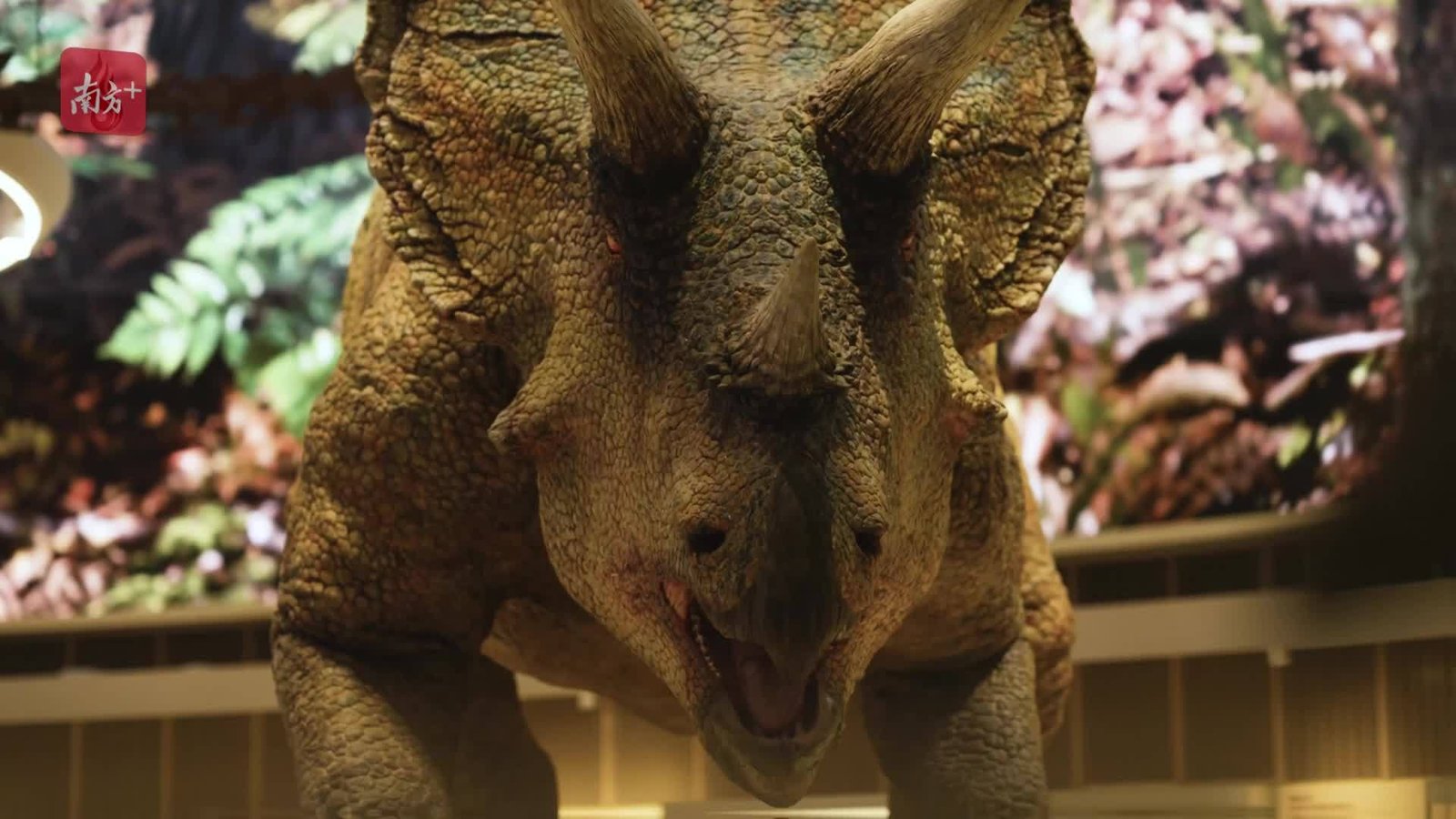
But the exhibits everyone talked about on opening day weren’t fossils. Among thousands of static displays, only two items were “alive”: a Tyrannosaurus rex and a Triceratops, both built by Shenzhen-based robotics company Dobot. It marks the first public deployment of ultra-large embodied-AI bionic dinosaurs in China.
The two creatures reach film-grade realism — visible skin texture, even the faint pulse of subdermal vessels. When visitors approach, the T. rex turns its head warily, its pupils contracting with light changes, a low warning rumble in its throat. The Triceratops adjusts its posture to the surrounding environment and exchanges glances with its companion. They breathe, blink, and tire.
The engineering difference matters. Traditional animatronic dinosaurs replay pre-scripted motion loops, with no perception of their environment. Dobot’s creatures run a full “perception–understanding–decision–action” loop: multimodal sensors capture crowd positions, sounds and movements in real time; an onboard decision model generates behaviour consistent with the species’ habits; and a precision motion-control system renders it naturally. Every head turn and growl is an autonomous response to the moment, not a playback track.
This is not Dobot’s first bionic creature. The company has previously deployed a self-walking Sinoceratops at China Dinosaur Park and a hatchling incubator exhibit at a Shanghai dinosaur venue. The Shenzhen museum installation is its largest and most interactive project to date — and a signal that large-scale embodied bionic creatures are entering public cultural institutions.
While most of the global robotics industry crowds into the humanoid race, Dobot is running a parallel bet: embodied intelligence means giving AI a physical body that interacts with the real world — and humanoid is not the only valid form factor. The company’s product matrix now spans four tracks: collaborative robots, humanoid robots, multi-legged robots, and super-bionic creatures, all sharing a common technology platform. Different bodies, one brain.
For museums, the implication is a shift in exhibition logic — from viewing static specimens to interacting with animated life. For Dobot, cultural and tourism venues offer something more valuable than ticket revenue: real-world training grounds for embodied-AI iteration.
Read the original report (Shenzhen News Network)
*Translated and adapted from Shenzhen News Network (https://www.sznews.com/news/content/2026-07/29/content_32135781.htm).*