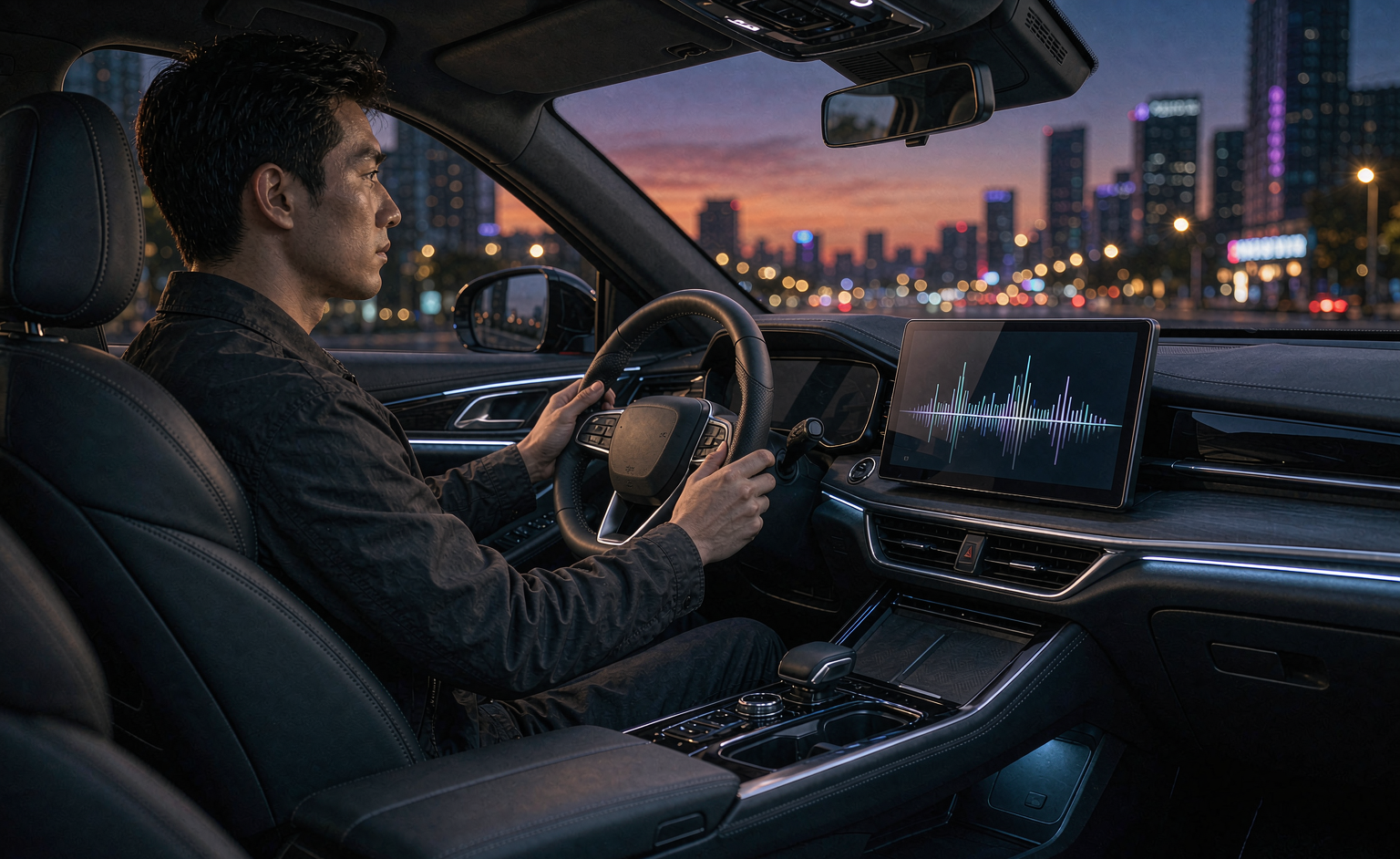
Smart cockpit penetration in China reached 87.5 per cent of passenger cars in August. Screens and voice assistants are now standard equipment, which means they no longer differentiate anything. The competitive ground has moved to whether the assistant can actually finish a task.
The gap between installed and used
Industry surveys say 84 per cent of respondents want a proactive in-car partner, and 64.1 per cent of electric vehicle owners list service as a main reason for choosing their car. The same owners stop using what they were sold. J.D. Power’s 2026 study found that 48 per cent of complaints about advanced vehicle features concern instability or inaccuracy, and its 2025 work found 56.5 per cent of users had deliberately cut their use of AI vehicle controls over reliability and safety concerns.
The failure is not conversational quality. Most assistants can report weather and play music. The break comes when a task crosses systems: planning a trip, paying for parking, booking a table. At that point the driver reaches for a phone, which is the only honest verdict on the product.
What Tencent built
At its 2026 global digital ecosystem conference, Tencent Cloud showed an upgraded TAI agent stack in four parts: a cockpit assistant, a mobility services agent, a content and entertainment agent, and a cross-device continuity service.
The cockpit assistant combines Yuanbao’s full-duplex speech model, Yuanbao search and the Hunyuan model. Search supplies the grounding, so answers carry a source rather than a plausible guess, and cross-device memory lets the assistant carry context between the car, the phone and the home.
The mobility agent is the commercially interesting piece. It connects Tencent Maps, WeChat mini programs and WeChat Pay, so a driver can book a hotel, buy a ticket, adjust an itinerary or place a restaurant reservation by voice. Tencent is explicit that the payment leg is a closed loop rather than a link out to a payment page.
The continuity service pushes the same assistant into the Yuanbao app, Xiaowei and Tencent Maps, so a destination chosen at home is already in the car and a parking payment made in the car is visible on the phone afterwards.
Why the payment leg matters more than the model
An assistant that can transact becomes a distribution channel. An assistant that can only converse remains a feature on a spec sheet, and spec sheets stopped selling cockpits years ago at 87.5 per cent penetration.
That is also where the risk sits. Voice-initiated payments inside a moving vehicle raise questions Chinese regulators have not finished answering, and an assistant that books the wrong hotel or pays the wrong amount is a liability event rather than a bad user experience. Tencent’s answer is grounding through search and confirmation steps, which is the right architecture but not a guarantee.
For automakers the calculation is uncomfortable. Building an equivalent stack in house means replicating a payments network, a map stack and a mini-program ecosystem, none of which any Chinese carmaker owns. Buying it means the most valuable customer interaction in the vehicle belongs to a supplier.
The cockpit stopped being a hardware category when penetration passed 87 per cent. It is now a payments and services business with a screen attached, and the companies that own the payment rails are setting the terms.
Editor’s note: This is an adapted translation of the original Chedongxi report. It has been trimmed and restructured for readability for an international business audience. The full original (in Chinese) is at https://chedongxi.com/p/379080.html.