At the end of June, Musk signed off on the latest Optimus. After more than three years and three internal versions, code-named Alpha, Beta and C, the third-generation machine is finally moving from lab to line.
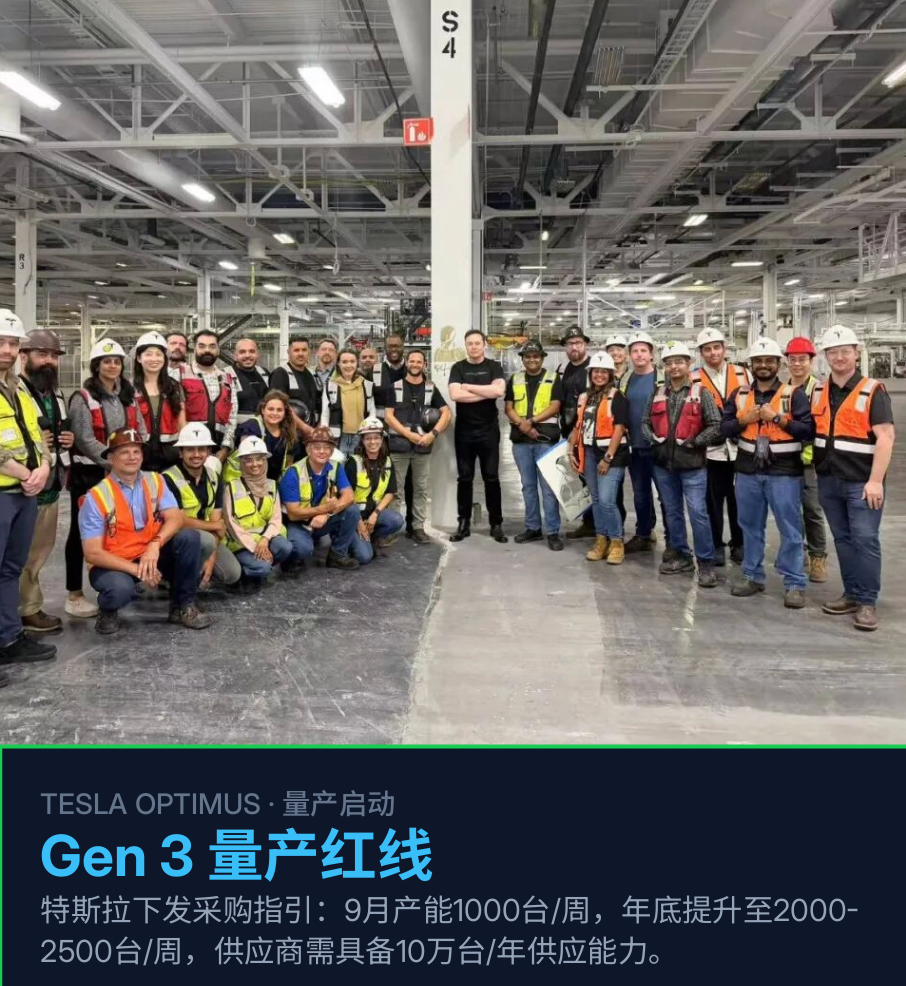
Supply-chain targets leaked via LatePost set the bar: 1,000 units a week by September, 2,000 to 2,500 a week by year end, and parts supply for 100,000 units a year. Musk himself says this year’s volume is hard to predict precisely, but he has given an ultimatum that the Optimus sourcing team gets replaced if the year-end target misses.
For suppliers who have followed Tesla for nearly four years, that no-exit stance signals he means it. Tesla sent its first part-buying guidance to suppliers, placed orders two months early, and hundreds of units were already visible as August orders.
Gen 3 pushes actuator integration higher. Key actuators are about 10 per cent smaller than the last generation, and the frame is slimmer than most full-size humanoids. Body freedom reaches 38, with 22 rotary and 16 linear joints, and 22 degrees of freedom in each hand. The hands add tactile sensors and gloves, and the head module is being redesigned.
The honesty gap is real. Tesla has fallen behind Chinese rivals on volume. Unitree shipped over 6,500 units in 2025, and AgiBot passed 10,000 units by late March. TrendForce sees China’s humanoid output jumping about 94 per cent in 2026, with Unitree and AgiBot taking roughly 80 per cent of the share.
Optimus has no clear external sale plan yet, so every unit built is capital spend, unlike some Chinese firms that convert related-party deals into revenue. Tesla is preparing small-batch production in the third quarter, with Fremont retooled for robots and a second Texas plant underway, long-term capacity planned at 1 million, then 10 million.
The harder truth sits in the engineering: joint life is capped at about 8,000 hours for reducers and shorter for roller screws, so under an eight-hour day a unit wears out in under three years and must be rebuilt. That grind, more than any demo, is what has pushed the timeline.
Editor’s note: This is an adapted translation of the original OFweek report. It has been trimmed and restructured for readability for an international business audience. Source: OFweek.