On 21 September, word that Tesla’s robot team had flown to Ningbo to audit factories lit another fire under China’s embodied-AI race. The visit was not a courtesy call. Suppliers including Tuopu Group, Sanhua Intelligent and Joyson Electronics had already taken humanoid-robot orders for joint modules, actuators and precision structures, and the audit was a last quality and compliance gate before volume production.
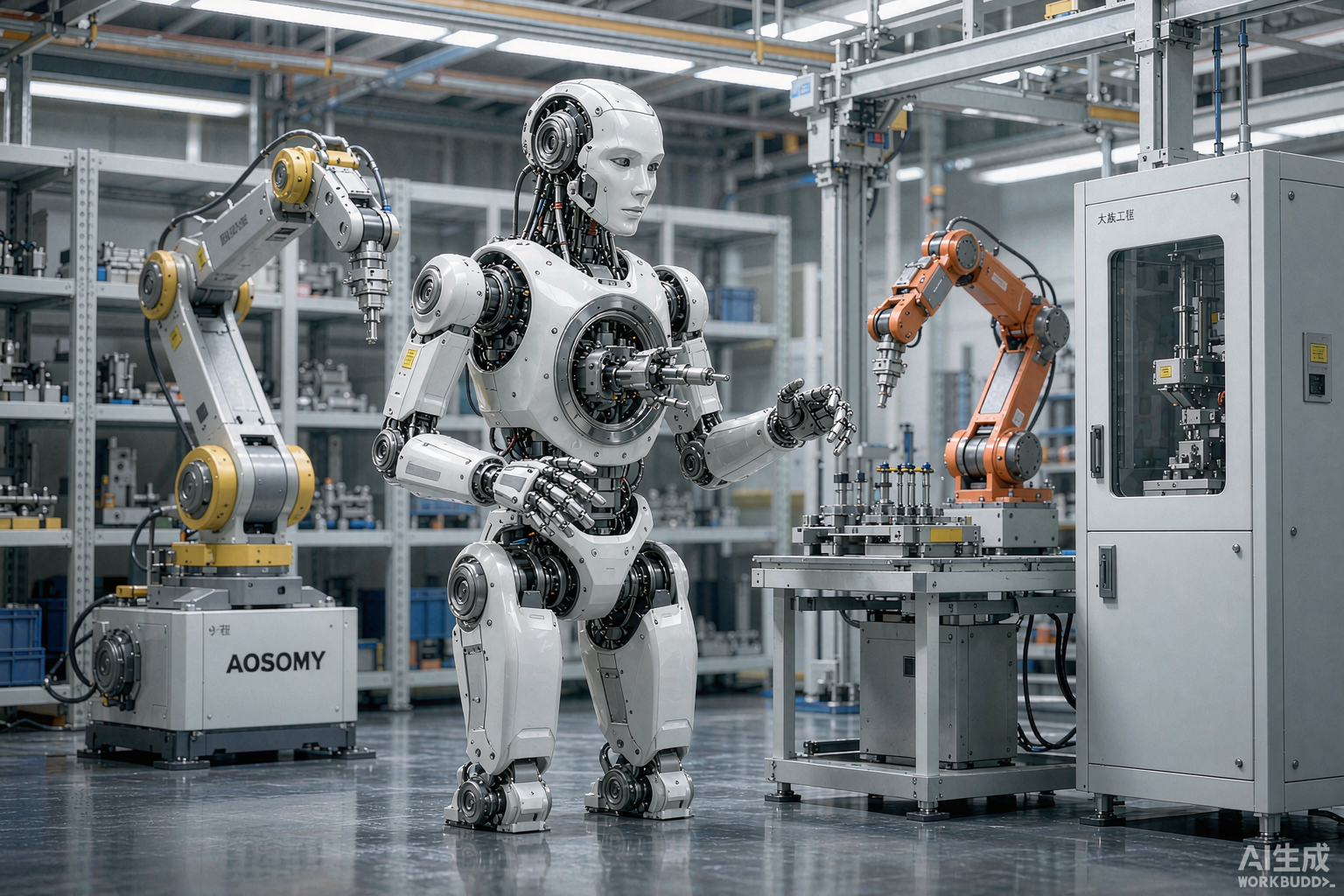
What makes the moment worth watching is the lineage. All three firms were Tesla’s car suppliers first. Strip a humanoid down and the precision structures, actuators, motors and motor controls are exactly the strengths they built supplying vehicles. Their reunion on the robotics supply chain was, almost, inevitable.
The numbers behind the pivot are large. Roland Berger’s “Humanoid Robots 2026” report projects that, in an optimistic case, the robot market built by car makers could reach USD 750 billion by 2035 and expand toward USD 4 trillion by 2050, a scale close to the car industry itself. By August 2026, nearly 20 major car makers had entered the embodied-robotics track through in-house builds, spin-offs or investments, with planned commitments exceeding RMB 100 billion.
The routes differ. Xiaomi’s robot ran unattended for three hours on a real car-plant screwing station at a 90.2 per cent two-sided success rate, holding a 76-second line cycle. BYD seeded AgiBot and later took a strategic stake in PaXini. XPeng spun out Pengxing, Chery built MoJia, GAC incubated Huilun and Changan launched Tianshu. XPeng’s robotics arm closed a first round above USD 900 million at a post-money value over USD 6.3 billion, a record for a single Chinese embodied-AI private round.
Capital is already repricing the suppliers. Citi estimates Tesla’s Optimus adds 2027 net-profit exposure of 5 per cent for Joyson, 4.5 per cent for Tuopu, 3.1 per cent for Xusheng and 3 per cent for Sanhua, rising to 8.6 per cent, 8.2 per cent, 5.8 per cent and 5.3 per cent by 2028. With Musk anchoring Optimus at 10 million units a year and a long-run cost of USD 20,000 to 30,000, the parts must walk the same cost curve as automotive.
Gasgoo’s research puts car-to-robot supply-chain overlap at 60 to 70 per cent, especially in perception, compute, decision, actuation and scale manufacturing, with 40 to 70 per cent cost headroom at scale. Ten years ago Lens Technology, Luxshare and CATL turned electric-vehicle demand into a second act. The script is repeating between car parts and robots.
Editor’s note: This is an adapted translation of the original Sohu report. It has been trimmed and restructured for readability for an international business audience. The full original (in Chinese) is at https://www.sohu.com/a/1085646269_116132.