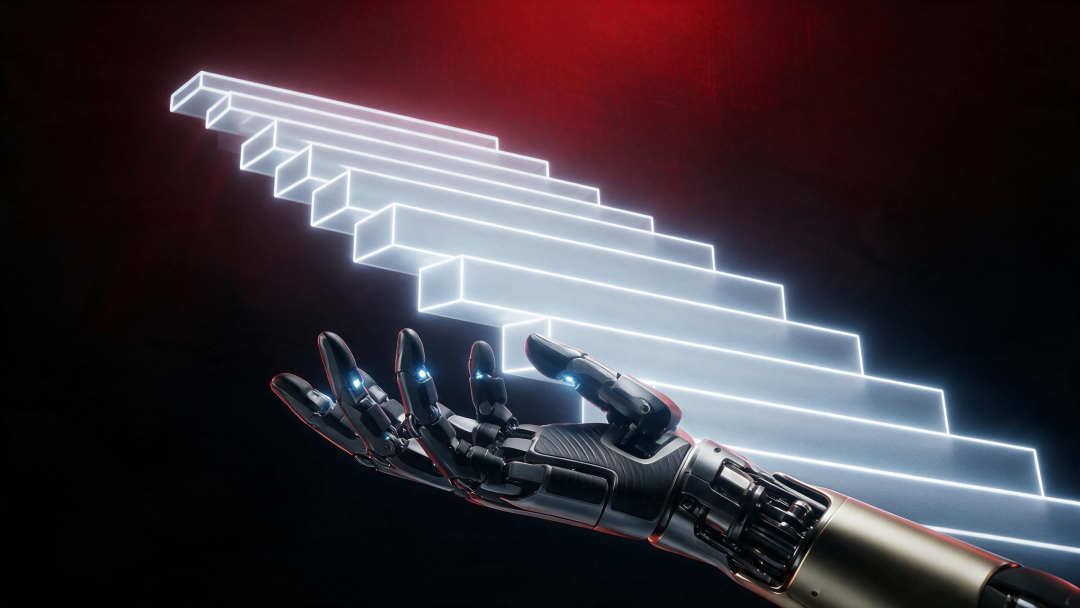
When a product’s output climbs tenfold in a few months, it looks like a breakout is near. But that tenfold started at a few dozen units a week, ends at a few hundred, and targets 1,000 a week by year end with a long-term aim of nearly 20,000. Each jump across an order of magnitude is not a linear step but an exponential engineering ordeal, and the first wall is not the AI. It is the hand.
One hundred parts and a manual line
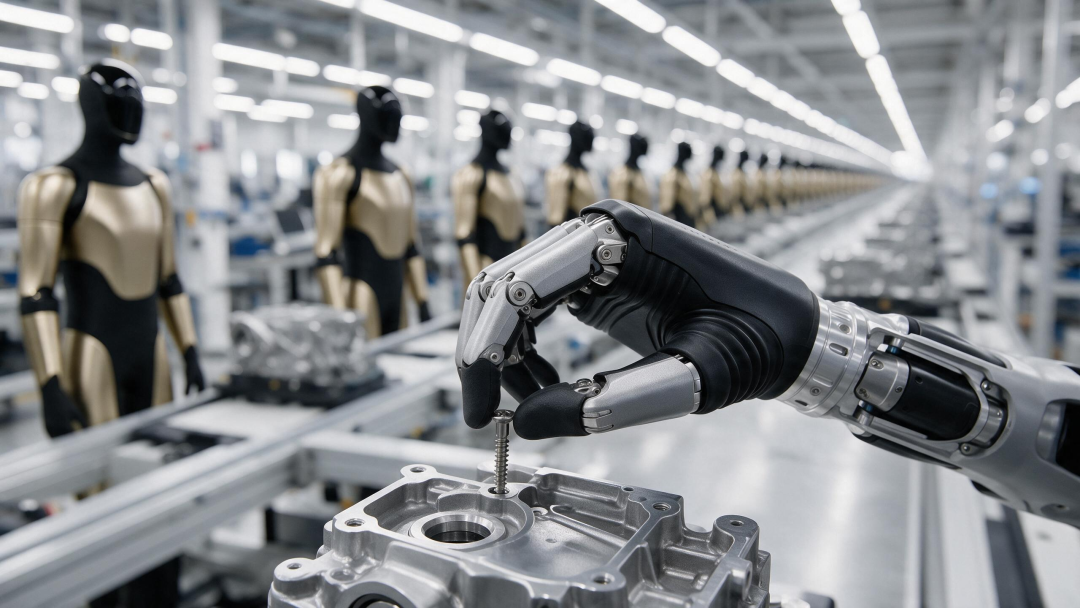
To the public the hard part of a humanoid is the brain: algorithms, large models, autonomous decisions. To a manufacturing engineer the thing that stalls the line is the unglamorous physical detail. The Optimus hand and forearm assembly carries more than 100 small components and fasteners, and large parts of it are still put together by hand. That means even if every other step is automated, the line is not truly continuous until the hand stops needing a human touch.
The Gen3 hand mimics close to thirty bones and muscles, with each finger carrying miniature motors, reducers and dense cabling. A typical dexterous hand holds about 23 degrees of freedom, and a single robot needs more than 300 precision parts working together. The tactile sensors are the deeper trouble: reporting indicates they are not reliable enough to mass produce, so Tesla added a glove-like sensor cover that can be swapped when it fails rather than replacing the whole hand. That is not an elegant solution but a compromise forced by production pressure.
The first mass-manufacturable Optimus is not ready
Gen3 is described internally as the first Optimus built for mass manufacture, but the evidence says the label is a vision more than a fact. The transmission moved from tendon plus worm gear to tendon plus screw, the motor went from integrated to external, and the forearm thickened to hold more actuators, with joints fully enclosed and the hip actuator tucked into a human-like pelvis. Those changes are really a manufacturing trial: enclosing a joint means thermal management, service access and assembly tolerance must all pass at once, or the robot throttles after two hours and servicing eats every margin.
The reliability numbers are the warning. Supply-chain information puts Gen3 no-fault runtime near 500 hours against the 2,000-hour industrial standard, the equivalent of a car designed for 200,000 kilometres that starts failing at 50,000. Some freshly built units need manual repair straight off the line, and the AI still requires task-specific programming in a tightly controlled setting. Being able to build it is not the same as building it well, and building it well is not the same as mass producing it.
Rent, do not sell
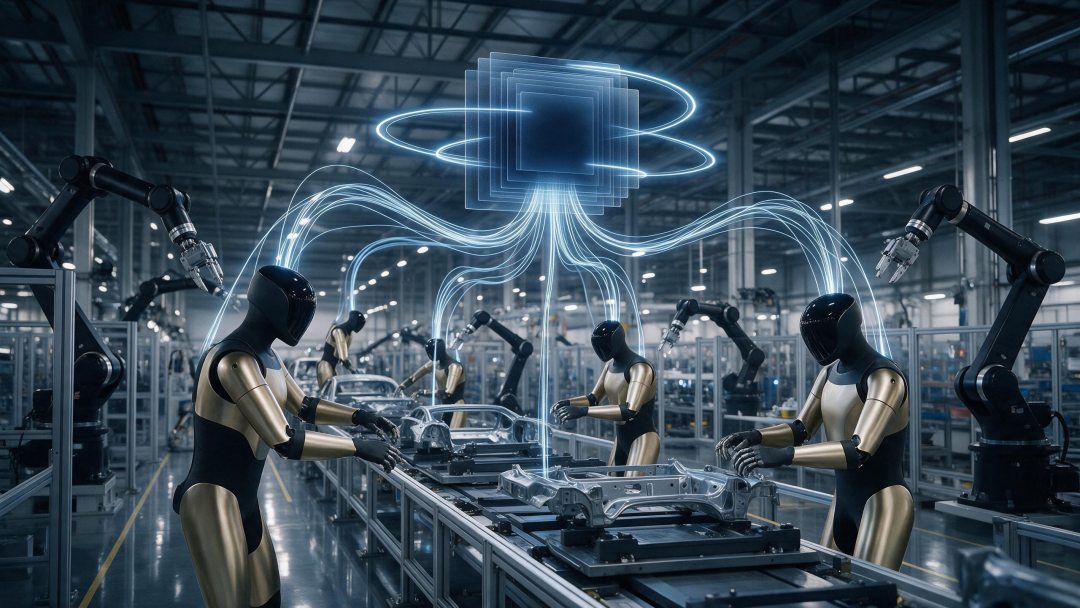
Facing a product that is not yet mature, Tesla chose to lease early Optimus units to commercial customers whose workplaces resemble its own factories rather than sell them. Leasing lets Tesla retrieve a unit, upgrade its mechanical parts and keep collecting real operating data to sharpen the AI. The deeper logic is a different kind of scaling law: more deployed units mean richer data, faster model iteration and steeper cost decline. Each rented robot becomes a data node, and the loop feeds itself.
This is why Tesla is not rushing to sell. A sale that fails damages the brand and triggers returns, while a lease lets Tesla recover and upgrade within the term and retain the data. It is less a product launch than a field trial with paying participants.
The supply-chain exam
Tesla’s audit standard, TS-00005, was refreshed in May 2026 with 112 core clauses across eight dimensions, including zero-defect full inspection with no AQL sampling and traceability down to second-tier suppliers, aimed at a USD 20,000 per-unit target. The robot team recently travelled to Ningbo for a new mass-production audit, with a plan to build about 50,000 Optimus this year for deployment across gigafactories.
Chinese suppliers are central. Tuopu Group has expanded from linear to rotary actuators and hand motors, sent repeated samples and set up a dedicated robot actuator division, with cumulative robot orders of RMB 1.75 billion. Sanhua focuses on electromechanical actuators and has stood up its own robot division. Roughly 80 per cent of humanoid part categories overlap with the new-energy-vehicle supply chain, and that migration skill is the distinctive edge of Chinese suppliers.
The real dividing line
2026 is called the first year of humanoid mass production. Goldman Sachs now sees global shipments rising from about 75,000 units in 2026 to about 890,000 by 2030, while JPMorgan forecasts 1.75 million by 2030 with China holding more than half. Morgan Stanley’s point cuts to the core: the contradiction is no longer whether a robot can be built but whether it can keep performing real tasks and turn deployment into data, iteration and lower cost.
Investors should hold three facts. The tenfold rise began from a tiny base, and the current V3 is still mostly for internal testing and data collection, not external commercial delivery. The cost target is far from met, with trial-build cost at USD 40,000 to 50,000 against a USD 20,000 goal. And the landing will likely be slower and more winding than the market expects.
Editor’s note: This is an adapted translation of the original OFweek Robotics report. It has been trimmed and restructured for readability for an international business audience. The full original (in Chinese) is at https://robot.ofweek.com/2026-09/ART-898890-12003-30704955.html.