A Chinese pool-cleaning robot company is moving toward what the industry calls the sector’s first stock-market listing, as a wave of domestic makers pushes into a market long dominated by Israeli and Spanish incumbents.
The demand for pool robots sits heavily in the West. Data from consultancy CIC shows there were about 34.1 million swimming pools worldwide in 2025. The United States accounted for 11.5 million and Europe for 9.8 million, together more than 60 per cent of the global total. Australia had 1.5 million. China had just 500,000, or about 1.5 per cent.

A small domestic market, a large export business
Pool density explains the difference. About 10 per cent of China’s pools in 2025 were public, and the country had 0.4 pools per thousand people. Europe had 21.8 and the United States 33.8. Australia, with a smaller population, had 54.2 per thousand. That shaped adoption: robot penetration reached 32.9 per cent in Europe, 36.9 per cent in the United States and 32 per cent in Australia in 2025, against 8.7 per cent in China.
Shen Meng, executive director at Song Capital, described pool robots in China as a false demand. Many Chinese pool operators, he argued, cannot support the full cost of using a robot, while high labour costs and strong demand for swimming and fitness in Europe and the United States create real space for the product.
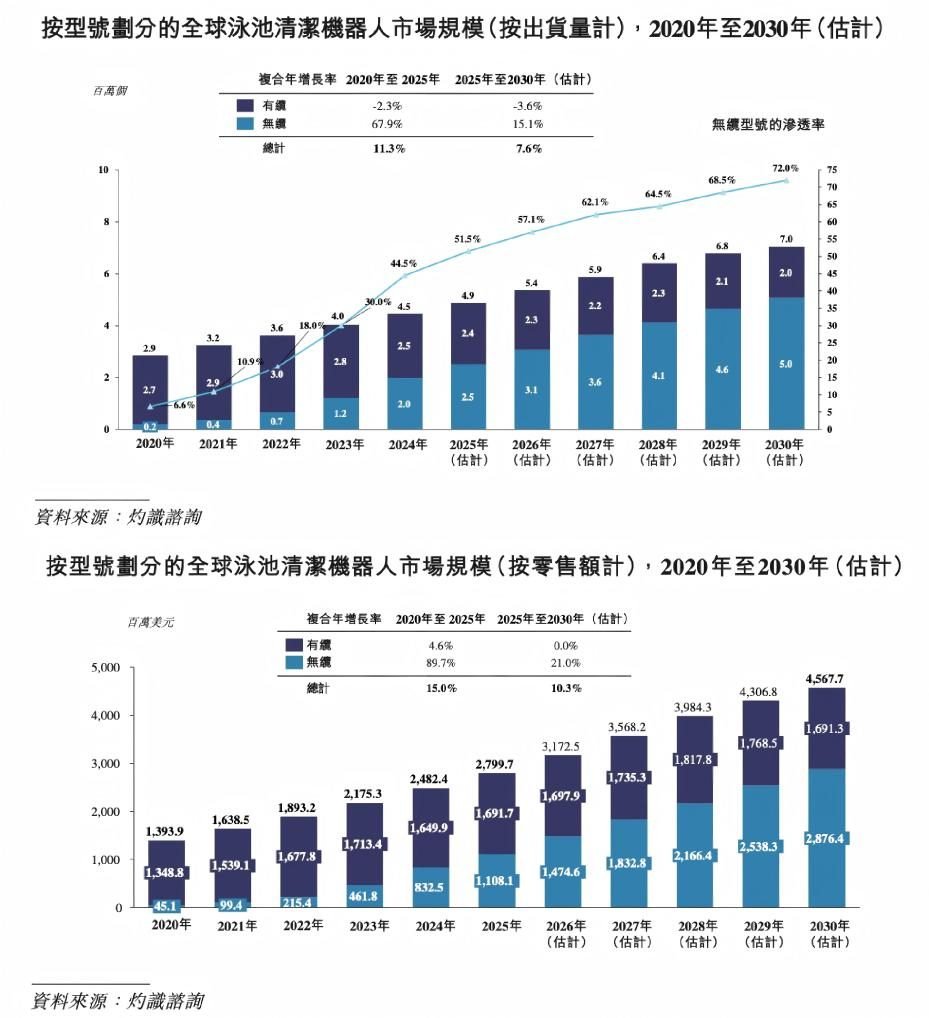
That concentration overseas does not cap growth. Global shipments rose from 2.9 million units in 2020 to 4.9 million in 2025, a compound annual growth rate of 11.3 per cent. Retail gross merchandise value over the same period grew from USD 1.394 billion to USD 2.8 billion, a 15 per cent compound rate. CIC projects 7 million units and USD 4.568 billion by 2030, implying 7.6 per cent and 10.3 per cent annual growth from 2025. China is the only one of the four major markets forecast to accelerate, with shipment and GMV growth of 21.8 per cent and 24.7 per cent over the next five years.
Bai Wenxi, vice chairman of the China Enterprise Capital Alliance, called the Chinese pool-robot market a fast-growing but small market. Absolute volume stays limited by the pool base, he said, so the real prize for Chinese manufacturers is replacing overseas installed machines during the shift to cordless models.
The incumbents are wobbling
Huajing Industry Research Institute data, measured by self-produced shipments in 2024, put the top five makers at 74.9 per cent of the global market. Israel’s Maytronics led with 34.8 per cent and Spain’s Fluidra held 18.5 per cent, together more than half. Chinese companies Wangyuan, Sunwoda and Xingmai Innovation took third, fourth and fifth with 9.2 per cent, 6.7 per cent and 5.6 per cent.
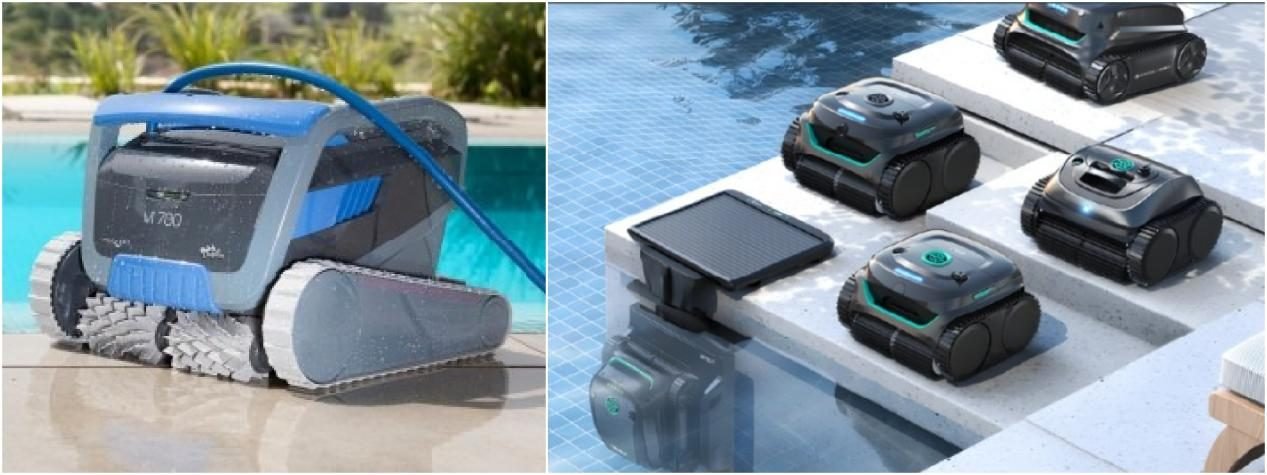
Maytronics, more than 40 years old and widely treated as the sector leader, had a difficult 2025. Revenue fell 13.6 per cent to ILS 1.4 billion. Gross profit dropped 35.9 per cent to ILS 375 million, and gross margin narrowed from 36 per cent to 26.7 per cent. The company posted a net loss of ILS 222 million, with the loss widening 624.43 per cent. It cited tougher competition and currency effects. The slide continued into the second quarter of 2026, with revenue down 15 per cent and North American and European revenue off 9.8 per cent and 29.5 per cent.
Fluidra fared better. Its 2025 sales reached EUR 2.184 billion, up 7 per cent at constant currency, while net profit rose 28 per cent to EUR 176 million. More telling, Fluidra joined a near RMB 1 billion C round for Chinese cordless maker Overspeed and took an initial 27 per cent stake. The global number two is now invested in a Chinese challenger.
Cordless is the opening
Pool robots split into corded and cordless models. Corded machines draw power through a cable, while cordless ones run on battery and are reshaping the product category. Chinese makers are using the cordless transition to take share from established brands in overseas markets, where most of the volume sits.
For a company chasing a first listing, the timing is deliberate. The incumbents are carrying falling margins and a legacy product line, while Chinese suppliers hold manufacturing scale and a lower-cost cordless design. Whether that converts into a public listing depends on how fast the company can turn overseas share into consistent earnings.
Editor’s note: This is an adapted translation of the original OFweek report. It has been trimmed and restructured for readability for an international business audience. The full original (in Chinese) is at https://robot.ofweek.com/2026-11/ART-8321203-8420-30712813.html.