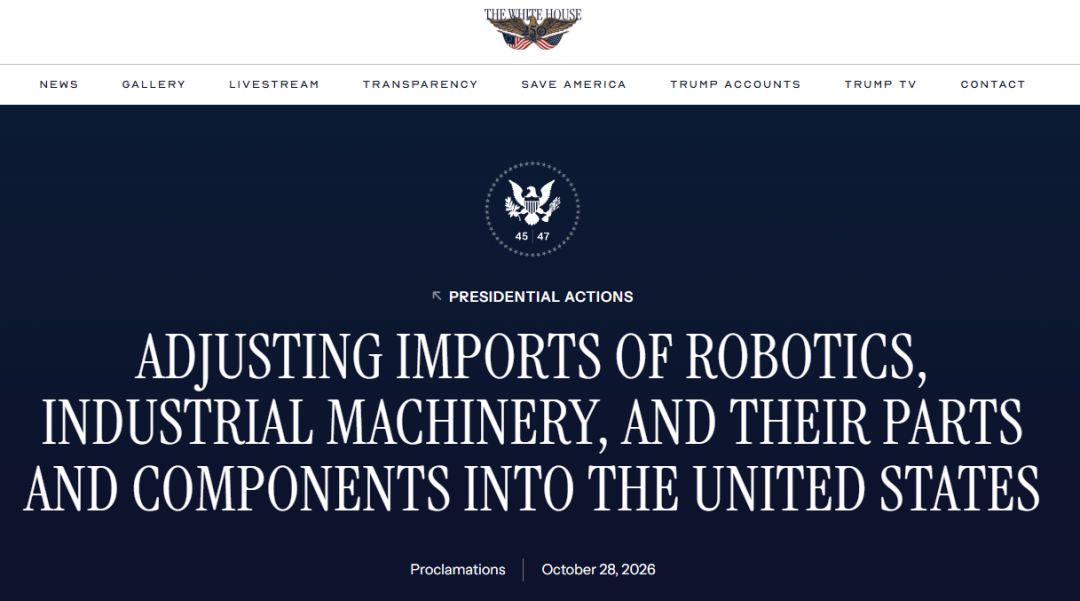
On 28 October President Trump signed a proclamation finding that imported robots and industrial machinery threaten US national security. He did not impose a tariff. He directed the Commerce Department, led by Howard Lutnick, and the Trade Representative Jamieson Greer to negotiate with trading partners for 180 days, with duties, quotas or other measures held in reserve if talks fail.
The interesting part of the document is not what it says. It is what it leaves standing.
What the investigation covers
The case rests on Section 232 of the Trade Expansion Act of 1962, and the scope is unusually wide: industrial robots, CNC machine tools, stamping equipment, laser cutters, autoclaves, even automatic tool changers and fixtures. The White House rationale is blunt. Robots are not only inputs to cars and electronics. They are required to build missiles, aircraft and warships, and foreign equipment handling sensitive data introduces a cyber risk.
What unsettles American manufacturers is a separate fact. The United States has almost no domestic substitute in heavy industrial arms. The robots used by automotive and aerospace giants come mainly from Fanuc, ABB, Yaskawa and Kuka, all headquartered in Japan, Switzerland and Germany. The US installed roughly 38,500 industrial robots in 2025, the second largest market in the world, while depending almost entirely on imported supply.
A tariff today would hit General Motors, Ford, Boeing and Lockheed Martin first. That runs directly against the reshoring objective, which is why the duty was suspended rather than dropped.
Three things the pause does not do
First, the finding itself does not expire. Section 232 concluded that import dependence is now a national security risk in its own right. Robot supply chains have been moved inside the scope of US security review, which means the tariff instrument can be reactivated the moment geopolitics shifts. Trade policy has changed category, from a cost question to a security question, and that reclassification is permanent.
Second, 180 days is a countdown, not an exemption. Pushing the final decision past the midterms is a political calculation. For industry it sets a clock: either allied suppliers expand American capacity, or importers find substitutes, or the duty lands.
Third, compliance cost will leak into the humanoid sector. The proclamation targets industrial arms and conventional equipment, but the FCC added foreign made advanced robotic devices to its controlled list in July, and humanoids and quadrupeds sit inside that perimeter. A Section 232 security framework stacked on an FCC supply chain review is a layered trade and security wall around an entire product category.
For any robot company planning to sell into the United States, whether the product works is moving towards parity with whether it clears review. That is a new line item in the go to market plan, and it does not appear on any spec sheet.
Editor’s note: This is an adapted translation of the original OFweek report. It has been trimmed and restructured for readability for an international business audience. The full original (in Chinese) is at https://robot.ofweek.com/2026-11/ART-8321206-8480-30709733.html.