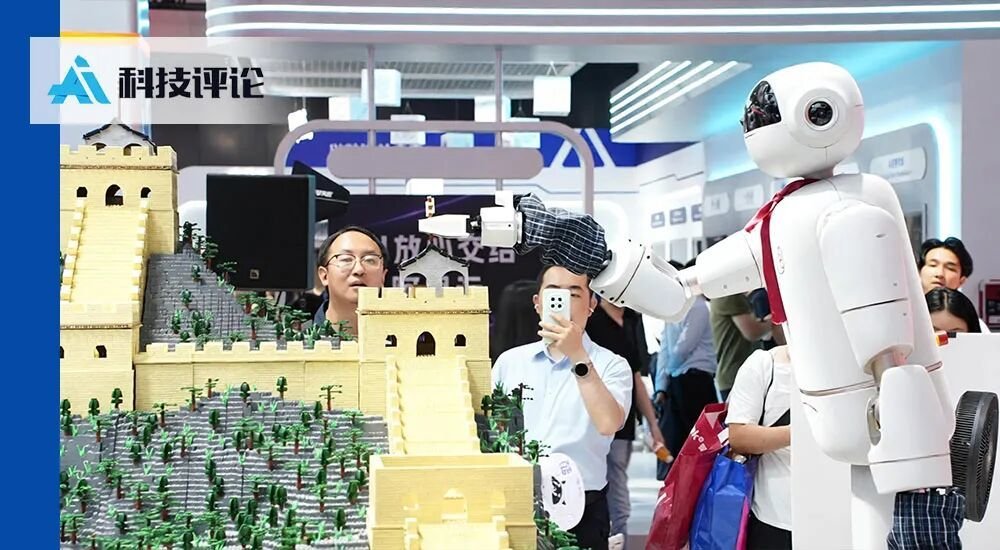
At WAIC 2026, Yuanli Lingji drew a crowd with an unusual demo: four desktop arms and two wheeled Apex robots worked 15 hours to assemble a 3.5-metre-by-1.5-metre Great Wall model from nearly 82,000 micro-blocks, some under 1 centimetre, at sub-millimetre precision.
The point was not the toy. Founded by Tang Wenbin, co-founder and former CTO of Megvii, Yuanli Lingji used the build to show three capabilities running together for hours: fine manipulation, error recovery and multi-robot coordination.
The hard part is recovery, not perfection. On a real line, a few per cent of scrap is acceptable; a stoppage is money lost. Yuanli Lingji collects tens of thousands of hours of real teleoperation data monthly and trains with reinforcement learning, arguing the real world is the best simulator. Its DM0.5 embodied foundation model holds minute-level task memory and runs at 10Hz on a single RTX 4090.
Six robots share one scheduler — an agent that calls StepFun’s latest large model — dividing work by atomic skills. The same logic moves to factories: Walmart and Uniqlo are already in talks to trial it for line-head and line-tail ‘fragmented’ tasks that pick-and-place automation struggles with.
From Megvii’s ResNet-era vision team, Yuanli Lingji preaches ’embodied-native models’ — use whatever works, don’t pick sides between VLA and world models. It has open-sourced Dexbotic 2.0, DM0, DM0.5 and DW0.5. The Great Wall is finished. The real factory work is just starting.
Original report: Leiphone.
Translated and adapted from Leiphone (leiphone.com).