Foundation models for embodied AI have a problem of proof. A team can demonstrate a capability because it chooses the task, the data, the hardware and the evaluation. Real robot videos rarely show the failed attempts, and simulation leaderboards rarely show the full test conditions. The result may be accurate, but outsiders cannot verify it.
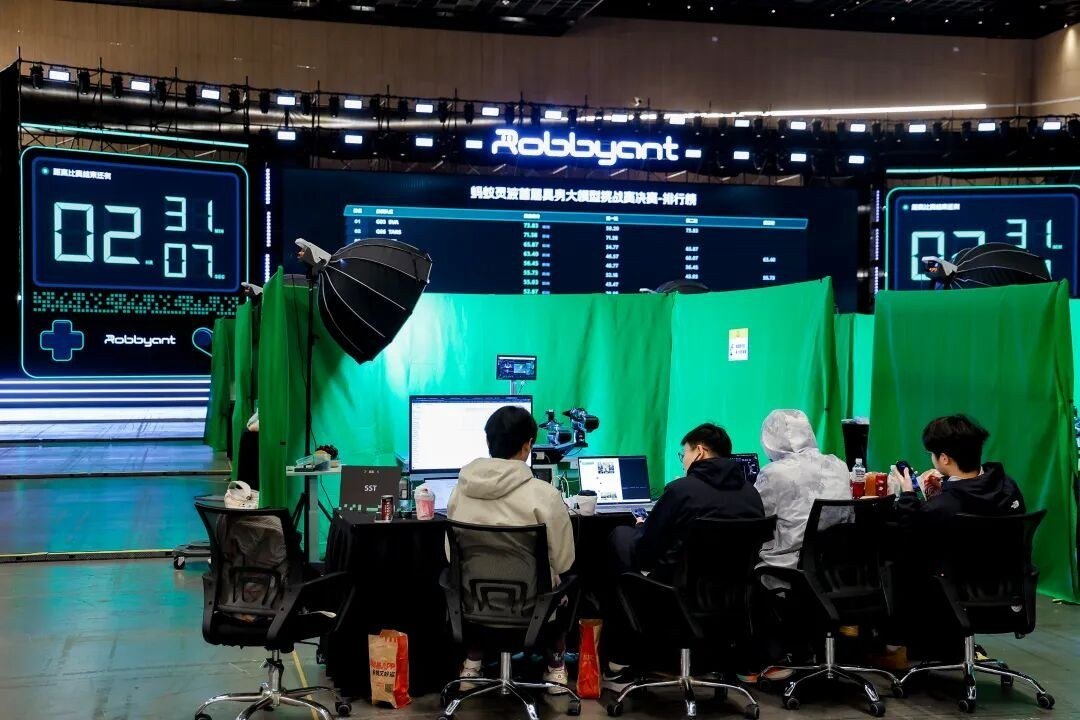
The first Ant LingBot embodied large-model challenge, which closed in Shanghai on 16 November, was built around that gap. From 1,855 teams across 13 countries, fifteen finalists were selected. Each worked with the same LingBot-VLA 2.0 model and the same AgileX COBOT MAGIC device, completing data collection, tuning and real-machine deployment within 48 hours.
Three tasks, three submissions
The tasks were deliberately plain: single-arm pickup of fruit and vegetables; single-arm pickup of cosmetics into a transparent box; and two-arm table clearing, sweeping debris into a bin. Each team had three submissions per task and the best score counted.
Holding the model and hardware constant let the same base be modified and tested by teams with different backgrounds. Some came from autonomous driving, some from visual recognition, some from robotics, and some were using a dual-arm machine for the first time.
The winner, TARS, scored 82. Across the cosmetics and produce tasks it introduced a Qwen model to generate visual masks, hiding everything except the target and destination, and reached 100 per cent and 90 per cent success. On debris clearing it decided the bottleneck was data, discarded the 216 official samples, moved the grasp point from the dustpan handle to its rear edge, collected 334 new samples and raised real-machine success to 60 per cent.
Runners-up EVA built its strategy around the recursive self-improvement approach that has dominated recent discussion. The robot’s result fed the next training round, with a human stepping in only on failure. After 705 on-site demonstration and takeover samples, seven rounds of data return and more than 110 real-machine tests, success rose from about 10 per cent to 70 per cent, for a score of 73.83.
More data did not guarantee a higher score. Teams that collected hundreds of samples without understanding the embodied data sometimes did worse. SST finished third with only 13 samples, using a language model to parse instructions, SAM3 to generate masks, pushing pixels outside the mask to 0.1 and treating the VLA purely as an executor. It scored 65.87.
What happens outside the contest
Beyond the organised final, overseas developers have connected the model to their own projects: farm inspection in Thailand, game prototypes in France, coral reef research in Switzerland. None has a shared problem statement. They only ask whether the model solves the task in front of them.
An investor quoted by the organiser made the distinction clearly. The application layer has not stalled because commercial demand is unclear. The technical base was not ready. Mobile internet only produced an application boom after the operating system absorbed communication and location as general capabilities, cutting the cost of building anything on top.
A model acquires industrial value when it leaves the original lab and enters someone else’s task, device and workflow. A competition that makes both success and failure visible under fixed conditions is one way to test whether that has happened.
Editor’s note: This is an adapted translation of the original OFweek report. It has been trimmed and restructured for readability for an international business audience. The full original (in Chinese) is at https://robot.ofweek.com/2026-11/ART-8321205-8420-30712144.html.