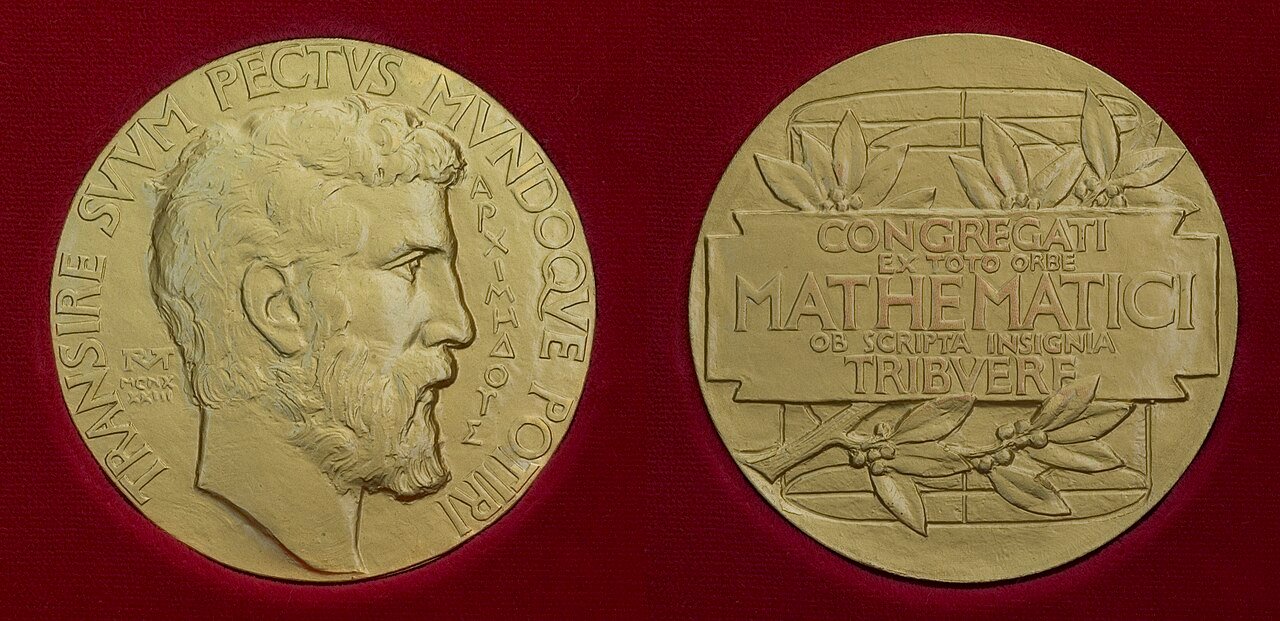
On July 23, the International Mathematical Union awarded the Fields Medal — mathematics’ highest honor — to four mathematicians. Two of them, Deng Yu and Wang Hong, were born in China. It is the first time in the prize’s 90-year history that two Chinese-born mathematicians have won in the same year.
Deng Yu, born in Shenzhen, studied at Peking University and MIT, earned his PhD from Princeton in 2015, and is now a professor at the University of Chicago. His work on nonlinear dispersive partial differential equations and wave turbulence led to a rigorous derivation of the Boltzmann equation from hard-sphere particle systems — a major breakthrough related to Hilbert’s Sixth Problem.
Wang Hong, now a permanent professor at the Institut des Hautes Etudes Scientifiques in France and a professor at NYU’s Courant Institute, also graduated from Peking University. She earned her PhD from MIT and is known for proving the three-dimensional Kakeya conjecture in 2025, alongside contributions to the restriction conjecture and local smoothing conjecture.
The other two winners: Jacob Tsimerman (Canada), who proved the Andre-Oort conjecture, and John Pardon (US), who solved the three-dimensional Hilbert-Smith conjecture.
This year’s Fields Medal has been dubbed “the last one belonging only to humans” — a nod to the rapid incursion of AI into mathematical research. AI systems have already disproved long-standing conjectures (Fable 5 disproved the Jacobian conjecture; GPT-5.6 Pro overturned the 30-year-old Dinitz-Garg-Goemans conjecture). But as the medal itself demonstrates, the award has never been about who can solve problems fastest — it rewards those who create new language and tools for previously indescribable questions.
As one mathematician at the WAIC forum put it: “AI can help write the answer. But judging which proof is beautiful, which step contains real insight, and which question is worth asking — that still requires understanding.”
Translated and adapted from Sohu IT (it.sohu.com).