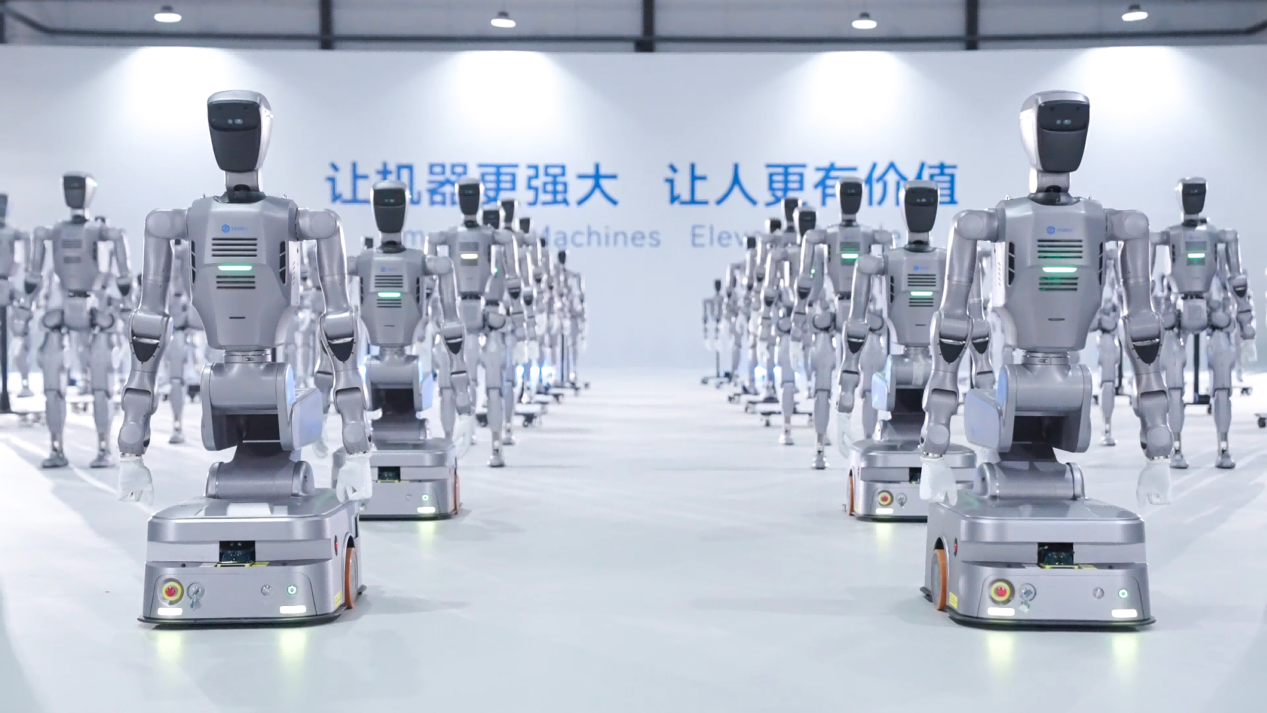
Shenzhen-based Dobot has begun deploying large batches of its humanoid robots across industrial sites worldwide, the company told Shenzhen News on July 24. The machines are running live validation and production tasks — loading and unloading, high-precision sorting, fine assembly, and finished-goods recycling — inside real manufacturing environments.
The move sends a clear signal: humanoid robots are leaving the lab. They have moved past prototype demos and function tests into real-world deployment, scaled mass production, and large-scale delivery.
Unlike the traditional “build the robot first, then find a use case” model, Dobot has spent years embedded in industrial manufacturing, defining robot capabilities from the actual needs of factories. Standardised lab demos rarely survive the real world — shifting material positions, part-size variance, and line-takt fluctuations. Dobot’s humanoids, while running continuous proof-of-concept work, feed real-world feedback from global sites back into R&D, manufacturing, and quality control, gradually closing the loop across core components, the robot body, the embodied large model, global deployment, and scaled delivery.
Drawing on more than a decade of motion control, force control, trajectory planning, and industrial-safety capability accumulated in collaborative robotics, Dobot has ported those skills to the humanoid’s upper body — letting it self-adapt to fixture pose errors and sustain industrial-grade stability through ultra-long continuous shifts. Running Dobot’s in-house embodied model “Kongyi / DobotWAM,” the robot understands task instructions through multimodal perception and plans its own execution strategy, markedly improving adaptability across different factories.
On the production side, Dobot has built an internationally certified smart-manufacturing base covering core-component production, final assembly, test verification, and roll-off — with core parts designed and made in-house. By feeding global site feedback back into R&D and manufacturing, Dobot has closed the full chain from core parts to body to embodied intelligence to global deployment and scaled delivery.
Dobot is now building a “one brain, many bodies” intelligent system: a unified base that decomposes tasks and schedules clusters of humanoids and collaborative robots alike, upgrading single-machine capability into replicable, deployable robot-cluster productivity.
Going forward, what decides industrial value is whether robots can produce stably, deliver fast, and keep completing tasks inside real global production scenes. The core of the humanoid race is shifting from spec-sheet comparisons to a composite contest of embodied intelligence, scaled manufacturing, quality control, supply-chain stability, and global deployment and delivery.
Source: Shenzhen News (sznews.com). Translated and adapted for The Robot Belt.