On June 24th, Shenzhen-based embodied-AI startup RoboScience (机器科学) hosted its official launch event in Shenzhen, unveiling Visics: a general-purpose embodied foundation model built around a novel architecture called VLOA (Vision-Language-Object-Action).
The company’s founding team carries unusual credentials. CEO Tian Ye (田野) previously served as Apple’s AI Platform technical lead, where he built infrastructure described internally as “Apple’s PyTorch and CUDA.” Chief Scientist Professor Shao Lin (邵林)‘s research team has secured two consecutive ICRA Best Paper awards or nominations — the only Asian group to achieve this distinction. Their latest work, T(R,O)Grasp, achieves 94.83% average grasp success rate across heterogeneous agents, setting a new global SOTA for cross-agent dexterous grasping.
The Three Bottlenecks
Tian Ye identified three core problems holding back robotic deployment at scale:
- Poor generalisation — models trained on narrow task distributions fail when objects, environments, or lighting shift even slightly.
- Fine manipulation difficulty — precision tasks (assembly, insertion, tool use) remain beyond the reliability threshold required for commercial deployment.
- Error accumulation — in multi-step tasks, small errors compound exponentially, causing late-stage failures that are hard to diagnose.
VLOA: Decoupling Cognition from Execution
Visics’s answer is the VLOA architecture, which introduces Object Trajectory — the continuous 3D point-cloud path of the target object — as an intermediate representation between perception and action.
This creates a clean two-layer stack:
- Upper layer (Embodied World Model): Handles cognitive reasoning and physical trajectory prediction. Trained on massive internet video datasets, it predicts how objects move through space without needing robot-specific data.
- Lower layer (Universal Operation Model): Converts predicted object trajectories into concrete control signals for any robot hardware. Hardware-agnostic by design.
The key innovation: cognition and execution are fully decoupled. The world model doesn’t need to know which robot arm it’s controlling. The operation model doesn’t need to understand the semantic goal — only how to follow a 3D trajectory. This separation enables both layers to be trained independently at scale.
The Data Flywheel
Model capability is meaningless without data at scale. Traditional embodied-AI data pipelines face a brutal bottleneck: real robot data collection produces roughly 10,000 samples per month at best, while post-training annotation for complex tasks demands 10,000+ manually labelled samples per task. Cost scales linearly with task count.
RoboScience’s solution is a dual data flywheel built around two core technologies:
- RoboMirage: A proprietary high-fidelity physics simulation engine that generates unlimited synthetic training scenarios via Scan2Sim (real-to-sim) and Gen2Sim (generative-sim) pipelines, including automatically synthesised long-tail edge cases.
- Automated Video Annotation Pipeline: Extracts demonstration data from ordinary internet videos of humans performing tasks (cooking, cleaning, assembling), with automatic pre-labeling plus human review achieving 10x efficiency gains over manual annotation.
Result: per-sample data acquisition cost drops to between 1/20th and 1/200th of traditional approaches, while the dataset grows at a rate of hundreds of thousands of training hours per week — approaching LLM-scale data regimes for embodied intelligence.
Commercial Backing and Roadmap
RoboScience’s investor roster signals serious institutional conviction: JD.com (京东集团), SenseTime (商汤科技), Fortune Capital (达晨财智), CM Investment (招商局创投), 01VC (零一创投), and Puhua Capital (普华资本). The company operates R&D and production centres across four cities: Beijing, Shenzhen, Suzhou, and Hangzhou.
Commercial pilots are underway with retail, logistics, elderly-care service providers, as well as robot body manufacturers and dexterous-hand companies. The company plans to achieve mass production of standardised robot body products for industrial and commercial scenarios within this year.
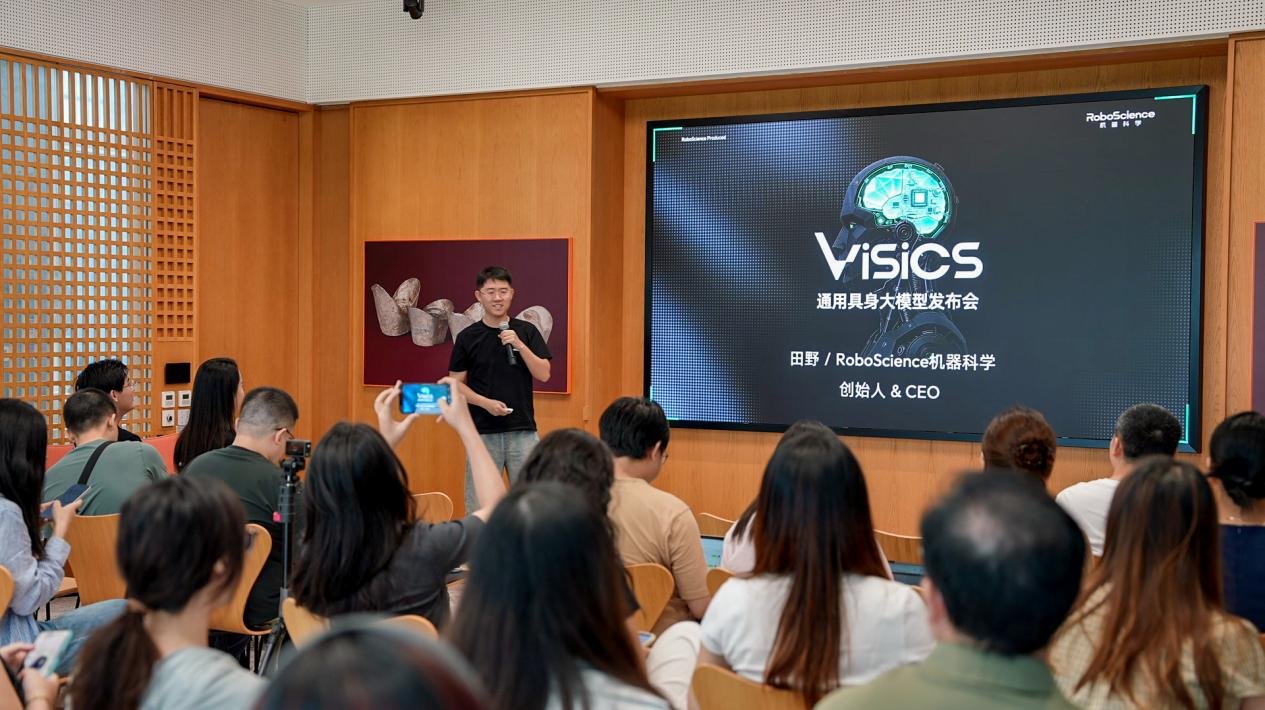
Source: Leiphone (leiphone.com)
Translated and adapted from Leiphone (leiphone.com).