A bionic robot developed by a Shanghai startup has ignited a fierce debate on overseas social media — not because it failed, but because it looked too human.
At the 2026 World Artificial Intelligence Conference (WAIC) in Shanghai on July 17, Shouxing Tech unveiled OriginF1: a desktop-scale bionic android with 26 degrees of freedom across its head, eyes, and facial modules alone. Videos posted shortly after showed a blonde-haired, blue-eyed bust making natural eye contact and carrying on real-time conversations with attendees.
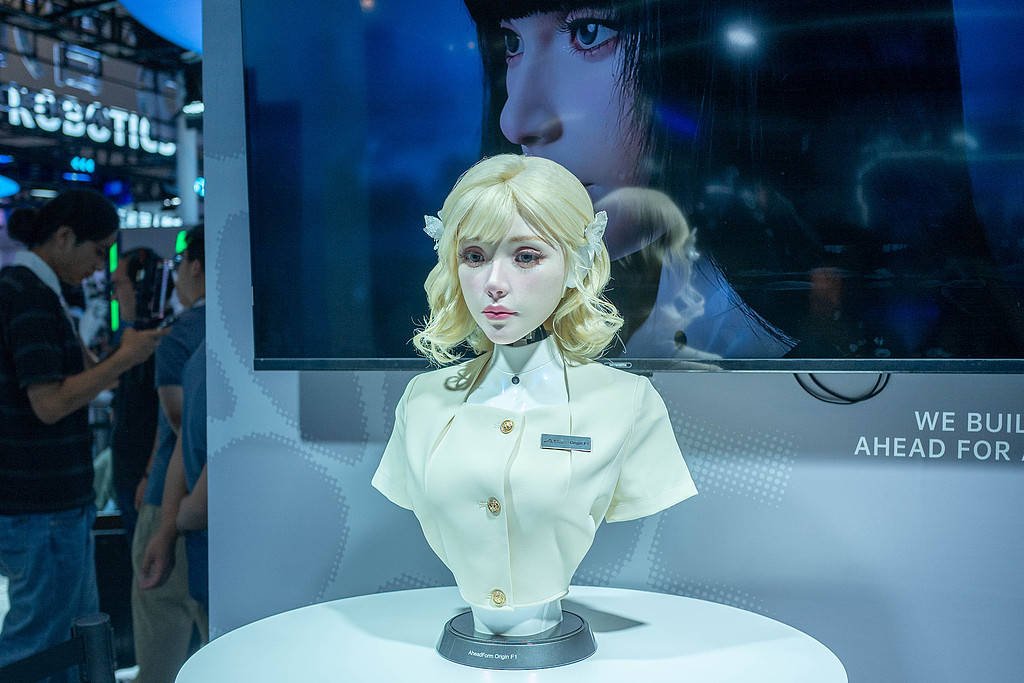
The reaction split almost immediately down the middle.
One camp argued that OriginF1 had pushed past the worst of the uncanny valley — its skin texture and eye contact were convincing enough that one commenter wrote they would genuinely consider buying one “if it had a fluid-moving, walkable body at an affordable price.”
The other camp found the opposite: while the face was remarkably lifelike, the head movements remained visibly mechanical, creating precisely the kind of cognitive dissonance that Mori’s uncanny valley predicts. To them, it looked less like a breakthrough and more like an unsettling doll.
The founder, Hu Yuhang, has been candid about the challenge. In earlier interviews he identified motion control as the single biggest factor separating convincing humanoids from creepy ones: “You have to move like a human. No real person sits perfectly still or moves at constant velocity. Even if you perfect the appearance, inadequate motion control amplifies the uncanny effect.”
He believes OriginF1 already sits on the right side of the curve and expects the company to cross the valley entirely within two years, bringing bionic androids into ordinary daily life.
The commercial backing suggests investors agree. Founded in 2024, Shouxing Tech recently closed a multi-hundred-million-yuan A2 round co-led by CITIC Jingshi and Geely Capital. Proceeds will expand the bionic product line, build standardized mass-production lines, and iterate on embodied intelligence algorithms.
This is not the first time a Chinese humanoid has triggered the “is that a real person?” response. XPeng’s IRON humanoid sparked identical accusations at its November 2025 tech day when videos showed it walking with unnaturally fluid gait — forcing the company to release an uncut continuous-shot rebuttal.
What makes OriginF1 different is the explicit focus on the face as the interaction surface. Most humanoid labs prioritize locomotion or manipulation. Shouxing bet that the next frontier in consumer robotics is emotional resonance through facial expression — and the global social media storm suggests they may have picked the right battleground.
Translated and adapted from Sohu IT (it.sohu.com).