When NVIDIA unveiled its Isaac GR00T reference humanoid at GTC Taipei during ICRA 2026, the industry noted the obvious choices: a Unitree H2 Plus body, Jetson Thor onboard compute, and the open-source Isaac GR00T model as the brain. But the component that drew the sharpest questions was the one few had heard of: the hands.
NVIDIA picked Sharpa’s Wave dexterous hands — and the choice tells a story about where robotic manipulation capability is actually concentrated today.
The Performance Case
Sharpa’s latest Wave hand is built at 1:1 human scale with 22 active degrees of freedom per hand. Each fingertip packs over 1,000 tactile sensing units with pressure sensitivity down to 0.02 newtons — fine enough to distinguish gram-level forces. The hands use direct-drive motors rather than cable-driven actuation, a design choice that the company argues solves the “impossible triangle” of miniaturization, joint flexibility, and data robustness that has plagued the dexterous-hand field.
The Data Advantage
Beyond raw specs, the 1:1 human-hand ratio gives Sharpa a structural edge in the current training paradigm. As the industry shifts toward human demonstration data for embodied model training, a hand that matches human proportions dramatically reduces the cost of redirecting and aligning human motions onto robot execution. The data collected transfers more naturally because the kinematics are already aligned.
A Full-Stack Play
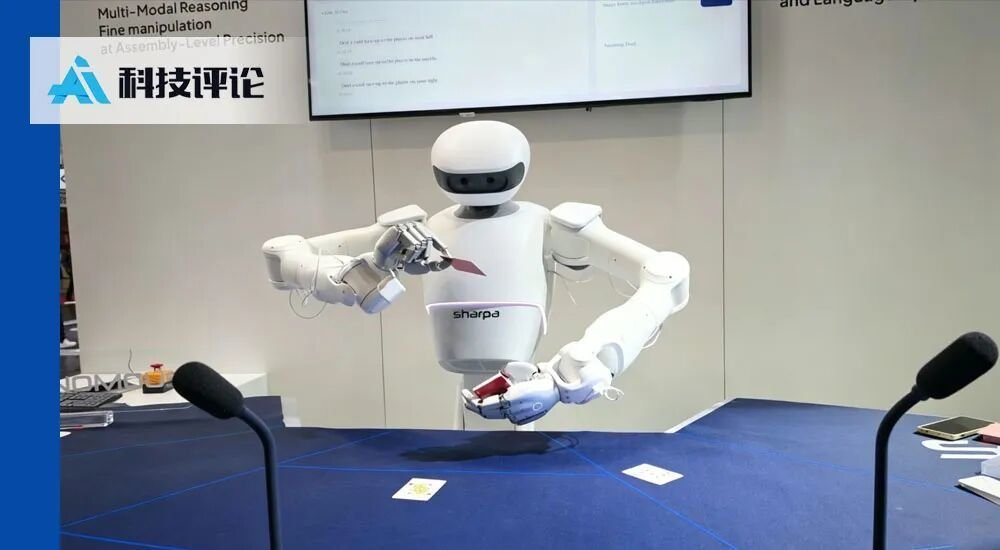
Sharpa is not just a hand supplier. At ICRA 2026, the company showcased three self-developed North humanoid robots — one dealing cards autonomously, one operating as a teleoperated receptionist, and a third for general interaction. North runs on 67 total degrees of freedom, uses a wheeled chassis, and launched in January 2026. At CES 2026, it played ping-pong against humans, took photos, dealt cards, and assembled paper windmills continuously for eight hours a day across four days.
Powering these demonstrations is CraftNet VTLA, Sharpa’s proprietary Vision-Touch-Language-Action model released in January 2026. It operates on a three-layer architecture: System 2 handles semantic reasoning at ~1Hz, System 1 manages coarse motion planning at ~10Hz, and System 0 executes millisecond-level tactile reflex control at ~100Hz — handling what the company calls the “last millimeter” of contact-rich manipulation.
Why Build Your Own Body?
Sharpa’s decision to develop its own humanoid chassis alongside the hands reflects a deliberate strategy: using someone else’s hardware limits feedback customization, while owning the full stack enables a hardware-algorithm-data closed loop. The company collects data through multiple channels — Manus motion-capture gloves, exoskeleton teleoperation, human video, and simulation — and is developing proprietary data-acquisition tooling.
The Partnership Goes Deeper
Sharpa’s collaboration with NVIDIA extends beyond the GR00T reference design. The two companies have jointly proposed technical frameworks including EgoScale (egocentric human-video-based dexterous manipulation scaling) and TacMap. In EgoScale deployments, a 22-DoF Sharpa Wave-equipped robot has already demonstrated complex tasks — folding clothes, sorting cards, unscrewing bottle caps — driven entirely by first-person human video demonstration.
For Western observers tracking the physical AI race, the signal is clear: the critical bottleneck in useful autonomy — dexterous manipulation — is increasingly being supplied by Chinese hardware companies. When NVIDIA’s canonical reference platform depends on a hand built in Shanghai, the supply chain map has shifted.
Source: LeiPhone (leiphone.com)
Translated and adapted from LeiPhone (leiphone.com).