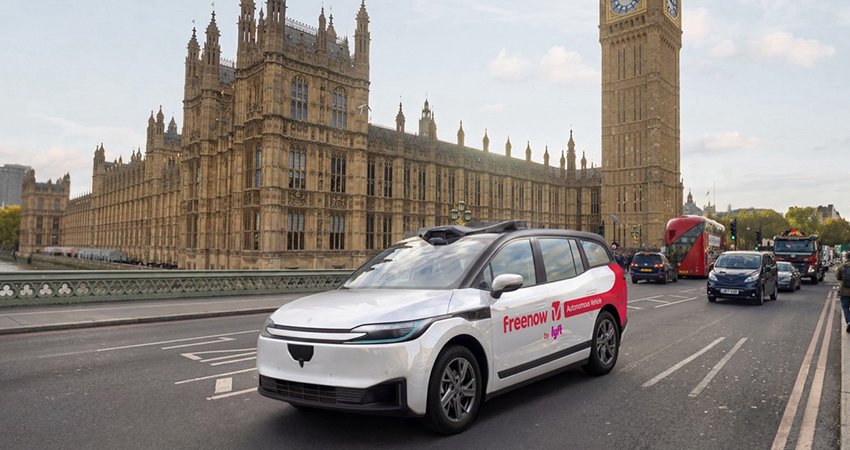
Five days separated the two events, and nearly ten thousand kilometres. On 27 July Baidu’s Apollo Go began public-road testing with nobody in the vehicle at all on Hong Kong’s airport island, the first fully driverless deployment anywhere in a left-side, right-hand-drive traffic system. On 28 July its sixth-generation RT6 appeared on the streets of London, running public-road tests with Uber and with Lyft’s Freenow unit.
Two of the largest mobility platforms in the world picked the same Chinese partner in the same week. That moves the story past a company validating its own technology and into something closer to a market test of whether Chinese autonomy travels.

Why the left-hand world waited
Robotaxi development has run along a clear dividing line. China and the United States built the scale: large home markets, expanding test fleets, enormous volumes of road data. Both pushed vehicles from closed courses to open roads, then to empty driver seats and commercial operation.
On the other side sits the left-side-driving world, largely undeveloped. Roughly 70 countries and territories drive on the left, covering more than two billion people. That group includes India and Indonesia as well as the United Kingdom, Japan, Australia and Singapore. London, Tokyo, Singapore and Sydney are dense, expensive to staff and heavy with taxi demand, which is exactly the profile a robotaxi business wants.
The obstacle was never interest. It was data. Almost every difficult scene the leading systems had ever seen came from right-side traffic. Certification regimes, road geometry and local driving manners differ across the left-side markets too, so each one carries its own adaptation and regulatory bill on top of a right-hand-drive vehicle variant.
Mirroring gets you part of the way
The visible change when a system switches sides is the steering wheel. The real change is the traffic grammar. Roundabout direction reverses. Junction conflict points move. The stream of traffic a car must cross when turning changes. Kerbside pick-up and drop-off swaps sides. The system has to relearn who holds right of way, where another vehicle is likely to appear from, and when to wait, yield or merge.
Much of the stack survives the move. High-definition mapping, perception and localisation architectures are broadly reusable, and the sensor and compute hardware does not need rebuilding. The disruption concentrates in prediction and in decision planning, where the same class of junction produces a different set of conflicts once the direction of travel flips.
Flipping existing scenes left to right speeds the transfer up and lets a developer reuse hard-won right-side data. Real traffic, though, is not symmetrical. Singapore drives on the left yet applies a give-way-to-the-right rule familiar from right-side countries. Rules written into law, and habits formed over decades, still have to be learned on real roads.
What Hong Kong actually proved
Technical generality does not mean one unmodified algorithm runs anywhere. It means different markets share one core architecture and one code base. On that common base the system absorbs local data, adapts to local rules, and feeds what it learns in a new city back into the same release. Left-side and right-side capability then improve together rather than forking.
Hong Kong tested three layers at once. First, road-rule adaptation, teaching a system raised on right-side traffic how right of way works on the other side. Second, transfer of driverless capability, meaning vehicle control, fault redundancy, remote assistance and exception handling all had to reach the point where no safety operator sits inside. Third, a regulatory and safety loop closed through test reports, physical inspection and phased approvals.
Baidu has scale behind it. Apollo Go now covers 27 cities. On 29 July the president of Slovakia, Peter Pellegrini, rode in a sixth-generation vehicle during a visit to the company and spoke well of its maturity and ride quality.
London is the harder exam
Generality answers whether capability can cross systems. Generalisation answers a colder question: how much data, money and time a new city costs before the service is fit to operate.
Parts of London are narrow, and kerbside parking is close to universal, so the lateral space available when two vehicles pass shrinks further. Lane widths change often, merges and splits are frequent, and road markings differ from Chinese practice. The system has to combine road edges, parked cars, oncoming traffic and live conditions into a moving estimate of what space is genuinely drivable.
Then there is behaviour at close quarters. Central London mixes cars, cyclists and pedestrians with very little separation. A parked car may pull away or fling a door open. A cyclist may pass down the side of the vehicle. Pedestrians cross away from signals. Detecting the object is the easy half. The system has to judge whether it will enter the vehicle’s path, and keep updating that probability as the scene develops.
Decision planning then has to balance safety against progress. Too conservative at a busy unprotected junction and the vehicle never completes a turn. Too assertive and it breaks its own safety envelope. Quantifying that negotiation is the core of the transfer.
The unit economics of going global
What Apollo Go appears to be doing in London is running local rules, local scene data and local driving policy on top of a single code base and architecture. New long-tail cases from London flow back into the same training and simulation system, and return through labelling, training, simulation and on-road testing in a later release.
A shared base is what decides the pace of international expansion. If most of the work in a new city sits in the local data loop and rule adaptation, the marginal cost of the next city can fall. That is not the same as global copy and paste. Moving from open-road testing to real operations still demands product scale, regulatory tolerance and a repeatable local ecosystem.
Hong Kong and London form a ladder. The first proved a driverless system can cross the left-right divide. The second tests how efficiently it generalises inside a complicated European city. For the past decade the industry asked whether a car could lose its driver. The question now is whether driverless vehicles can enter the traffic, regulatory and social systems of other countries. London is not the finish line, but it may be the point at which regional leaders find out whether they can become global operators.
Editor’s note: translated and adapted for RobotBelt from Chedongxi. Read the original report here.