Ask people what a coffee shop will look like in ten years and you get a thousand answers, but most of them contain a robot somewhere.
On 29 July, at an online summit for the XBOT embodied commercial robot programme, founder and chief executive Tang Mu made a forecast. Within three years, he said, China will have at least 100,000 robot coffee kiosks. That number is twice the combined operating store count of Luckin Coffee and Cotti Coffee.
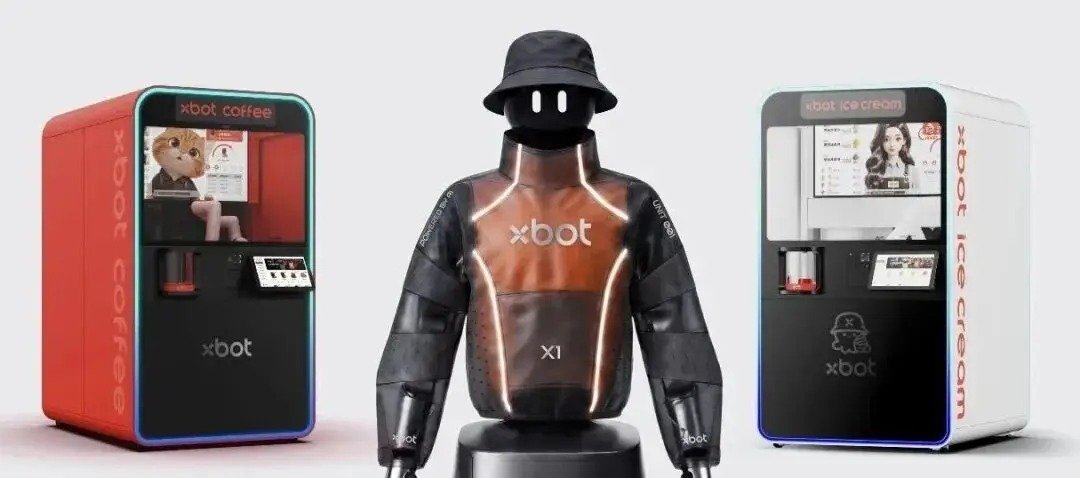
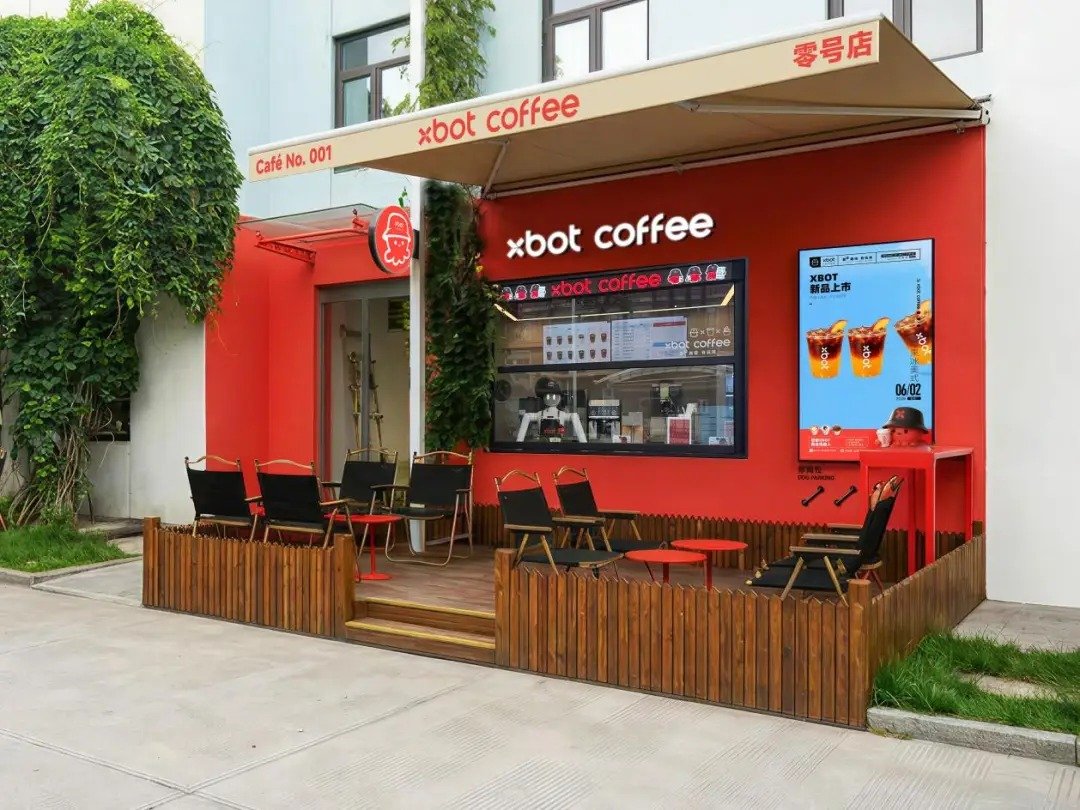
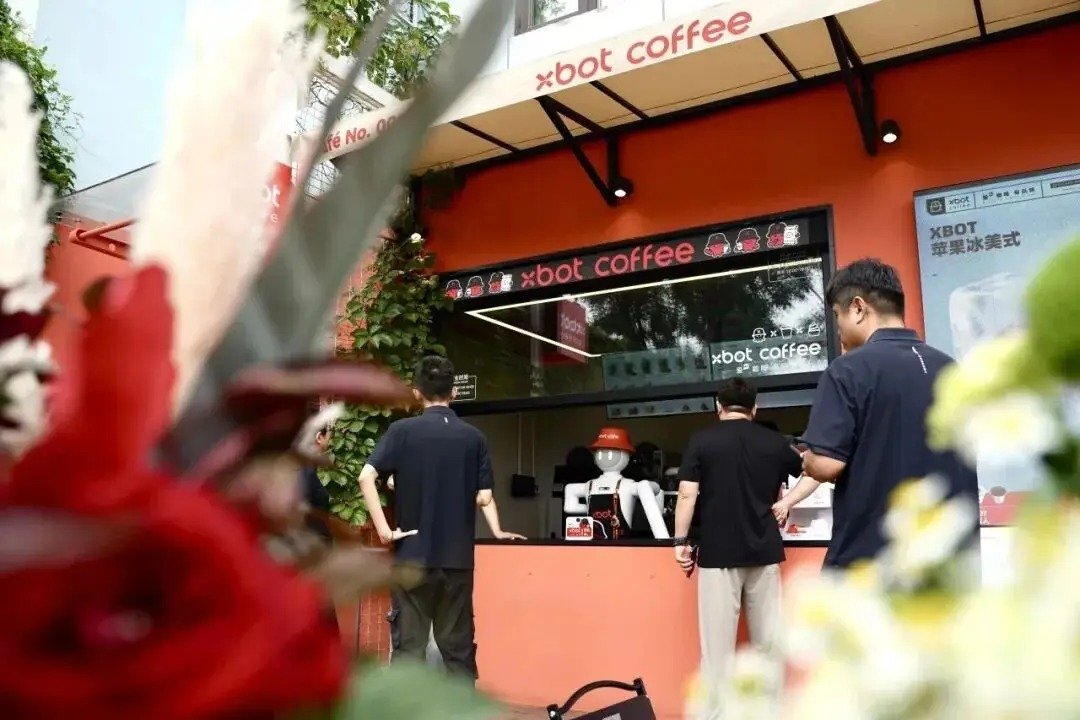
XBOT has already launched its own chain brand, XBOT COFFEE, and a flagship experience store called XBOT Lab. Neither is staffed by human baristas at the core. They are staffed by coffee robots.
What the machine actually is
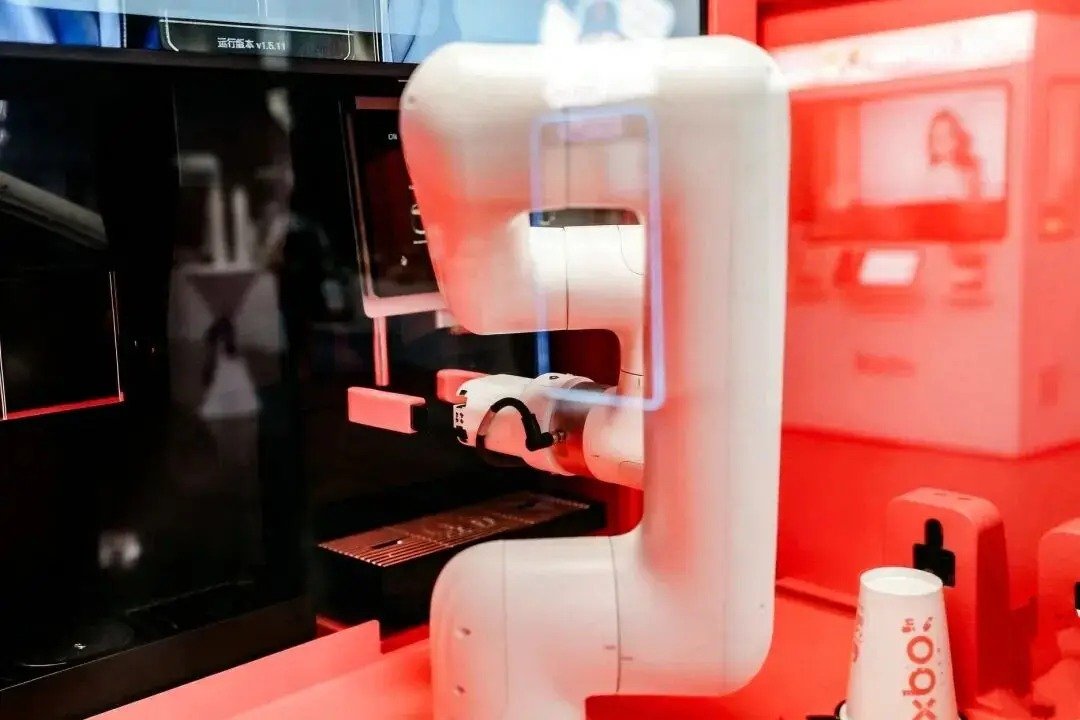
The XBOT C3 makes coffee mainly with a robotic arm. Beyond a standard americano or latte, it can produce custom latte art. XBOT Lab is positioned as human and machine collaboration, with the robot handling consistent output and human staff covering packaging, restocking and daily maintenance.
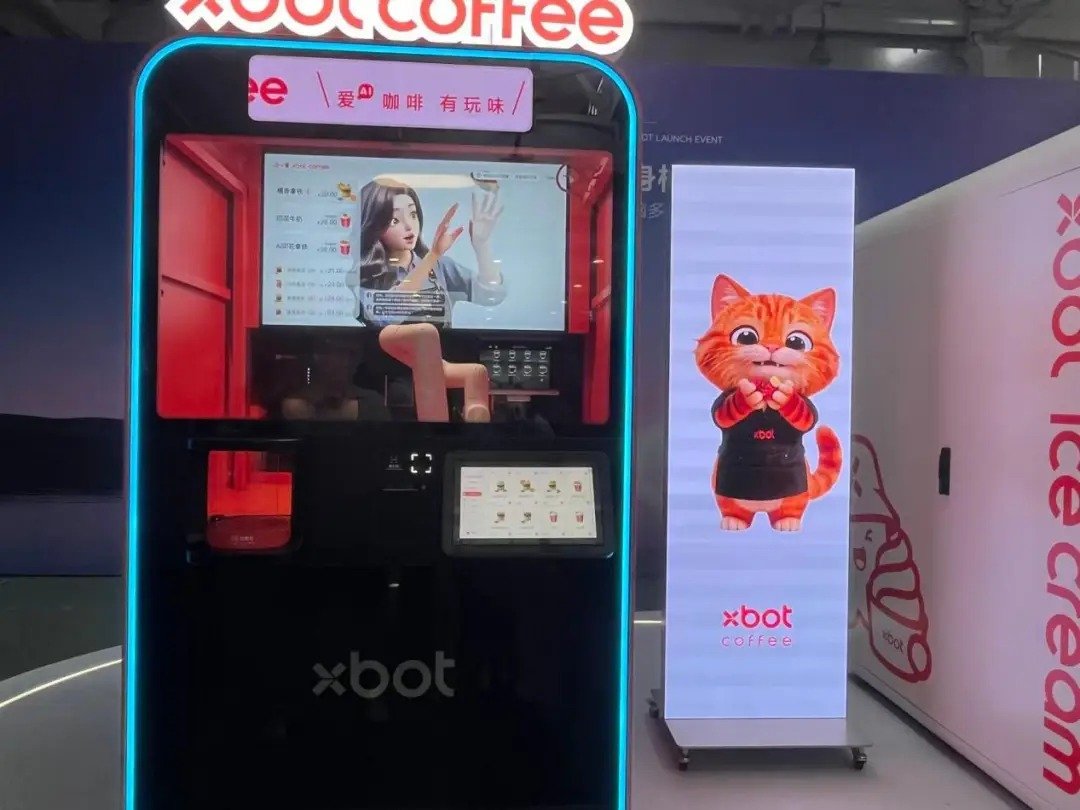
The C3 compresses an entire coffee shop into a machine occupying roughly two square metres. Inside sit a coffee machine, a milk frother, an ice maker and a printing unit, with the robotic arm holding the cup and moving it between stations.
On top of the hardware runs XOS 3.0, XBOT’s own system, giving the robot a full loop of seeing, understanding and executing. The apron-wearing agent on the interaction screen that tells you your order is ready is part of that system. XBOT says the system supports cross-embodiment skill transfer, so a skill learned once remains usable when the robot form changes.
Why not a humanoid
Some consumers look at the machine and see equipment rather than a robot. One said flatly that after watching the C3 closely it felt like a robotic arm bolted to an automatic coffee machine.
Tang Mu explained the choice of an arm over a humanoid in two parts. First, making coffee is mostly wrists and forearms, with fingers used mainly to grip cups, so a gripper reproduces the vast majority of a barista’s motion. Second, a gripper costs far less than an anthropomorphic finger joint assembly, which matters for scaling.
In real deployment, some interactivity was sacrificed for safety and stability. The arm used to be exposed, so customers could watch the process closely and some would touch the arm as it handed over the cup. That created a hygiene risk, Tang said, so the arm went behind glass.
The insistence on commercial practicality traces to his career. Before founding XBOT, Tang Mu worked at Tencent’s Customer Research and User Experience Design Centre and at Xiaomi’s exploration lab, leading experience design on the QQ product line and building the Xiao Ai speaker and Xiaomi routers. Those years taught him that leaning too hard on technological prestige, and keeping consumers at arm’s length, does not produce commercial success.
A coffee robot is a plain name, he said, and its position is to genuinely enter consumers’ lives. So rather than emphasise the robot concept, I care more about whether it hands over a good cup of coffee.
The numbers behind the pitch
XBOT was founded in November 2022 and now sells coffee robots, ice cream robots and general purpose catering humanoids. According to earlier reporting by 36Kr, the company has closed two rounds totalling several hundred million yuan. The A round was 200 million yuan, roughly 28 million dollars, from Hong Kong-based GPTX, and the B round was 300 to 500 million yuan from a mix of government funds, dollar funds and industrial investors.
On deployment, XBOT coffee robots have passed 1,000 units globally across 100 cities, with more than 4 million cups produced. In Beijing the machines sit mainly in office buildings, scenic sites and shopping centres.
To grow faster, XBOT COFFEE has opened franchising and in mid-July listed the machines for sale on JD.com. The C3 sells for 219,000 yuan, around 30,000 dollars, and a Lite version for 239,900 yuan, with the Lite running dual-arm coordination against the C3’s single arm.
The company runs two commercial models. Under solution sales, a customer buys the equipment and can customise the body finish, use their own logo and pick their own coffee suppliers, but cannot use the XBOT brand or its food safety credentials. Under franchising, both parties operate inside the coffee brand’s rules, with XBOT supplying operations and maintenance support alongside equipment purchase and centralised material sourcing.
Compared with opening a physical coffee shop, the main advantage is saving rent and labour, a sales lead said. At an average of 100 cups a day, payback is roughly six months.
Where it collides with Luckin
China’s coffee industry reached 354.9 billion yuan in 2025, roughly 50 billion dollars, up 13.3 per cent year on year, according to the 2026 China City Coffee Development Report. Consumption reached 28.57 cups per person, against 22.24 in 2024 and 16.74 in 2023.
Barista opinion splits along a predictable line. Baristas at chains such as Luckin and Cotti say their process is already close to what a robot does. Independent speciality operators say part of their work cannot be replaced.
A barista at Luckin for 18 months said she makes 200 cups on a peak day, working four or five hours without a break, and the process is completely fixed. Making a coconut latte, she said, the millilitres of coconut milk and coffee liquid are standard, extraction runs on a fixed programme, and the only variables are sugar, temperature and a swap of milk base or bean. The repetition gives her almost no sense of achievement, and she has often wished a robot would do it.
A barista at Cotti agreed that drink preparation is standardised enough to learn in a day or two.
The timing comparison is close. A human takes 30 seconds to a minute per cup. The XBOT machine takes about 45 seconds for a non-printed drink, produces 80 cups an hour, and runs 24 hours with steadier output.
The Luckin barista also named the gap. Humans are more flexible. If a customer orders wrong or wants something personalised, we can respond immediately, she said, while an unstaffed robot responds slowly.
A worker at a Starbucks Reserve store framed it differently. The process is standardised, but her satisfaction comes from customer interaction. I like finishing latte art and having a customer photograph it, she said, and I introduce the origin of the beans and how Starbucks sources them.
The last mile, and the ceiling
Tang Mu’s own framing is a division of labour. Robots take repetitive standardised production, human baristas take conversation and new product development. That matches comments by Nowwa Coffee operations director Shao Buyun, and in April this year Nowwa and Keenon Robotics ran a robot cafe pop-up in Shanghai, the first tie-up between a humanoid robot brand and a coffee chain.
Tang says the harder problem is how chains perceive the machine. We think a coffee robot is a form of employee, and a robot coffee store is a future store format, he said, but some chains see it only as a machine. That gap in perception means XBOT gets treated as one link in a supply chain and pushed on price, which hides its advantages in user experience and store operations.
The scale gap is stark. As of July 2026, Luckin operated more than 34,000 stores and Cotti 16,000, according to industry tracker Canyan. XBOT’s deployed base is a rounding error against that, which means the machines have to reach into the capillaries of a city.
One customer explained the logic precisely. She does not use the robot because there is no Luckin nearby. She uses it because the robot is closer. In summer, walking to the coffee shop means a stretch with no shade, she said, and delivery arrives at the wrong temperature, so having a machine outside the canteen is simply more convenient.
That is the real position. XBOT is filling the last mile in closed office parks that delivery riders cannot enter, in university buildings and canteens.
Even so, chain store density keeps eating the available space. Several office building operators told the original reporters that there is a Luckin nearby and they have no plan to bring in a coffee robot, with one noting that Luckin opened on the ground floor of the building itself.
Delivery price wars have also reset expectations. Average delivery coffee ticket prices fell from 29.42 yuan to 14.30 yuan in 2025, dropping to 11.88 yuan at the peak of the third quarter subsidy war, with sub-10 yuan orders taking almost half the market. XBOT COFFEE prices sit at 6.9 to 18.9 yuan, in the same band as Luckin, Cotti and Lucky Cup.
Three walls
Efficiency is the coffee robot’s main weapon, but it is not yet a trump card. The machines genuinely fill scenarios traditional chains do not reach, using unstaffed operation to open a cheaper price tier and cut operating cost. Three walls remain, and they are taste, repeat purchase and brand awareness.
Machines across the market sell for 130,000 to 400,000 yuan, and several brands quote the same six to eight month payback. Consumer education is still running. Machines in scenic areas can attract novelty visits with location-specific latte art, but machines in offices and campuses live or die on repeat purchase, which demands consistent taste and a steady stream of new drinks.
Rivals are building flavour systems. COFE+ runs a national styles series. Fuyou Coffee uses regional Cantonese herbal ingredients. XBOT works on inputs, with its own beans and premium milk. None of them has anything like Luckin’s flavour authority yet, and one consumer put the problem plainly. If the robot cannot beat Luckin on price, why would I not just buy Luckin?
Robots will not replace baristas. They will reshape the division of labour, with machines taking repetitive standardised work and people focusing on conversation, development and service. Technology is a means of serving the customer, not the point of the exercise.
Editor’s note: This is an adapted translation of the original OFweek report. It has been trimmed and restructured for readability for an international business audience.