Closing an A+ round above RMB 100 million
Mengshi Technology has completed and settled an A+ round of over RMB 100 million, according to the report. Investors in the round include Leading Capital, Hangzhou Heda and Huifu Investment. Hangzhou Heda is the local state fund that came in after the company relocated to the Qiantang district of Hangzhou. A Series B round is still being advanced.
The financing points to a shift in autonomous mining. The sector is moving away from competing purely on selling self-driving kits and towards a model of robotics-based haulage operations, which offers a new template for commercialising autonomy in closed environments.
Why anchor on the robotics route
Almost every autonomous mining company positions itself as a self-driving solutions provider. Mengshi chose a different path from the start, calling its product a haulage robot. That positioning is not a marketing wrapper added later. It comes from the technical background of the founding team.
Founder Qiu Changwu holds a doctorate from the robotics institute at Shanghai Jiao Tong University, and his first company focused on industrial robot control systems. When he founded Mengshi Technology in 2018, the stated vision was already to build a world-class intelligent robotics company.
The funding history tracks that evolution. The company took an angel round from Yijin Capital at incorporation in 2018, with strategic investment arriving at the same time from Boleton. The Pre-A round in 2021 was led by Weichai Industrial Fund, when industrial capital was looking for proof that the technology could be deployed. In 2022 the A round brought in financial investors including Leading Capital and Galaxy Ventures, betting on the growth of the sector. In this A+ round local state capital has joined, taking the investor base from industrial players and financial investors to include a local government fund.
The report reads the layered entry of capital as the market gradually accepting that autonomous mining is not about converting vehicles but about robotics haulage services. Capital is no longer assessing only algorithm demos. It is weighing the ability to operate continuously in real conditions.
In September 2026 the Huzhou intelligent manufacturing base of Mengshi began operations, focused on high-end equipment and robot manufacturing, with the aim of producing core products in house and substituting imports. That further cements its identity as a robotics company rather than a solutions provider doing software integration.
Can reused technology carry a business
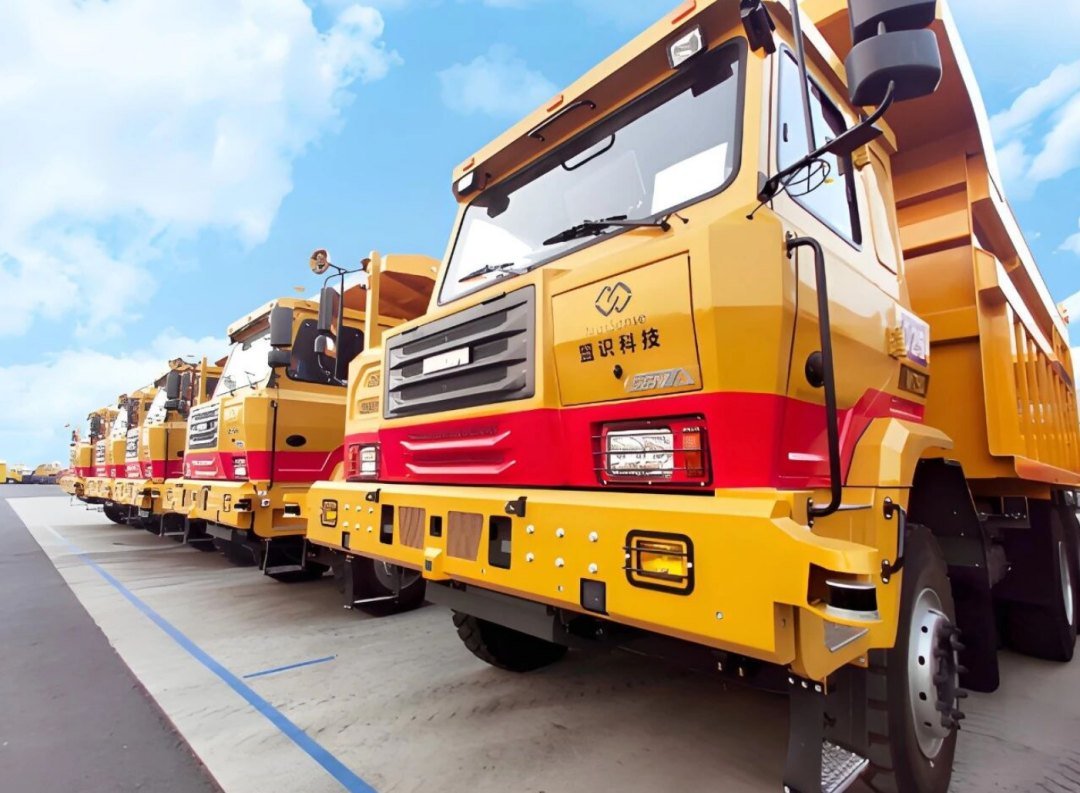
Defining an autonomous mine truck as a haulage robot rests on the idea that the vehicle is only the hardware carrier, while the real core asset is the full robotics system of perception, decision-making and execution. That is what shapes the fully self-developed stack at Mengshi. The company built its own VCS vehicle control system, FOS scheduling platform, CSS cloud operations system and simulation platform. The stack reuses more than 85 per cent of its components across mining sites, ports and factories, and is compatible with diesel, battery-electric, hybrid and hydrogen powertrains. This cloud-edge-device hierarchy differs from the usual self-driving approach that emphasises single-vehicle perception, putting more weight on fleet coordination and the ability to transfer across scenes.
The value of the technology has to show up in project data. In mining, the Tongling project was the first fully unmanned mining operation in China, and the Ruoqiang Zhicun Lithium project is the longest-haul unmanned operation in the country, running around the clock with laden speeds of 40 kilometres per hour.
At the Bachu vanadium-titanium magnetite mine in Xinjiang, 33 hundred-tonne battery-electric autonomous haul trucks run continuously, and the Argemin project in southern Xinjiang has deployed an integrated space-air-ground smart mine. On the port side the company worked with Weichai and Shandong Port on unmanned bulk cargo terminal transport, and its battery-electric container truck project between warehouses at the Shanghai Lingang plant has run stably for years, cutting on-site staffing by 80 per cent, lifting overall efficiency by 15 per cent and increasing operating hours by 20 per cent.
Signed autonomous driving project value has passed RMB 1 billion, with more than 30 customers served. Plenty of projects in the industry stay at the small pilot stage. Routine operation of a large fleet is precisely the measure that separates a demonstration from a real commercial project. The dust, the uneven surfaces and the day-night cycle of a mine erode theoretical algorithm performance substantially. Only large fleets running for a long time test what a robotics system can really do.
Is the haulage model the answer
The autonomous mining industry has moved past technical validation. The problem is no longer whether the trucks can run but whether running them makes money. Many solutions providers are stuck selling systems and conversion kits as one-off business, where the service chain effectively ends at handover and the mine customer still has to assemble its own operations and scheduling teams. That is why many flagship projects prove hard to copy.
Mengshi positions itself as a smart haulage operations provider, supplying not just software and hardware but taking a deep role in on-site transport operations, and even exploring a leasing model that combines finance, equipment and site. Overseas it is using Morocco as a base for mining logistics in Africa and Europe.
The report argues that the industry is making a common mistake in reading the competition on autonomous mine trucks as a contest of driving algorithms. In closed production logistics, algorithms are only the foundation. Operating capability is the real barrier to scaling. The haulage robot framing lands directly on that problem. A generalised robotics base cuts the cost of redeveloping for each new site, and the operations model ties the revenue of the company to the actual output and haulage volume of the mine, so the company answers for the transport result rather than only for system delivery.
The model brings its own challenges. Deep operations mean heavy on-site maintenance staffing, and a heavy-operations model raises the demands on capital reserves, supply chain management and field service. Money raised has to convert into more steadily profitable operating projects for the story to hold.
What is changing in the sector
Autonomous mining is leaving the era of telling stories through showcase projects, and capital has become more practical. Where the market once rewarded algorithmic highlights, investors now work out the input-to-output ratio of a single mine project and how hard it would be to replicate. On the industrial side China has a very large number of open-pit mines, but conditions differ enormously. Every mine has its own roads, extraction rhythm and equipment mix, and heavy custom development raises the cost of commercialisation. That is one of the biggest obstacles to scale.
The answer from Mengshi is a highly reusable technology base built around the haulage robot idea, an attempt to push back against the fragmentation of mining sites. A high reuse rate does not guarantee easy deployment. The process requirements of mines, ports and factories differ greatly, and a general robotics framework still needs substantial adaptation and debugging on site.
The report expects the sector to split in two. One group keeps selling software kits and stays asset-light. The other moves into deep haulage operations and becomes part of the production process itself. Neither route is inherently better, but the companies that survive will have to show customers a working economic case.
This A+ round shows capital is willing to give the robot plus haulage operations model room to make mistakes. Funding is fuel, not an outcome. Mengshi now has to answer the question the whole industry faces. Can this robotics system keep producing a positive operating model across more mines, and can the experience of a flagship project really be replicated across the vast number of second-tier mining sites. That will decide how far the haulage robot route travels.
Editor’s note: This is an adapted translation of the original OFweek Robotics report. It has been trimmed and restructured for readability for an international business audience.