Open any tech outlet and humanoid funding looks like a flood. 2026 was crowned the first year of embodied intelligence, capital queuing to pay.
Step into an embodied-AI lab and you see something else. No sci-fi autonomy. No elegant conversation. An operator wears a VR headset, motion-capture suit and handheld controller, repeatedly driving an arm to grab a cup or fold clothes. Ten times, a hundred times. Behind every training sample stands a living person.
This is the crudest reality of embodied intelligence today: it rests on labour-intensive data collection. Every robot action is taught hand by hand.
Capital celebrates while the industry hides a splinter it cannot pull out: if machine intelligence can only be stacked from human labour, that cost structure can never support the dream of entering every home.
At the 2026 CCTV Spring Festival Gala, an embodied-AI firm called Galbot appeared briefly, then returned to lab quiet. Its new paper, LDA-1B: Scaling Latent Dynamics Action Model via Universal Embodied Data Ingestion, poses a claim that could rewrite the field’s base logic: abandon worship of perfect data, understand physics first, then learn to act. Among the listed signatory institutions are NVIDIA, Tsinghua and Peking.
01 Copying the cat never draws a real tiger
Most robot foundation models walk one road: behaviour cloning. Plainly, copying the cat. Human experts leave tens of thousands of perfect teleoperation samples. AI extracts features from the frames and predicts what action a human took each frame. Intuitive and fast, it became mainstream.
But it has a fatal flaw: a rock-bottom ceiling. Imitation sets the model’s upper limit at the demonstrator’s level from the start. If the goal of AGI is to exceed the human average, this road shows no exit.
Worse than the ceiling is the floor. Technically it is called covariate shift. Motors age, gears have play, light changes, all noise to a robot. A robot trained purely by imitation produces tiny errors that immediately push camera frames outside the training distribution. The model has never seen this, does not know how to correct. Errors snowball, motion collapses. The humanoid lurching into the spectator stands at a recent robot marathon was a public footnote to covariate shift.
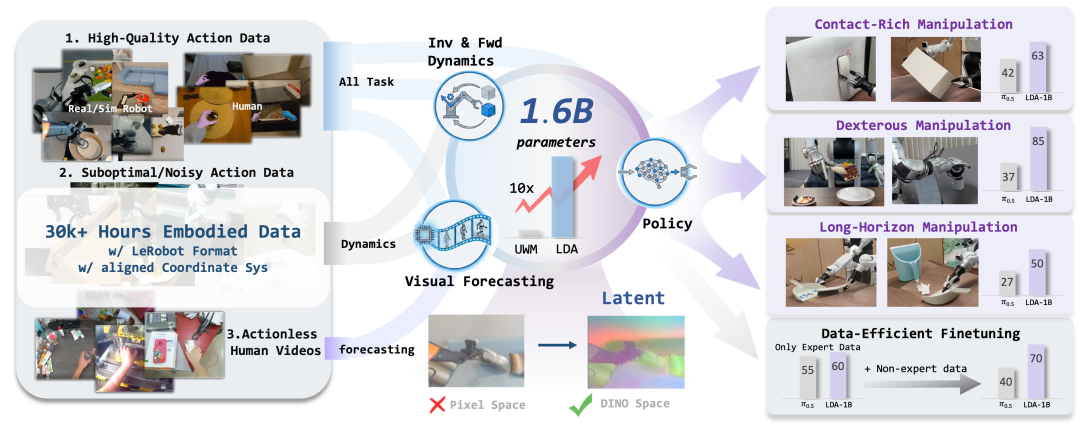
Galbot’s paper chose another road: abandon reflex imitation, take the world-model route. Large language models transformed because they grasped language’s underlying rules in vast text. Robots need the same layer of understanding: before acting, understand the physics of the world. LDA no longer only predicts the next action. It jointly predicts the future frame. Before a command, the model must first simulate in its digital brain: push it, how does the cup move, what do gravity and friction do?
The essence of this shift: knowledge first, the understanding of world rules, then application, learning to operate. Causal order cannot reverse.
02 Stop fighting pixels
To predict the future, first decide what to predict. Sora and image-video generators offered a ready answer that points the wrong way. You may have noticed AI-generated text in images turns to distorted gibberish. The reason is simple: those models splice pixels by probability. They never saw the text, only remembered that some colour probably sits next to another.
A cup or apple, photographed, flattens into an arrangement of RGB blocks. Early world models erred exactly at predicting future pixels. Making a robot brain guess the next frame’s pixels wastes compute on the shadow of an arm, the glint on a cup, the texture of a wallpaper. All high-frequency noise, all allergic over-reaction to the environment.
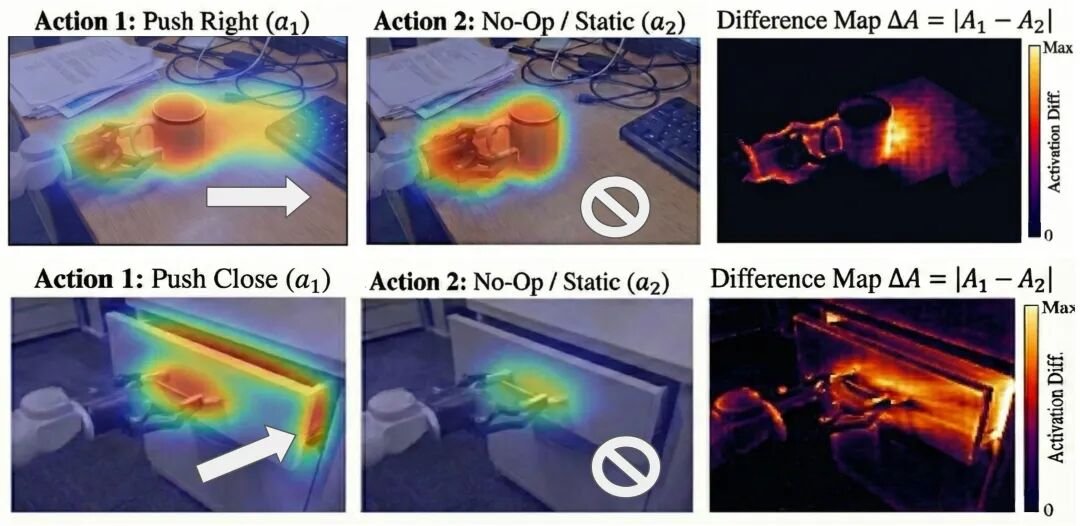
LDA leaves that pixel space. It uses the visual foundation model DINO to strip irrelevant light and background before the prediction network, extracting a highly abstract semantic space. It no longer fusses over the colour of a million pixels next frame, but tries to understand an equation: the semantics of cup plus the action of push equals cup shifting right.
Ignore details, watch semantics. Counter-intuitive, yet it works. At equal model scale, the old pixel-prediction scheme scored 14.2 per cent success. Switching to semantic space jumped that to 55.4 per cent. The business meaning is direct: expensive compute clusters no longer burn electricity simulating light and shadow, cost drops sharply, and cross-environment stability rises markedly.
03 Perfect data is a superstition
The paper’s sharpest hit on the industry is shattering the commercial fantasy of perfect-data worship. Robot training logic was copied from large language models. For three years, the LLM field proved a hard law: chaotic logic, harmful code, low-quality corpus pollutes the model. Garbage in, garbage out. Robot firms copied wholesale: pay operators to record near-perfect data, the premise of a capability breakthrough.
But physical-world data logic differs from text. In the real world, failure itself is the most complete demonstration of physical law. A robot missing a cup, knocking something over, retrying after a mistake, these are garbage to traditional algorithms because they do not show how to finish perfectly. Yet they obey gravity, friction and collision laws strictly.
A robot that only saw high-quality data is like a plant raised in a sterile greenhouse, dying once it leaves. Most embodied firms target the home as the first commercial goal, but real homes are far messier than such robots can handle. A slight deviation and it freezes.
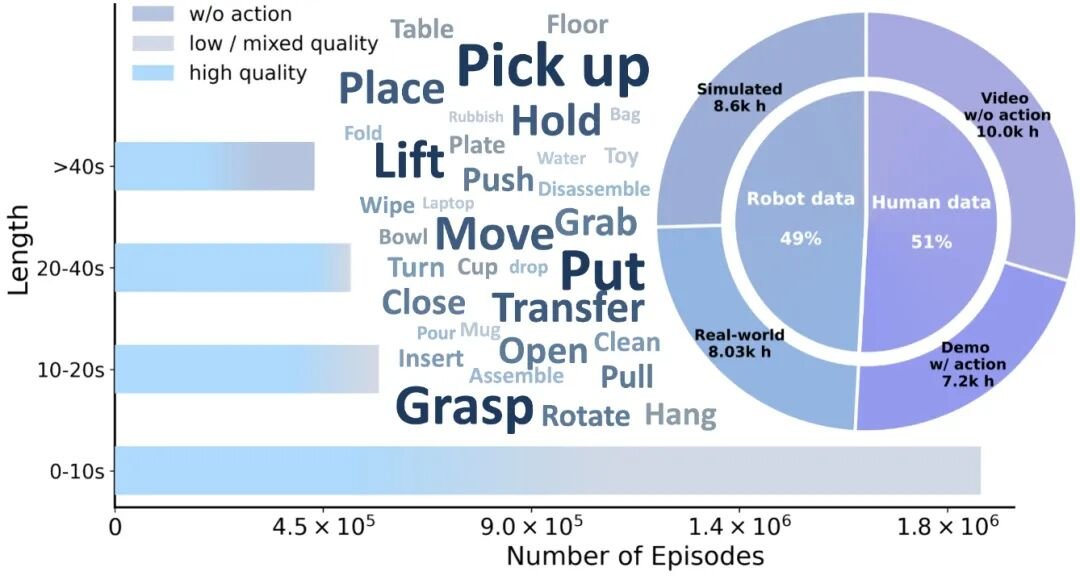
LDA’s universal data ingestion rewrites that economy: potentially harmful data is removed. Vast low-quality, unlabelled wild data, like casual short videos online, becomes treasure, fed to the world model to learn physical common sense and boundaries. Extremely scarce high-quality expert operation data is used only in the final fine-tuning, when the machine already understands physics and only needs efficient strategy selection.
The test data is telling: in fine-tuning, mixing 30 per cent low-quality data containing pauses and mistakes into perfect data raised execution success by another 10 per cent. The model learned something: this is how it goes wrong, and this is how to recover.
Those now burning investor cash, staffing hundred-person teams, hiring full-time human data collectors, have not finished building their moat and the riverbed is already moving. The core barrier in coming years will not be who bought more perfect data, but who has the stronger pipeline: cheaply harvesting vast rough data and squeezing physical common sense from it. A structural lead in cost will grow from here.
04 The GPT moment is still far
2026 was called the first year of embodied intelligence, with voices everywhere that the GPT moment is imminent. Calm commercial observers do not easily agree.
If embodied intelligence follows the LLM reinforcement-learning path, the three core elements hold: compute, algorithm, data. Text data is the accumulated digital record of human civilisation over millennia. Today OpenAI or DeepSeek can obtain trillions of tokens without trouble. Physical-world interaction data is stuck at the bottom of Moravec’s paradox, still in the handicraft era. Without the underlying data base, general intelligence is a castle in the air.
Research like LDA-1B offers not an all-powerful product but a correctly pointed signpost. That is more valuable than immediately launching a robot that claims to reach the heavens.
It ends the blind-imitation paradigm, shows the necessity of causality and world models. Pixel-level compute waste is replaced by semantic representation. Most important, it overturns the expensive high-quality-data-collection model and opens a low-cost, waste-to-treasure data-scaling path.
Put down the arrogance toward perfect data, let AI draw real-world physical law from roughness and failure. The road is long, but the direction is now visible.
Images
Editor’s note: This is an adapted translation of the original OFweek report. It has been trimmed and restructured for readability for an international business audience.