Wanxun, a global front-runner in flexible embodied intelligence, has released NOVA 2.0, the Neuromorphic Omniversal Versatile Architecture, which it calls the industry’s first open-world, all-weather, commercial-delivery-grade embodied intelligence architecture. It is forged from more than 10 million multi-dimensional extreme-condition operations across 40-plus real industry scenarios.
Somatic intelligence against extreme conditions
Embodied intelligence is moving out of ideal-environment demos and early proofs of concept into the messy open world, where high-frequency random disturbance, noisy data and harsh environments are the norm. Three problems block it: long-chain inference latency against high-frequency response, a severe shortage of real multimodal scene data, and weak brain-body reliability in commercial deployment.
Wanxun’s answer is Somatic AI. Drawing on four billion years of biological evolution, it treats the natural coupling of a flexible body and intelligence as the native algorithm for physical-world randomness. The soft robot’s physical perception and adaptability replicate life’s subconscious brain without over-reliance on models and data.

A touch-native layered brain
NOVA 2.0 generates trajectories in real time from subconscious multimodal action primitives, yielding three gains: low data need, ultra-fast response and strong generalisation. One brain fits many forms, from muscle joints to soft single and dual arms to dexterous hands and humanoids. A 20-plus-dimension subconscious action space handles more than one billion dynamic parameter combinations and copes with abrupt-condition shifts. Trajectory generation lands in 20 milliseconds, beating conventional large models at millisecond correction and suited to irreversible, zero-tolerance tasks.
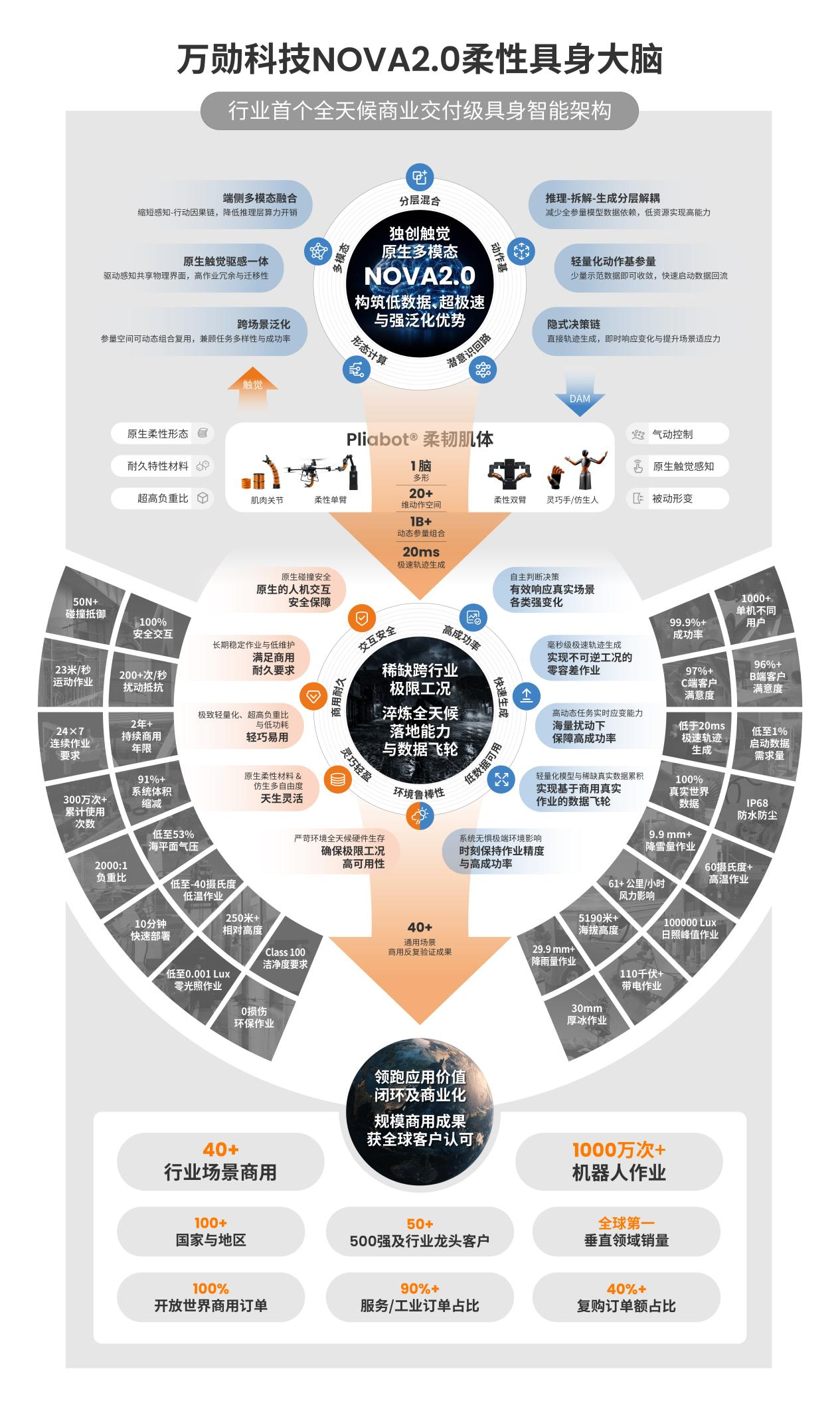
The architecture ships ten all-weather commercial-delivery strengths: real-time adaptation, a real-data flywheel, autonomous decision making, one-shot success on irreversible jobs, full-domain control, extreme-environment survival, native safety, durability, low weight and native flexibility.
A rare real-world data flywheel
NOVA 2.0 has been generalised across 40-plus real industry scenarios, from property construction and power energy to transport, smart driving and industrial manufacturing, with more than 10 million multi-dimensional extreme-condition operations. Validated on extreme tasks, environments and data, it has built a genuinely scarce, hard-to-copy data flywheel from 100 per cent real operations.

The signal is that embodied intelligence has crossed the open-world application watershed, not just the demo one.
Editor’s note: This is an adapted translation of the original LeiPhone report. It has been trimmed and restructured for readability for an international business audience.