18 September 2026. TrendForce’s second-quarter 2026 global Fabless TOP 10 shows the top ten combined revenue of US$141.45 billion, up 73 per cent year on year. The 73 per cent climb is eye-catching but only a total. The more telling question is who grew, by how much and where. The reshuffle shows up clearly.
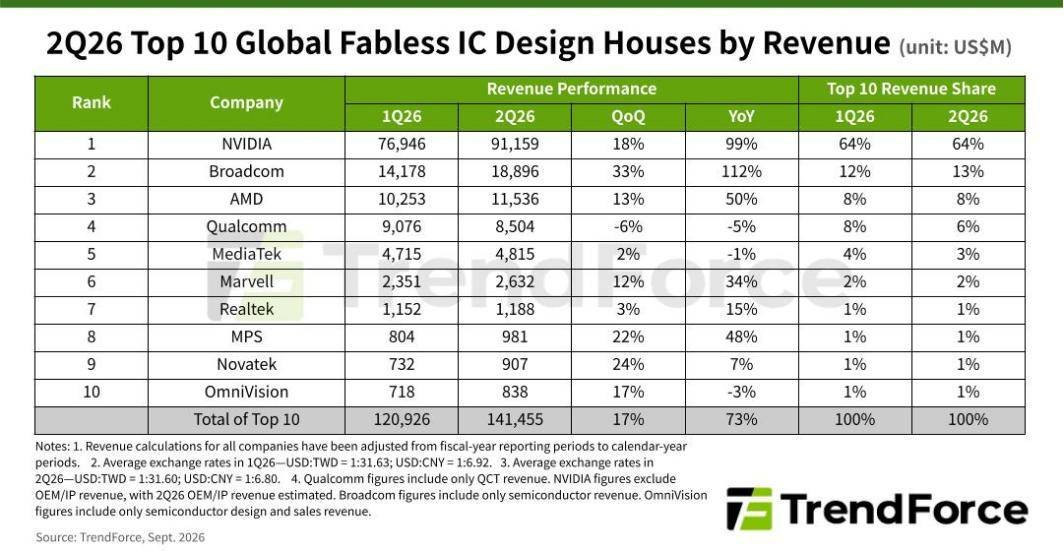
Nvidia still tops, alone taking 64 per cent of the top-ten total, far beyond reach. Broadcom holds second, with the fastest growth above 110 per cent. AMD, at US$11.536 billion, overtook Qualcomm for third, while Qualcomm slipped to fourth with both year-on-year and quarter-on-quarter growth negative. The rest, in order, are MediaTek, Marvell, Realtek, MPS, Novatek and OmniVision. Marvell grew 34 per cent year on year and 12 per cent quarter on quarter; MPS grew 48 and 22 per cent, smaller in scale but higher-quality growth.
How Nvidia eats 64 per cent
The answer has two parts. First, sustained AI GPU demand. As large-model training, inference and agentic AI expand, cloud providers, AI firms and enterprise customers keep lifting AI infrastructure spend, and the GPU remains the dominant accelerator in AI data centres. TrendForce notes that beyond hyperscalers, NeoCloud, sovereign-AI projects and enterprise customers now contribute more Nvidia revenue, widening the customer base. In Nvidia’s own results, data-centre revenue reached US$89 billion, up 117 per cent and about 92 per cent of total revenue.
Second, Nvidia’s reach beyond the GPU. As AI clusters scale, high-speed data exchange between GPUs and between GPUs, CPUs, networks and nodes governs system efficiency, so Nvidia built NVLink, network chips and rack-scale systems into an AI-infrastructure stack. NVLink fuses multiple GPUs into a larger compute domain; NVLink-C2C handles processor-accelerator links; NVLink Fusion extends NVLink to third-party custom chips, with Marvell, d-Matrix and MediaTek already joining. From GPU to NVLink to network and rack, Nvidia keeps widening its coverage, and customers get a more unified software-hardware base.
AMD to third, AI dividend spreads to the CPU
If Nvidia caught the most direct AI-compute dividend, AMD’s rank change shows that demand is spreading to broader data-centre compute. AMD’s data-centre revenue reached US$6.7 billion, 58 per cent of its total, up 107 per cent. CEO Lisa Su stressed the success rode on strong demand for EPYC processors and Instinct GPUs. Server CPU revenue has set records for five straight quarters, with cloud and enterprise sales each up over 70 per cent, and fifth-gen EPYC Turin now covers nearly a third of over 1,600 EPYC public-cloud instances. AMD bundled EPYC, Instinct and network into its Helios rack-scale system.
The logic differs from the GPU path. Parallel-compute demand first lifted GPU accelerators, then as more GPUs entered data centres, the servers around them needed more CPUs for data handling, scheduling and management, transmitting the increment to general compute. Owning both GPU and CPU lines lets AMD catch both layers.
Phone-chip vendors grab the AI slice
Qualcomm and MediaTek chose a different path. Both built on phone chips, but as that market saturates, AI became their breakout. Qualcomm diversified into automotive, IoT and data centre. Its automotive revenue reached US$1.588 billion, up 61 per cent and 23 quarters of double-digit growth; IoT brought US$1.83 billion, up 9 per cent, with 2029 targets of US$10 billion for auto and over US$14 billion for IoT. In June it unveiled a full data-centre AI roadmap with a 2029 data-centre target above US$15 billion, including the Dragonfly C1000 CPU, high-bandwidth computing, the Dragonfly AI300 inference accelerator and the acquisition of AI software platform Modular.
MediaTek concentrated on AI ASIC. It raised its 2027 ASIC market estimate to US$70 to 80 billion and lifted its 2026 data-centre target from above US$1 billion to above US$2 billion, with its first US hyperscaler AI-accelerator ASIC entering mass production in the fourth quarter. Smart Edge revenue reached 53 per cent of total, surpassing Mobile’s 41 per cent. On 31 August Nvidia invested US$3.5 billion in MediaTek to deepen NVLink Fusion cooperation, letting MediaTek customers build custom AI chips into Nvidia’s data-centre infrastructure.
Legacy consumer-chip firms find an AI entry
MPS, a high-performance analog and power vendor, does not compete in AI compute directly, but rising AI-server power density lifts demand for power management. Its second-quarter revenue was US$981 million, up 47.6 per cent, with enterprise-data revenue US$381 million, up 164.3 per cent, and it is sampling 800V architecture products. OmniVision posted about US$1.135 billion, up 18.65 per cent, with image sensors at RMB 9.254 billion, down 10.55 per cent, while emerging markets reached RMB 1.726 billion, up 47.12 per cent, including machine vision and robotics up 71.15 per cent and edge AI up 8.46 per cent, as it expands into optical communications and AI-infrastructure chips.
AI is redrawing fabless growth logic
Four answers emerge across the list. One, keep betting on general compute, the safest choice, as GPU and CPU demand keeps rising. Two, extend to custom ASIC, as Broadcom, Marvell and MediaTek build for hyperscaler self-designed chips. Three, extend to AI infrastructure, as Qualcomm and MediaTek broaden from chips to data-centre systems. Four, explore emerging markets, as MPS and OmniVision ride AI spillover into power, optics, machine vision and edge AI. AI is redistributing where chip growth comes from. Rankings are just the result. The deeper story is that the competition boundary for fabless firms keeps widening.
Editor’s note: This is an adapted translation of the original Sohu report (Semiconductor Industry Watch, via TMTPost). It has been trimmed and restructured for readability for an international business audience.